Most marketers don’t struggle because they lack ideas. They struggle because they target the wrong search terms.
A good keyword suggestion tool helps you move past guesses and find the phrases people actually search for. That matters whether you’re planning blog posts, optimizing product pages, building topic clusters, or improving paid search campaigns.
Here’s the real value: the right keyword research process doesn’t just give you more terms. It shows intent, reveals content gaps, and helps you prioritize work that can bring qualified traffic. In this guide, you’ll learn how a keyword suggestion tool works, what to look for, how to use the data wisely, and how to turn search ideas into a practical SEO plan.
Suggested Image: Technology concept illustration of search terms expanding into keyword clusters on a digital dashboard
What is a keyword suggestion tool?
A keyword suggestion tool is a search research tool that generates related keyword ideas based on a seed term. It helps marketers discover variations, long-tail queries, question-based searches, and related topics that can support SEO and content planning.
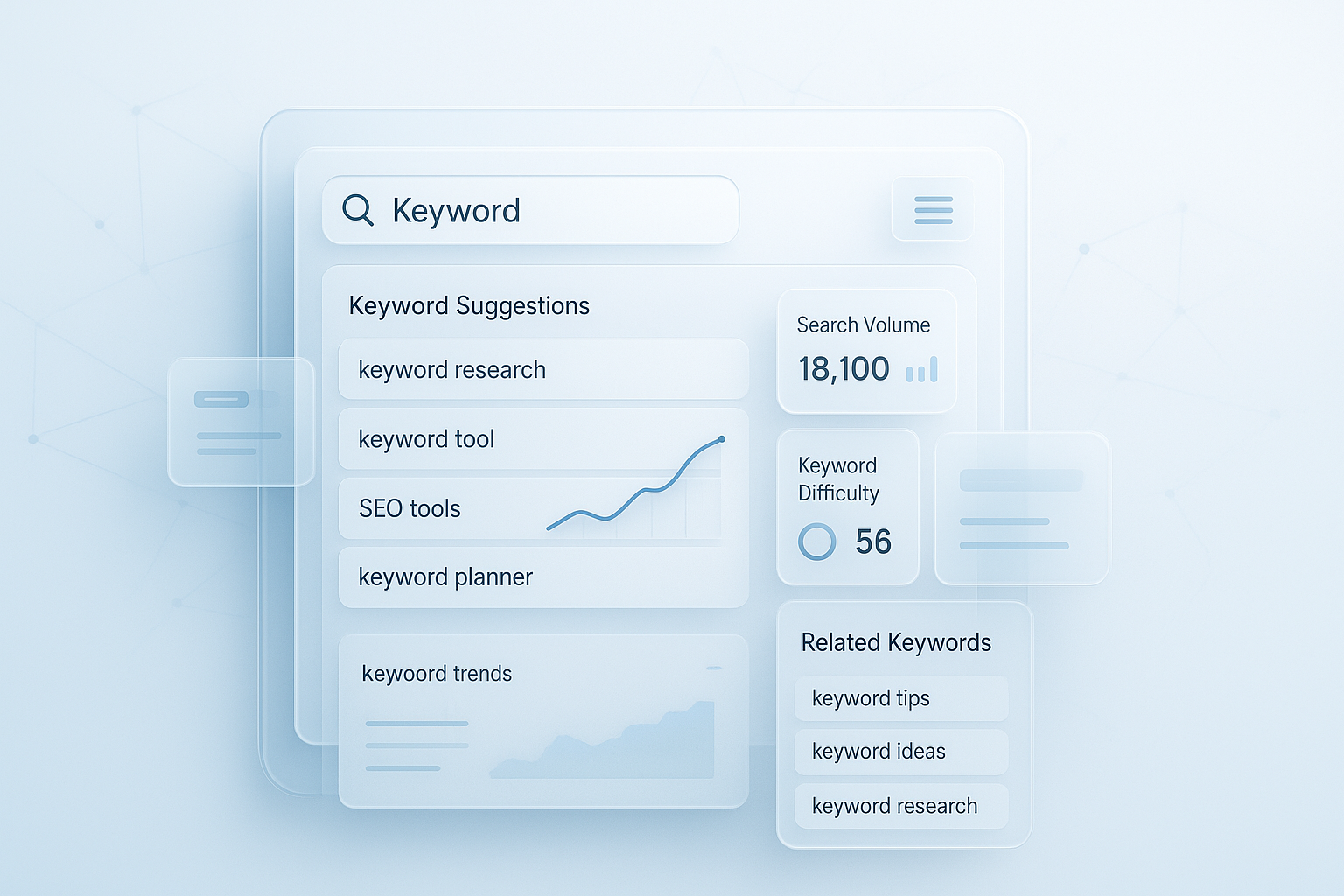
At a basic level, you enter a phrase such as “email marketing,” and the tool returns related ideas like “email marketing for ecommerce,” “best email marketing subject lines,” or “email marketing automation examples.” Many tools also show useful signals like search volume, trend direction, or keyword difficulty.
For marketers working across content and technical SEO, these suggestions are often the starting point for better page targeting. If you also review page structure and output formatting, tools such as the HTML Viewer can help you inspect content more clearly while refining on-page elements.
Why keyword suggestions matter for SEO research
Keyword suggestions matter because they reveal how real users phrase their problems, questions, and buying intent. That gives you a more accurate picture of demand than brainstorming alone.
Here’s why experienced marketers rely on them:
- They uncover search terms your team may never think of internally.
- They reveal long-tail opportunities with clearer intent.
- They help group content into clusters instead of isolated posts.
- They expose seasonal or trend-driven search behavior.
- They improve alignment between content, landing pages, and user needs.
Google itself emphasizes creating content that helps people first, not pages built around search engines alone. The keyword data should guide relevance, not replace judgment. You can review this directly in the Google helpful content guidance.
Now comes the important part. A keyword suggestion tool is only useful if you understand what the suggestions actually mean.
How a keyword suggestion tool works
Most keyword tools gather search-related phrases from autocomplete behavior, search trends, keyword databases, and related-query patterns. Then they organize those phrases into useful lists you can evaluate.
While each platform has its own method, the output usually comes from a mix of sources:
- Search engine autocomplete suggestions
- Related searches and question variations
- Historical search query databases
- Topic relationships and semantic associations
- Commercial keyword datasets built from large-scale query analysis
The better tools don’t just dump a long list of words. They help you spot patterns. For example, they may group keywords by modifiers such as “best,” “how,” “vs,” “near me,” or “for beginners.” That makes intent easier to identify.
If you’re cleaning exported research data before clustering it, a utility such as the Remove Duplicate Lines tool can save time by eliminating repeated keyword entries.
Common data points you’ll see
Not every keyword metric is equally important. Some are directional, while others can be misleading if taken too literally.
| Metric | What it tells you | How to use it |
|---|---|---|
| Search volume | Estimated monthly searches | Use as a rough demand signal, not an exact forecast |
| Keyword difficulty | Estimated competition in organic search | Compare relative difficulty across similar ideas |
| CPC | Average paid-ad cost per click | Often useful for spotting commercial intent |
| Trend data | Interest changes over time | Use to identify seasonality and rising topics |
| SERP features | Snippets, videos, maps, shopping, AI-style layouts | Helps determine content format and click potential |
What makes a good keyword suggestion tool?
A good keyword suggestion tool gives you relevant ideas, useful filtering options, and signals that help you make decisions fast. Bigger keyword lists are not automatically better.
Here’s what to look for:
- Relevant suggestions: The output should stay close to the topic instead of generating random terms.
- Intent clues: Question keywords, comparison terms, and commercial modifiers are especially helpful.
- Clean filtering: You should be able to sort by word count, topic, or likely intent.
- Export functionality: This matters if you manage larger content calendars or SEO campaigns.
- Trend awareness: Fresh data helps in fast-changing markets.
- Simple workflow: A tool should speed up research, not add friction.
This is where many people struggle. They judge a tool by volume alone. In reality, the best tool is the one that helps you translate raw ideas into publishable content and measurable SEO priorities.
When you need to turn exported keyword lists into cleaner briefing documents, the Word Counter tool can help with title drafts, metadata checks, and content brief constraints.
What types of keywords should marketers look for?
Marketers should look for a mix of broad terms, long-tail queries, buyer-intent keywords, question keywords, and supporting semantic phrases. A balanced keyword set gives you both reach and relevance.
Let’s break this down into practical categories.
Short-tail keywords
These are broad phrases like “SEO tools” or “keyword research.” They tend to have high search volume but heavy competition and less precise intent.
Long-tail keywords
These are longer, more specific searches such as “keyword suggestion tool for blog topic ideas.” They usually have clearer intent and are often easier to target with useful content.
Question keywords
These include phrases like “how does a keyword suggestion tool work” or “what is keyword difficulty.” They are especially useful for FAQ sections, featured snippets, and AI Overviews.
Commercial intent keywords
Searches with words like “best,” “top,” “compare,” “pricing,” or “software” often indicate evaluation or purchase intent. These are valuable for product pages, solution pages, and comparison content.
Local or niche modifiers
These terms add industry, audience, or location details. Examples include “keyword research for SaaS,” “SEO for real estate agents,” or “keyword tool for ecommerce.”
If you want a useful framework for understanding how Google approaches search documentation and performance, browse the Google Search documentation. It gives context for how query intent connects with crawlable, helpful content.
How to use a keyword suggestion tool step by step
The best way to use a keyword suggestion tool is to start with a seed topic, expand into variations, group them by intent, and then pick terms that fit achievable content goals. The process is simple, but the quality of your decisions matters more than the number of keywords collected.
- Start with one core topic. Choose a broad but relevant term tied to your product, service, or content pillar.
- Generate keyword suggestions. Collect related, question-based, and long-tail ideas.
- Filter obvious noise. Remove terms that don’t fit your audience, offer, or geographic market.
- Group by search intent. Separate informational, commercial, navigational, and transactional ideas.
- Review SERP reality. Search the keyword manually to see what Google is rewarding now.
- Pick a primary topic and supporting secondary terms. Build one page around one clear intent.
- Create or optimize content. Match format, depth, and structure to what searchers expect.
- Track results and refine later. Keyword research is not one-and-done work.
Suggested Screenshot: Example workflow showing seed keyword, filtered suggestions, and grouped intent buckets
A simple example
Imagine you run a content site for marketing teams and start with the phrase “email segmentation.” A keyword suggestion tool might uncover:
- email segmentation examples
- email segmentation best practices
- email segmentation for ecommerce
- how to segment an email list
- email segmentation vs personalization
That one seed term can support multiple content types: a beginner guide, a comparison article, a how-to tutorial, and an industry-specific landing page.
If you’re drafting keyword group names, article angles, or cluster labels across dozens of pages, the Text Case Converter can help standardize capitalization for spreadsheets and content briefs.
How to match keyword suggestions with search intent
Search intent is the reason behind the query. If your page does not match that reason, even a strong keyword target may fail to rank or convert.
Most keyword opportunities fit into four intent types:
| Intent type | What the user wants | Best content format |
|---|---|---|
| Informational | To learn something | Guides, explainers, tutorials, FAQs |
| Commercial | To compare options before choosing | Comparison pages, reviews, best-of lists |
| Transactional | To take action or buy | Product pages, service pages, signup pages |
| Navigational | To reach a specific brand or page | Brand pages, support pages, named resources |
Here’s what experienced professionals do differently. They don’t just look at the phrase. They inspect the search results. If Google shows videos, short definitions, product pages, or discussion forums, that tells you what users expect.
Google Trends can also add context when you need to compare interest between topics or seasonal patterns. It’s a useful companion resource for planning around timing and demand shifts. See Google Trends.
Keyword suggestion tool vs keyword planner vs autocomplete
These tools sound similar, but they serve different purposes. Choosing the right one depends on whether you need brainstorming, forecasting, or SERP-level intent clues.
| Tool type | Best for | Main limitation |
|---|---|---|
| Keyword suggestion tool | Finding related ideas and long-tail opportunities | May need manual validation |
| Keyword planner | Paid search estimates and ad planning | Less content-focused for SEO ideation |
| Search autocomplete | Quick insight into real wording patterns | Limited without filtering or metrics |
For advertisers, Google Ads Keyword Planner is still a useful reference. For SEO content planning, though, marketers usually need broader topic discovery and intent organization than ad forecasting alone provides.
Common mistakes when using a keyword suggestion tool
The biggest mistake is treating keyword output like a final strategy. Suggestions are inputs, not decisions.
Other common errors include:
- Chasing volume only: A lower-volume keyword with strong intent can outperform a broad vanity term.
- Ignoring the current SERP: Ranking is harder when your content format doesn’t match what search engines already reward.
- Targeting too many primary keywords on one page: That usually weakens focus.
- Skipping internal linking: Strong topic connections help users and search engines understand relevance.
- Duplicating near-identical pages: Similar keywords often belong in one stronger page, not several weak ones.
- Using exact-match phrasing everywhere: Natural language and topic completeness matter more.
This small detail changes everything: keyword research works best when it shapes editorial decisions, not when it dictates awkward writing.
When reviewing draft outlines or extracting repeated topic headings from planning files, the Find and Replace Text tool can streamline edits across large keyword lists.
How to turn keyword ideas into a content strategy
A keyword list becomes a strategy when you group terms into themes, assign them to the right page type, and prioritize by business value, ranking potential, and audience need.
Here’s a practical model marketers can use in 2026 and beyond:
- Create topical clusters. Group keywords around one core subject instead of publishing disconnected articles.
- Assign one search intent per page. Every page should answer one main need clearly.
- Map content types. Use guides for informational queries, comparison pages for commercial research, and landing pages for transactional searches.
- Score opportunities. Consider relevance, content effort, competition, and conversion potential.
- Build internal links intentionally. Connect supporting articles to core pages and vice versa.
Example keyword cluster for one topic
| Cluster topic | Primary page | Supporting content ideas |
|---|---|---|
| Keyword research | Complete guide to keyword research | Long-tail keywords, search intent, keyword clustering, common SEO keyword mistakes |
| Content optimization | On-page SEO checklist | Meta descriptions, heading structure, internal linking, content freshness |
If you’re organizing SEO tasks and support assets, a simple document conversion tool like the PDF to Word tool can help turn exported reports into editable planning files.
How keyword research supports AI search and Google AI Overviews
Keyword research still matters in AI search, but the goal is no longer just to rank for exact phrases. The goal is to create content that clearly answers a topic, covers related subquestions, and is easy for search systems to interpret.
AI-powered search experiences often pull from pages that do several things well:
- Define the topic clearly near the top
- Answer common questions directly
- Use helpful structure with headings and lists
- Cover related subtopics naturally
- Show expertise and practical understanding
- Stay consistent with search intent
This is one reason a keyword suggestion tool is still valuable. It helps you surface the connected questions and subtopics that users ask around a main theme. That makes your article more complete and more usable for both readers and AI systems.
For a deeper technical look at how search engines understand page markup and structure, the MDN HTML reference is a reliable source. And if you’re checking page markup manually during content QA, the HTML Formatter can make raw code easier to review.
Best practices for choosing the right keyword opportunities
The best keyword opportunities sit at the intersection of relevance, realistic competition, and business value. That balance matters more than raw search volume.
- Prioritize relevance first. If the topic doesn’t serve your audience, ranking for it won’t help much.
- Choose achievable targets. Mid-volume or long-tail terms often produce faster wins.
- Look for intent clarity. Clear intent makes content creation much easier.
- Use supporting semantically related terms. They improve topical depth without keyword stuffing.
- Refresh research regularly. Trends shift, SERPs change, and user language evolves.
- Validate with performance data. Use actual impressions and clicks to refine future choices.
Google Search Console is especially useful here because it shows how your site already appears in search results. For ongoing optimization, the Google Search Console performance reports can reveal emerging queries that deserve dedicated pages or updates.
Suggested Infographic: Venn diagram showing relevance, intent, and ranking opportunity as the core of strong keyword selection
Frequently asked questions
1. Is a keyword suggestion tool enough for SEO research?
No. A keyword suggestion tool is the starting point, not the full process. It helps you find search terms and content ideas, but you still need to review search intent, SERP competition, topic relevance, and your site’s authority. The strongest SEO research combines keyword suggestions with manual review, competitor observation, and performance data from tools like Search Console.
2. What is the difference between a keyword suggestion tool and a keyword research tool?
A keyword suggestion tool usually focuses on generating related keyword ideas from a seed phrase. A broader keyword research tool may also include competition analysis, SERP tracking, trend monitoring, and content gap evaluation. In practice, many platforms combine these functions, but suggestion tools are especially useful during the brainstorming and content planning stage.
3. Are long-tail keywords better than high-volume keywords?
The answer depends on your goal. Long-tail keywords are often better for targeting specific intent, reaching niche audiences, and earning earlier SEO wins. High-volume keywords can bring more exposure, but they are usually more competitive and less precise. Many effective strategies use both: broad terms for authority building and long-tail phrases for conversion-focused content.
4. How many keywords should I target on one page?
Most pages should focus on one primary keyword and a small set of closely related secondary terms. The page should cover the topic naturally rather than forcing multiple unrelated targets together. If two keywords reflect the same intent, one page can often rank for both. If the intent differs, separate pages are usually the better choice.
5. Can a free keyword suggestion tool still be useful for marketers?
Yes, especially for idea generation, topic expansion, and early-stage content planning. Free tools can help you spot wording patterns, question queries, and long-tail opportunities without adding cost. Their limitations usually appear in advanced filtering, deeper competitive metrics, and historical data. For many marketers, free tools are enough to build a solid editorial pipeline when paired with SERP review and Search Console insights.
6. How often should I do keyword research?
Keyword research should be ongoing. For active content programs, a monthly review is a practical baseline. You should also revisit research when launching a new product, entering a new market, updating important pages, or seeing performance changes in search results. Search behavior shifts over time, so a keyword list that worked last year may miss new opportunities today.
7. What should I do after collecting keyword suggestions?
After collecting suggestions, clean the list, group similar terms, identify search intent, and assign the best opportunities to specific page types. Then