Type a keyword into Google, and the results page can look deceptively simple. A few blue links, some ads, maybe a map pack, a featured snippet, and now AI-generated answers. But if you’re trying to grow organic traffic, that page tells a much bigger story. A good SERP checker helps you read it properly.
For marketers, rankings alone don’t explain why traffic rises or drops. You also need to see who appears above you, which SERP features dominate the page, and whether the keyword is still worth chasing. That’s where this tool becomes useful.
In this guide, you’ll learn what a SERP checker does, how to use one for rank tracking and SERP analysis, what metrics matter most in 2025, and where teams often make the wrong call. If you also review page speed or media size while optimizing content, tools like the Image Compressor can help support on-page improvements.
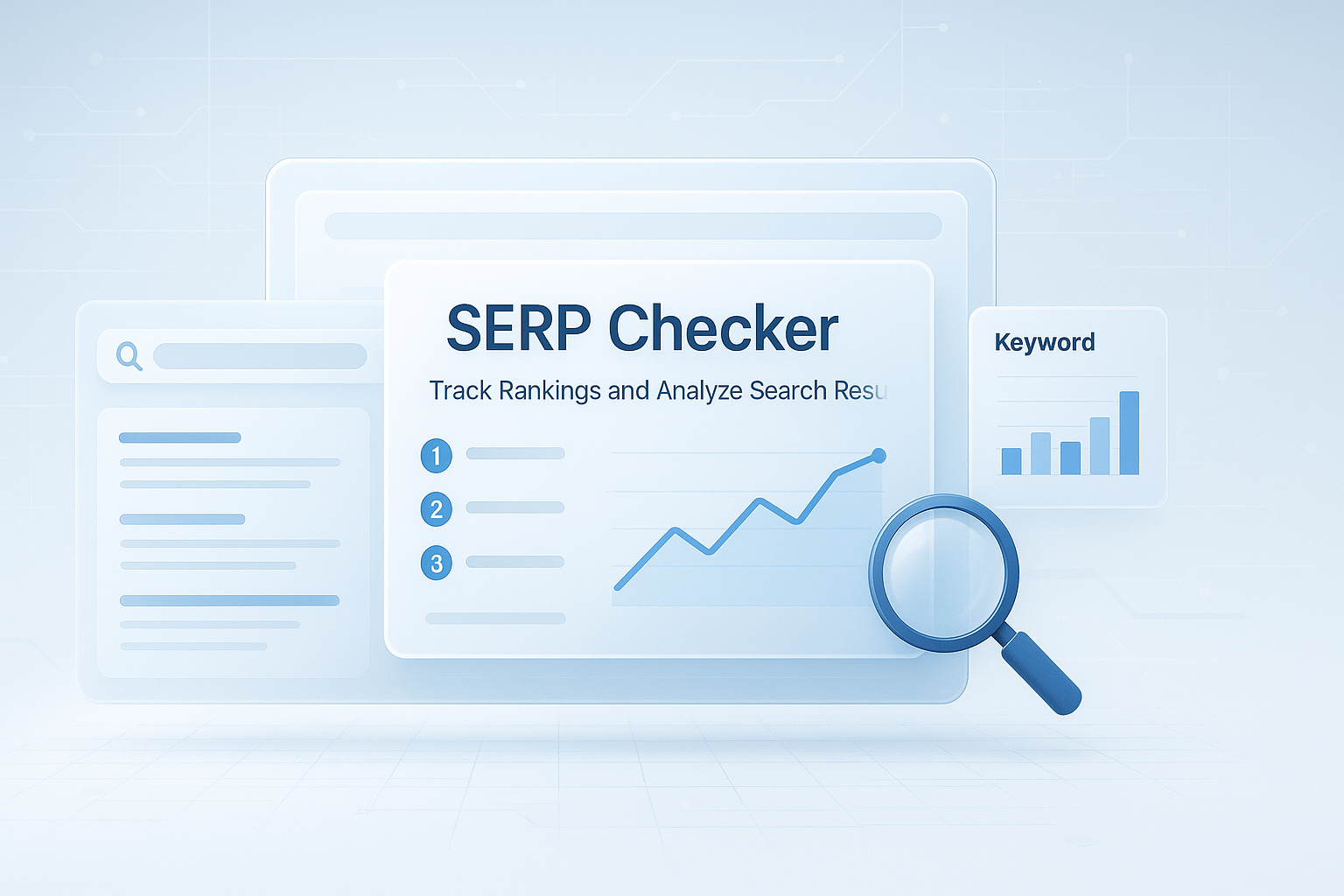
Suggested Image: Technology concept showing a search results dashboard with keyword rankings, competitor positions, and SERP features
What is a SERP checker?
A SERP checker is a tool that shows how a page or keyword appears in search engine results for a specific query, location, device, and sometimes language. It helps marketers monitor rankings, inspect competitors, and understand the layout of the results page beyond a simple position number.
That last part matters more than many teams realize. Ranking number three is very different when the page also includes ads, local results, shopping listings, video carousels, and AI-generated summaries. According to Google Search Central documentation, search results can include many formats, and each one changes click behavior.
- Keyword position for a target term
- Top-ranking URLs for that search
- SERP features such as snippets, People Also Ask, maps, videos, and AI elements
- Location-based result differences
- Mobile versus desktop result changes
- Competitor visibility over time
In practice, a SERP checker gives context. If your page moved down one spot but the page now shows a large featured snippet and video pack, your click-through rate may fall even if your ranking looks stable.
Why marketers use a SERP checker instead of checking Google manually
Manual searching can help with a quick spot check, but it’s unreliable for serious SEO work. Search results are personalized, localized, and constantly changing. A SERP checker creates a cleaner, more repeatable way to track what’s actually happening.
Here’s the problem. Many people search their keyword in a browser, see a result, and assume that’s the real ranking. It usually isn’t. Google can tailor results based on your location, device, search history, and language settings. Google’s explanation of how Search works makes it clear that results are dynamic.
A dedicated SERP checker helps by giving you:
- Neutral rank tracking
- Consistent location targeting
- Device-specific results
- Competitor comparison in one view
- Historical data for trend analysis
- SERP feature visibility, not just blue-link rankings
If you work on broader search reporting, a structured workflow matters. For example, teams that build campaign updates often pair keyword review with performance calculation tools such as a Percentage Calculator to quickly measure movement in impressions, clicks, or ranking changes.
How a SERP checker works
A SERP checker takes a keyword, applies selected conditions such as country, city, device, and language, then returns the search results page in a structured format. Depending on the tool, it may also show ranking positions, domain ownership, result types, and feature placement.
At a basic level, the tool gathers result data and organizes it so you can analyze it faster than a manual search ever could. Better tools also keep snapshots over time, making trend tracking possible.
Common inputs
- Keyword or search query
- Target country, state, or city
- Desktop or mobile device
- Language
- Domain or URL to compare
Common outputs
- Your domain’s current ranking
- Top 10 to top 100 ranking pages
- Search intent clues from the result types
- Presence of snippets, local packs, videos, or shopping results
- Competitor overlap
- Ranking volatility over time
This is where many people struggle. They focus on the position number and ignore page composition. But modern SEO is often about visibility type, not just visibility rank.
| What the tool shows | Why it matters |
|---|---|
| Ranking position | Shows relative visibility for a keyword |
| Top-ranking URLs | Reveals the kind of content Google prefers |
| SERP features | Shows whether snippets, maps, or videos reduce organic clicks |
| Location data | Important for local SEO and regional campaigns |
| Device-specific results | Mobile and desktop rankings often differ |
What to analyze on a search results page
When using a SERP checker, the goal is not simply to ask, “Where do I rank?” The better question is, “What kind of page wins this query, and what’s standing between me and the click?” That shift leads to better SEO decisions.
Let’s break this down. A useful SERP review usually includes five layers of analysis.
1. Ranking position
This is your starting point, not your conclusion. Check where your page ranks and whether that position has changed recently.
2. Search intent
Look at the top results and ask what users really want. Are they looking for a guide, a tool, a product page, a comparison, or a quick answer? If the top results are all educational articles, a sales page may struggle.
3. SERP features
Featured snippets, AI answers, video packs, local packs, image results, and People Also Ask boxes change how much room organic listings receive. Google documents many of these formats in its search results help resources.
4. Competitor quality
Review the top-ranking pages for depth, freshness, internal linking, formatting, and page experience. If your content is thinner or slower, ranking issues may have nothing to do with backlinks.
5. Click potential
A keyword with heavy SERP clutter may bring less traffic than a lower-volume term with cleaner results. If you create visuals for content testing, a responsive image resizer tool can help prepare properly sized graphics for articles and landing pages.
Key benefits of using a SERP checker
A SERP checker helps marketers make better decisions faster. It reduces guesswork, improves reporting, and highlights opportunities that may be invisible inside traffic analytics alone.
- Track rankings accurately: Monitor target keywords by location and device.
- Spot competitor gains early: See who is outranking you and for which queries.
- Understand traffic drops: Identify whether a ranking loss, a new SERP feature, or a shift in intent is affecting clicks.
- Find content opportunities: Look for keywords where weak pages rank in the top 10.
- Improve content strategy: Match content format to what Google already rewards.
- Support local campaigns: Check visibility in specific cities or regions.
Now comes the important part. The biggest benefit is not measurement. It’s prioritization. A SERP checker tells you where to spend effort first.
SERP checker vs rank tracker: what’s the difference?
A SERP checker and a rank tracker are closely related, but they are not exactly the same. A SERP checker usually gives you a snapshot of search results for a keyword. A rank tracker focuses more on monitoring positions over time across many keywords.
Many platforms include both features. Still, it helps to separate the two functions when planning your workflow.
| Feature | SERP Checker | Rank Tracker |
|---|---|---|
| Primary use | Analyze live or recent search results | Monitor keyword positions over time |
| Best for | SERP analysis and competitor review | Trend reporting and campaign tracking |
| Timeframe | Point-in-time view | Daily, weekly, or monthly history |
| Data focus | Result types, intent, competitor pages | Position changes and performance trends |
Here’s what experienced professionals do differently. They use both. The rank tracker flags movement. The SERP checker explains the reason.
How to use a SERP checker for smarter SEO decisions
The best way to use a SERP checker is as a decision tool, not just a reporting tool. Every check should answer a practical question: create new content, improve existing content, target a different keyword, or leave the term alone for now.
- Start with one priority keyword. Use a term that already matters to the business, not a vanity phrase with weak conversion value.
- Check location and device settings. A local service business should not rely on national desktop-only data.
- Identify your real competitors. They may differ from your business competitors. In search, you compete with whoever owns the page.
- Review the top 10 results. Note content type, title style, freshness, and SERP features.
- Compare your page objectively. Is your page more useful, easier to scan, and better aligned with intent?
- Document the opportunity. Decide whether the keyword needs an update, a new page, a richer media format, or stronger internal links.
If you publish SEO content frequently, polishing page assets matters too. Teams often use a Word Counter tool to check article length and readability balance before final updates.
Suggested Screenshot: SERP checker results showing keyword position, ranking URLs, and search features for mobile and desktop
Which SERP features matter most in 2025?
In 2025, the most important SERP features are the ones that either capture clicks directly or push organic results lower on the page. A keyword can look attractive on paper and still deliver weak traffic because the search results are crowded.
The answer depends on one thing: how users interact with that specific query. A local service keyword behaves differently from a software keyword or a how-to search.
- AI Overviews: Can satisfy informational intent before users click through.
- Featured snippets: Strong visibility, but can reduce clicks for some queries.
- People Also Ask: Reveals related questions and content expansion ideas.
- Local pack: Critical for location-based businesses.
- Video carousel: Important where visual explanation wins.
- Shopping results: Often dominate product-intent queries.
- Image packs: Matter for design, travel, product, and tutorial content.
To understand which structured elements Google may use, review Schema.org and Google’s structured data guidance through Search Central. For page code validation, some marketers also lean on the HTML CSS JS Minifier when cleaning front-end assets during technical updates.
How to analyze competitors with a SERP checker
Competitor analysis becomes more useful when you stop asking who ranks first and start asking why they rank first. A SERP checker gives you the list. Your job is to identify the pattern behind the winners.
Look at these areas first:
- Content format: Is Google favoring tutorials, category pages, tools, or landing pages?
- Depth: Do top pages answer related questions thoroughly?
- Freshness: Are recently updated pages dominating?
- Snippet targeting: Are competitors using concise definitions, lists, or tables?
- Topical breadth: Do ranking domains support the page with related content and internal links?
- Media: Are images, videos, charts, or screenshots improving usability?
This small detail changes everything. Your page does not need to be “better” in a vague sense. It needs to be more useful for that exact query.
If you’re comparing page structures or brief templates across teams, file handling tools such as the PDF Merger can help combine draft audits or exported reports into one review document.
Common mistakes when using a SERP checker
Most ranking analysis problems come from interpretation, not from the tool itself. Marketers often collect the right data and draw the wrong conclusion from it.
- Tracking too many keywords: Large reports can hide the few terms that actually drive revenue.
- Ignoring search intent: A page may rank poorly because it solves the wrong problem.
- Using the wrong location: Local and national results can be completely different.
- Looking only at average rank: Averages mask volatility and SERP feature changes.
- Skipping mobile analysis: Mobile results often differ sharply from desktop.
- Assuming all ranking drops are failures: Sometimes Google rewrites the page layout rather than penalizing your content.
For site updates tied to search performance, technical cleanliness matters as well. The Meta Tag Generator can help teams draft cleaner title and description tags during optimization work.
What to look for in a good SERP checker
A strong SERP checker should do more than return a ranking number. It should help you analyze context, compare results across conditions, and act on what you find.
Here’s a practical checklist:
- Location-specific tracking
- Desktop and mobile views
- SERP feature detection
- Competitor URL comparison
- Historical snapshots or trend visibility
- Clean export or reporting options
- Fast results without unnecessary clutter
- Support for multiple languages where needed
For technical verification after content changes, marketers often reference MDN Web Docs for browser and HTML behavior, and W3C standards resources for markup best practices.
Practical workflow for marketers
If you want your SERP checker process to stay useful, keep it simple. Most teams do better with a repeatable weekly review than a complicated dashboard nobody actually uses.
- Select 10 to 30 business-critical keywords.
- Group them by intent: informational, commercial, local, branded.
- Check results by mobile and desktop.
- Flag terms with major shifts in rank or SERP layout.
- Review the live result page for the affected terms.
- Assign one action: update content, improve internal links, build a new page, or hold position.
- Recheck after publishing changes.
If you need to summarize gains and losses for stakeholders, simple utility tools like a Random Number Generator are not relevant here, so skip forced workflows and keep your tool stack practical. Use only what helps interpret rankings and improve pages.
Frequently asked questions
1. Is a SERP checker accurate?
A SERP checker can be highly accurate when it lets you choose the right location, device, and language settings. No tool can reflect every user’s exact experience because search results vary, but a good checker removes much of the personalization that makes manual searching unreliable. For SEO work, consistency matters more than a one-off spot check. Use the same settings each time so trend data stays meaningful.
2. Can I use a SERP checker for local SEO?
Yes, and that’s one of the most valuable use cases. Local rankings can change by city, neighborhood, and device. A SERP checker that supports geo-specific results helps you see whether you appear in local packs, map results, or localized organic listings. This is especially useful for agencies, service businesses, and multi-location brands that need visibility beyond a single national ranking report.
3. What is the difference between a SERP checker and Google Search Console?
Google Search Console shows how your site performs in Google based on impressions, clicks, queries, and average positions from your own verified property. A SERP checker shows the visible search results page itself, often including competitors and SERP features. Search Console tells you what happened to your site. A SERP checker helps explain why it happened by showing the surrounding search environment.
4. How often should I check keyword rankings?
For most marketers, weekly checks are enough for strategy and reporting. Daily tracking is helpful for competitive niches, active campaigns, or sites that publish often. The key is not frequency alone. It’s consistency. If you only check rankings after traffic drops, you miss the trend line that could have warned you earlier. Review more often when launching or updating important pages.
5. Are free SERP checkers enough for small businesses?
For quick checks and early research, a free SERP checker may be enough. It can help you validate ranking position, inspect top results, and understand page features. As your SEO program grows, you may need recurring tracking, multi-location support, exports, and larger keyword sets. Small businesses can start free, but they should still focus on search intent, page quality, and local relevance rather than rankings alone.
6. Why do my rankings differ between mobile and desktop?
Mobile and desktop search results often differ because layout, user behavior, and intent patterns differ. Mobile pages may show local packs, app-related results, or richer visual features more prominently. Your site may also perform differently by device due to speed, usability, or page design. Since Google primarily uses mobile-first indexing guidance, mobile analysis should be part of every regular SEO review.
7. Can a SERP checker help improve click-through rate?
Yes, indirectly. A SERP checker helps you see how your listing appears against competing results. You can compare title styles, result formats, snippets, and feature presence. If you rank reasonably well but still get weak clicks, the issue may be your title tag, meta description, or mismatched intent. CTR improvement usually comes from better alignment with the search results page, not from rewriting in isolation.
8. What’s the best next step after finding a low ranking?
Don’t update the page blindly. First, analyze the result page to understand intent, dominant content format, and SERP features. Then compare your page to the top results for depth, clarity, freshness, structure, and usefulness. Sometimes the right answer is a content refresh. Other times you need a new page entirely. A low ranking is a signal, not a diagnosis. The SERP context tells you what to do next.
Conclusion
A SERP checker is more than a ranking tool. It helps marketers understand how search results are built, why competitors win, and where the real opportunities are. When used well, it turns raw position data into practical SEO decisions.
The main takeaway is simple: don’t judge a keyword by rank alone. Check the full search results page, measure by location and device, and pay close attention to intent and SERP features. That’s where meaningful insight lives.
Your next step is to review a handful of high-value keywords and compare what ranks today with the content you currently publish. If you’re refining pages afterward, related tools like the Keyword Density Checker, Robots.txt Generator, and XML Sitemap Generator can help support the rest of your optimization workflow.