Writing ads is easy. Writing ad copy that fits Google’s limits, matches intent, and still earns clicks is harder than it looks.
That’s why so many marketers are turning to AI Google Ads descriptions. A good AI workflow can help you generate options faster, test angles you may not have considered, and keep campaigns moving when deadlines are tight. But if you rely on AI without a process, you usually end up with bland, repetitive copy that sounds like every other ad on the page.
This guide shows you how to use AI well. You’ll learn what makes a strong Google Ads description, how to prompt AI for better outputs, examples you can adapt, and the mistakes that quietly hurt CTR and relevance. If you’re refining search campaigns in 2026, this is the practical playbook.
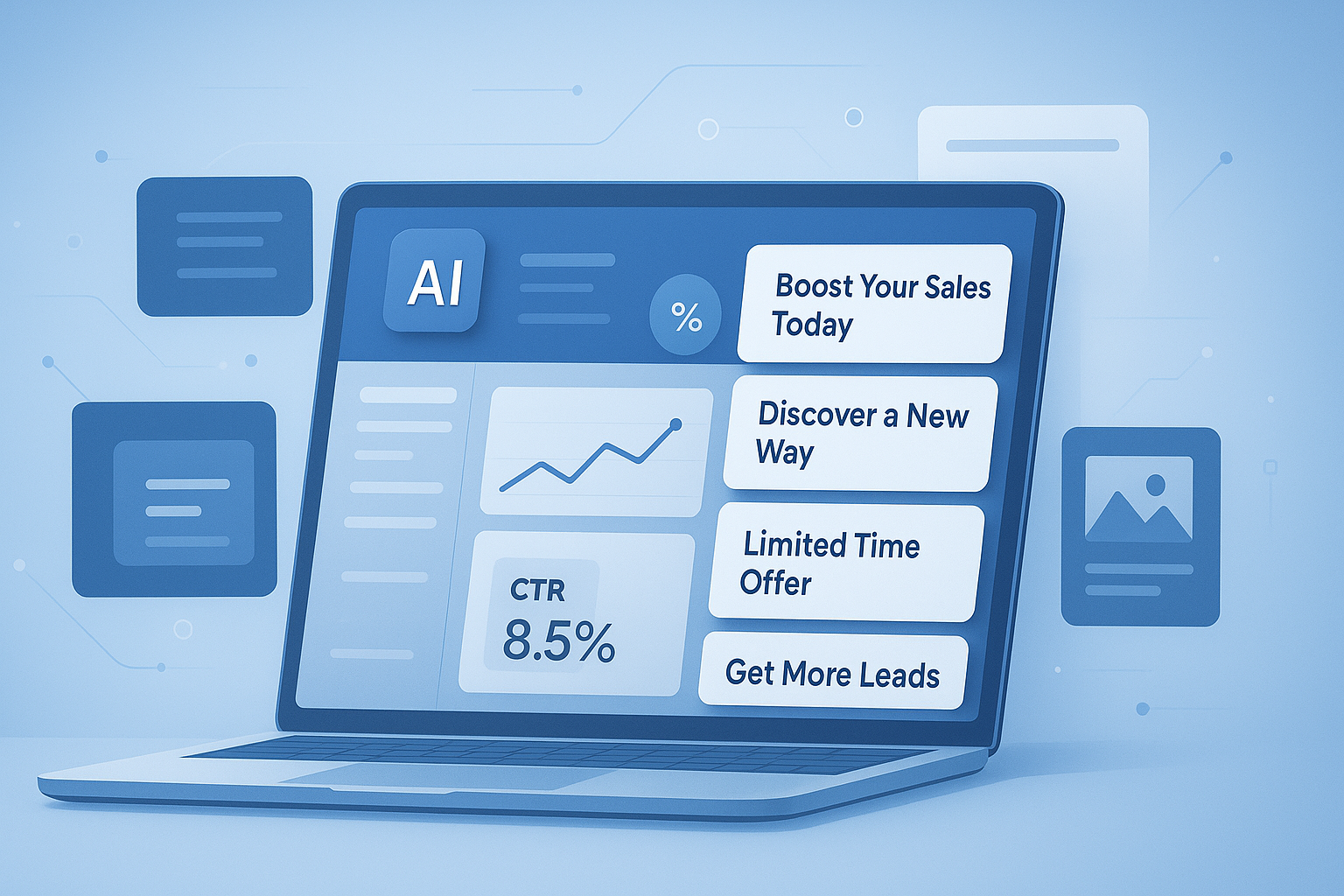
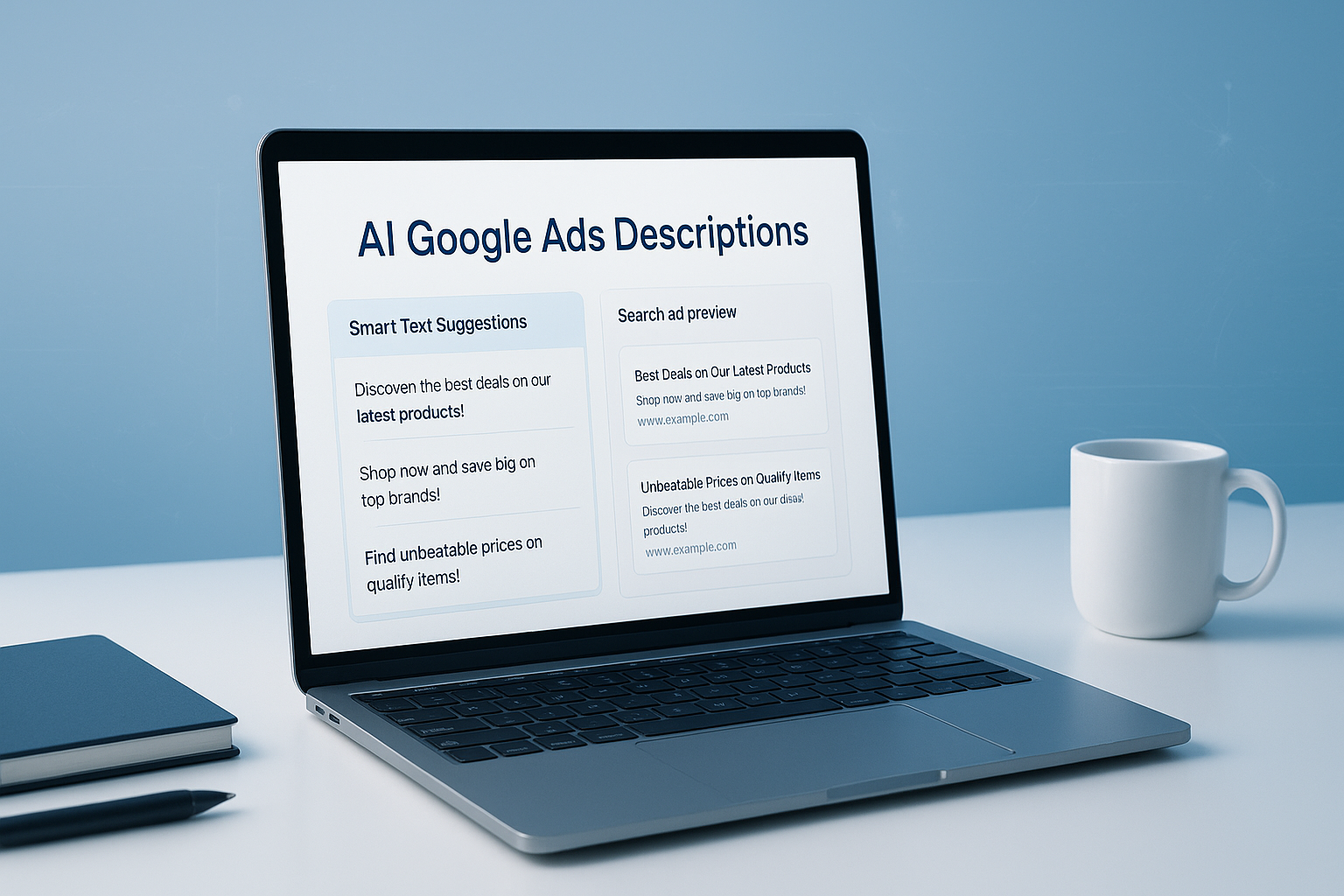
Suggested Image: Technology concept showing AI-generated ad copy on a digital marketing dashboard
What are AI Google Ads descriptions?
AI Google Ads descriptions are short ad text lines created or assisted by artificial intelligence for Google Search campaigns. They are meant to support your headlines, reinforce the offer, and encourage the click while staying relevant to the keyword, landing page, and search intent.
In responsive search ads, Google combines headlines and descriptions dynamically. According to Google Ads responsive search ad guidance, advertisers should provide varied, useful text assets instead of near-duplicates. That matters because AI should not just write faster. It should help you create stronger variation.
- It speeds up first drafts
- It helps brainstorm benefits and angles
- It can adapt copy for different audiences
- It supports testing at scale
- It reduces blank-page friction for busy teams
Still, AI is only as good as your prompt and review process. If you want help polishing the wording before publishing, tools like the AI Paragraph Rewriter can help turn stiff drafts into cleaner, more natural copy.
Why marketers use AI for Google Ads copy
The biggest benefit is speed, but speed alone is not enough. Marketers use AI because it helps create multiple ad directions quickly, making testing easier without sacrificing consistency across campaigns.
Here’s the problem. Many teams waste hours rewriting the same value proposition across ad groups. AI can reduce that repetition by producing new versions based on audience pain points, product benefits, location modifiers, pricing cues, and urgency signals.
Where AI helps most
- Launching campaigns with dozens of ad groups
- Refreshing stale ad copy with new angles
- Localizing or segmenting descriptions by audience
- Creating variants for promos, seasonal offers, or lead-gen campaigns
- Turning landing page messaging into ad-friendly language
Where AI still needs human control
- Compliance-sensitive industries such as finance, health, and legal
- Brand voice consistency
- Claims about pricing, guarantees, or performance
- Intent matching for high-value keywords
- Eliminating vague or generic phrasing
If you’re also refining landing page messaging, a quick pass through an online word counter is useful for tightening sections and removing unnecessary copy before feeding page content into AI prompts.
What makes a high-performing Google Ads description?
A strong description does four things at once: it matches search intent, adds a specific benefit, reduces friction, and supports the click with clear language. Short space means every word has to earn its place.
Google’s Search ads policy and format documentation is a useful baseline, but performance usually comes down to message fit more than character count alone.
| Strong description traits | Weak description traits |
|---|---|
| Speaks directly to the user’s need | Uses generic language that could fit any brand |
| Highlights one or two concrete benefits | Stacks too many claims into one line |
| Supports the landing page offer | Promises something the page does not show |
| Uses readable, natural phrasing | Feels stuffed with keywords |
| Includes a subtle reason to click now | Lacks urgency or next-step clarity |
Here’s what experienced professionals do differently. They don’t ask AI for “10 ad descriptions.” They feed it structure.
- Keyword theme
- Audience segment
- Offer details
- Top conversion benefit
- Trust element
- Desired tone
- Character limit
- Call to action style
If your team creates ad screenshots, visuals, or campaign assets, keep them fast-loading with an Image Compressor so landing pages stay lightweight.
How to prompt AI for better Google Ads descriptions
The quality of your prompt determines the usefulness of the output. Vague prompts produce vague ads. Specific prompts produce copy that sounds closer to something you’d actually publish.
This is where many people struggle. They give AI a product name and ask for ad copy. That’s not enough context. Better prompts tell the model who the ad is for, what action matters, and what constraints it must follow.
A simple prompt framework
- State the product or service clearly
- Define the audience
- Name the target keyword or theme
- List the core benefits
- Add the offer or differentiator
- Set tone and reading level
- Include Google Ads character limits
- Ask for multiple variations with different angles
Prompt template
Create 12 Google Ads descriptions for [product/service]. Target audience: [audience]. Primary keyword theme: [keyword]. Highlight these benefits: [benefits]. Include this offer or trust signal: [offer/trust element]. Tone: [tone]. Keep each description natural, specific, and under the recommended Google Ads limit. Avoid hype, repetition, and exclamation marks. Give 4 benefit-led options, 4 urgency-led options, and 4 trust-led options.
Stronger prompt example
Create 10 Google Ads descriptions for a B2B SEO reporting platform for agencies. Audience: agency owners and account managers. Keyword theme: white label SEO reports. Benefits: automate reports, save analyst time, client-friendly dashboards, faster monthly delivery. Trust signal: used by growing agencies. Tone: clear and professional. Avoid generic phrases like best-in-class or cutting-edge. Make each description distinct and easy to scan.
If you want to clean up prompt outputs quickly, the AI Text Humanizer is useful for smoothing robotic phrasing before final review.
AI Google Ads descriptions examples by intent
The best ad descriptions change based on what the searcher wants. Someone comparing options needs different wording than someone ready to buy. Matching copy to intent improves relevance and usually leads to better click quality.
1. Commercial intent example
Keyword theme: project management software for teams
- Plan tasks, track deadlines, and keep every team update in one place.
- Compare team workflows, automate routine work, and scale without the chaos.
- See projects, workloads, and progress clearly with tools built for growing teams.
2. Transactional intent example
Keyword theme: buy ergonomic office chair
- Shop ergonomic chairs with lumbar support, fast shipping, and simple returns.
- Find office seating designed for comfort, posture support, and daily use.
- Upgrade your desk setup with adjustable chairs built for all-day comfort.
3. Local service intent example
Keyword theme: emergency plumber near me
- Need urgent plumbing help? Book fast local service for leaks, clogs, and repairs.
- Get same-day plumbing support from licensed local pros you can trust.
- Fix burst pipes, blocked drains, and water issues with rapid local response.
4. Lead generation intent example
Keyword theme: CRM demo for small business
- Book a quick demo and see how small teams manage leads without the busywork.
- Track contacts, automate follow-ups, and close deals faster with one CRM.
- See how an easy CRM helps small businesses organize sales and save time.
5. Price-sensitive intent example
Keyword theme: affordable payroll software
- Run payroll with transparent pricing, simple setup, and fewer manual errors.
- Manage payroll, taxes, and employee records without paying enterprise rates.
- Choose payroll software built for small businesses that need value and clarity.
Suggested Infographic: Search intent types matched with ad description angles
Best prompts for different ad copy angles
Not every campaign needs the same voice. Sometimes you want trust. Sometimes speed. Sometimes a strong economic reason to click. Prompting by angle gives you more useful test variants.
Benefit-led prompt
Write 8 Google Ads descriptions focused on practical customer benefits. Keep the language clear and direct. Avoid vague claims. Product: [product]. Audience: [audience]. Keyword: [keyword].
Problem-solution prompt
Write 8 Google Ads descriptions that begin with the user’s pain point and lead into a simple solution. Product: [product]. Audience pain point: [pain point]. Tone: helpful, not dramatic.
Trust-led prompt
Create 8 Google Ads descriptions that emphasize reliability, verified results, reviews, experience, or transparent pricing. Avoid unsupported guarantees. Product: [product].
Urgency-led prompt
Generate 8 Google Ads descriptions that create timely action without sounding pushy. Mention limited-time savings, quick setup, or immediate support only if relevant. Product: [product].
Local-intent prompt
Write 8 Google Ads descriptions for a local service business. Mention speed, local availability, trust, and booking convenience. Service: [service]. City/area: [location].
You can also refine rough outputs with the Sentence Rewriter tool if a line has the right idea but awkward phrasing.
How to review AI-generated ad descriptions before publishing
AI drafts should never go live untouched. Review is where performance gains happen. The goal is not just to catch errors. It’s to make sure each description is persuasive, distinct, compliant, and aligned with the landing page.
Google’s ad systems also evaluate relevance and experience. The Quality Score overview helps explain why weak message alignment can hurt results beyond CTR.
Use this review checklist
- Does the description match the keyword intent?
- Is the main benefit obvious in one read?
- Does it support the actual landing page content?
- Does it avoid unverifiable claims?
- Is it clearly different from other variations?
- Does it sound human and brand-appropriate?
- Is the CTA implied or clearly supported?
- Does it stay within ad format limits?
Quick QA workflow
- Generate 10 to 20 options per ad group
- Remove duplicates and generic lines
- Group survivors by angle: benefit, trust, urgency, proof
- Shorten for clarity
- Check against the landing page
- Pin only when necessary
- Launch and monitor combinations
For landing-page alignment, readability matters more than many teams realize. If you’re pasting ad copy into mockups or briefs, a clean case converter helps standardize presentation for internal review.
Common mistakes with AI Google Ads descriptions
Most poor AI ad copy fails in predictable ways. It sounds generic, repeats the same promise, and misses the real reason a searcher would click. Once you know the patterns, they’re easy to catch.
- Keyword stuffing: repeating the search term unnaturally weakens readability
- Empty claims: phrases like top-rated, innovative, or premium without proof add little value
- Overpromising: unsupported guarantees can create policy and trust issues
- Ignoring intent: a comparison search needs different copy than a buy-now search
- Using one prompt for every campaign: different products need different framing
- Publishing near-duplicates: little variation gives Google less to test
- Skipping brand review: legal, tone, and offer errors are common in raw AI output
Example: weak vs improved description
| Weak AI output | Improved version |
|---|---|
| Best CRM software for all your business needs. Get amazing features now. | Track leads, automate follow-ups, and manage deals in one simple CRM. |
| Affordable dentist near you with the best quality and service today. | Book a local dental visit with flexible appointments and transparent pricing. |
| Try our advanced tool for better productivity and powerful performance. | Organize tasks, cut manual work, and keep projects moving on one dashboard. |
Now comes the important part. Improvement usually means replacing adjectives with specifics. Not bigger claims. Better details.
How many AI-generated descriptions should you create?
There’s no perfect universal number, but most marketers benefit from creating more options than they expect to publish. A practical range is 10 to 20 draft descriptions per ad group, then narrowing to the strongest set after review.
Google recommends asset variety because machine learning performs better when it has meaningful options to test. See Google’s asset performance guidance for how combinations are evaluated in responsive formats.
A workable volume by campaign size
| Campaign situation | Recommended draft volume |
|---|---|
| Single service, narrow audience | 8 to 12 drafts |
| Multi-feature SaaS campaign | 12 to 20 drafts |
| Local services with multiple cities | 10 to 16 drafts per location set |
| High-CPC, high-intent campaigns | 15 to 20 drafts with tight review |
If you’re managing ideas across teams, a Random Name Picker can even help fairly assign variant testing rounds or copy review ownership in workshops and sprint sessions.
Best practices for AI Google Ads descriptions in 2026
AI-assisted ad writing is maturing, but the fundamentals have not changed. Relevance, clarity, and truthful messaging still win. What has changed is how quickly teams can produce and test variants when they use AI with discipline.
- Start with the landing page, not the prompt
- Build prompts around one keyword theme at a time
- Ask for contrasting angles, not just more versions
- Use specific proof points where available
- Tailor copy to funnel stage and device context
- Review for policy risk before launch
- Refresh underperforming assets regularly
- Track performance by message angle, not only by ad group
For ad and landing-page performance, page experience still matters. Google’s SEO starter guidance and web best practices remain useful because speed, clarity, and relevance influence user behavior beyond the click. If campaign images need cleanup before upload, you may also find the JPG to PNG converter helpful for asset preparation.
Frequently asked questions
Can AI write Google Ads descriptions that actually improve CTR?
Yes, but only when the output is reviewed and shaped around intent. AI can generate more testable variations faster than a manual process, which improves your chances of finding better-performing copy. CTR gains usually come from clearer benefits, stronger variation, and better message matching, not from AI alone. Treat AI as a drafting assistant, not a replacement for strategy.
Are AI Google Ads descriptions allowed by Google?
Yes. Google does not prohibit using AI to help create ad copy. What matters is whether the final ad follows Google Ads policies, accurately represents the offer, and provides a good experience. You are still responsible for every claim in the ad. This is especially important in regulated industries or campaigns involving pricing, financial outcomes, or health-related language.
What is the biggest mistake when using AI for ad descriptions?
The biggest mistake is accepting generic output without editing it. AI often defaults to broad, empty phrases that sound polished but say very little. That type of copy may pass a quick glance, yet it tends to underperform because it lacks specificity. The fix is simple: add audience context, clear benefits, and landing-page alignment in the prompt, then edit hard before launch.
How do I make AI-generated ads sound less robotic?
Use better prompts and tighter editing. Ask for plain English, concrete benefits, and a natural tone. Tell the model to avoid hype, clichés, and repeated sentence patterns. After generation, remove filler adjectives and replace them with customer-relevant details. Reading the copy out loud also helps. If it sounds like something nobody would actually say, it still needs work.
Should I add keywords directly into every description?
No. Your description should support relevance naturally, not force the keyword into every line. Overuse makes ads awkward and can lower readability. It is better to reflect the keyword theme with related language, the right benefit, and a matching offer. One or two well-placed mentions across assets are usually more effective than repeating the exact term mechanically.
How many description variants should I test in one ad group?
A practical starting point is 10 to 20 AI-generated drafts, narrowed down to a small set of distinct final options. The exact number depends on campaign complexity, traffic volume, and how different your audience segments are. Focus on meaningful variety. Testing four near-identical descriptions is less useful than testing versions built around trust, speed, savings, and convenience.
Can AI help with regulated industries like finance or healthcare?
It can help generate ideas and first drafts, but extra caution is required. In regulated categories, AI may introduce unsupported claims, risky wording, or oversimplified promises. Use AI only within a strict approval process. Review every line for compliance, accuracy, and user trust. When legal or policy risk is high, human review should be mandatory before anything goes live.
What should I do after generating ad descriptions with AI?
Review them against the keyword, landing page, and policy requirements. Remove duplicates, tighten wording, and make sure each variation has a distinct angle. Then launch the strongest set and monitor performance over time. Look for patterns in message themes, not just individual ads. The next improvement often comes from learning which type of promise gets the best click quality.
Conclusion
AI Google Ads descriptions can save time and improve testing, but only when you guide the process well. The winning formula is simple: start with search intent, give AI better context, edit for specificity, and test meaningful variation. That’s how you turn fast drafts into stronger ad assets.
Your next step is practical. Pick one active ad group, create a structured prompt, generate multiple angles, and review them against the landing page before publishing. If you want to keep refining content around your campaigns, helpful next tools include the AI Paragraph Rewriter, AI Text Humanizer, Word Counter, and Image Compressor.