Writing dozens of eBay listings sounds simple until you’re staring at the same blank description box for the tenth time. Most businesses don’t struggle because they lack products. They struggle because turning product details into clear, persuasive copy takes time.
An AI eBay product description workflow helps solve that problem. It can speed up writing, improve consistency across listings, and make product pages easier for buyers to understand. But speed alone isn’t enough. If the copy is vague, repetitive, or inaccurate, it can hurt trust and sales.
This guide explains how to use AI for eBay descriptions the right way. You’ll learn what these tools do well, where human review still matters, how to structure better listings, and how businesses can build a repeatable process that saves time without lowering quality.
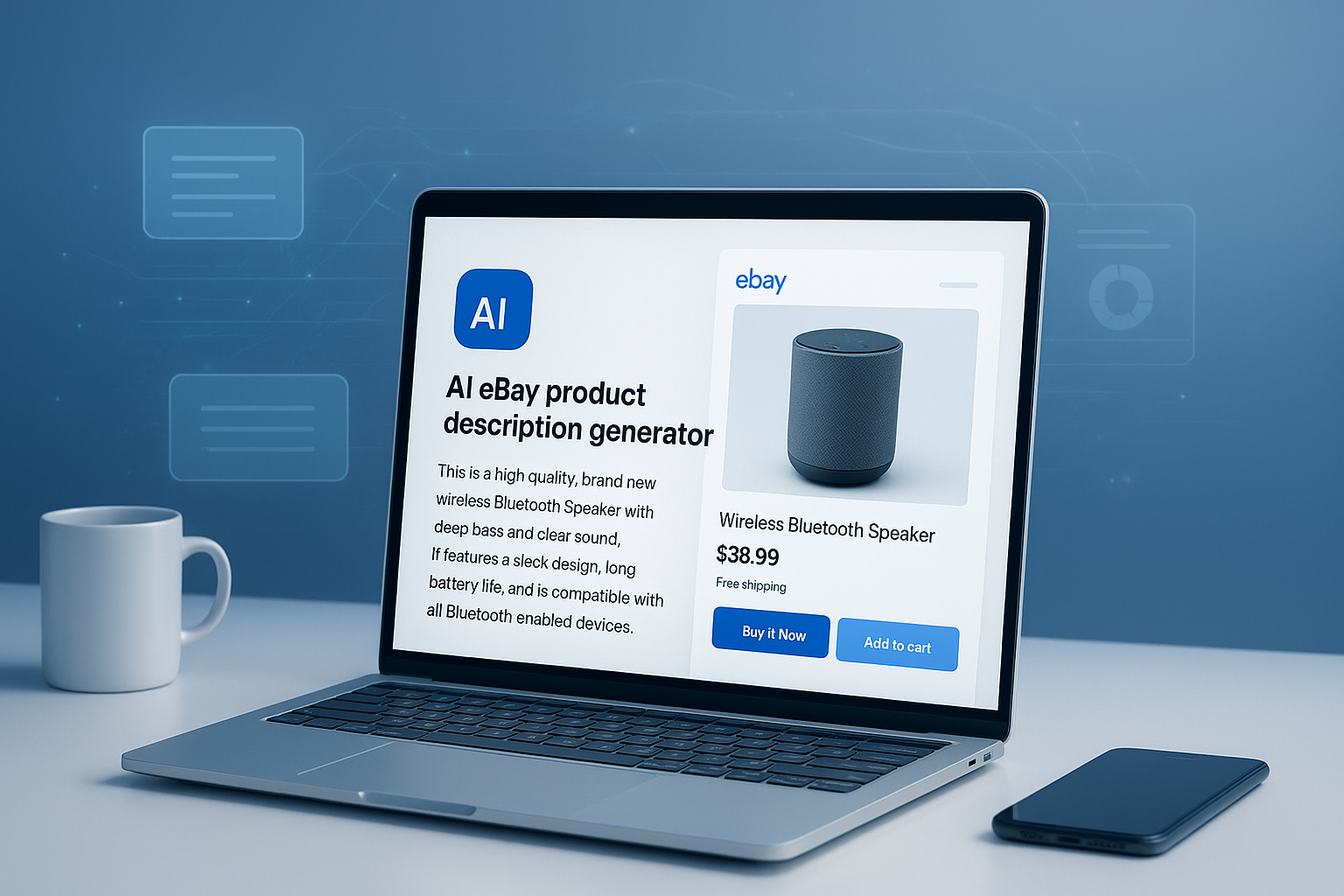
Suggested Image: Technology concept showing AI-assisted eCommerce listing creation on a laptop dashboard
What is an AI eBay product description generator?
An AI eBay product description generator is a writing tool that turns product inputs such as title, features, condition, brand, size, and use case into a readable listing description. Its main job is to help sellers write faster while keeping listings informative and buyer-friendly.
Most tools work by asking for a few details, then producing ready-to-edit copy. Some are basic text generators. Others let you control tone, structure, length, and audience. For businesses managing many listings, this can reduce repetitive writing and speed up catalog publishing.
- It saves time on first drafts
- It helps standardize listing quality
- It can improve clarity for buyers
- It reduces writer fatigue for large inventories
- It works best when paired with human editing
If your team also creates product visuals, a tool like the Image Compressor can help prepare listing images for faster page performance without unnecessary file size.
Why businesses are using AI for eBay listings in 2026
Businesses are using AI because listing at scale is hard to do manually. The more products you publish, the more valuable a fast, repeatable writing process becomes. AI helps teams move from rough product data to publishable copy much faster than starting from scratch every time.
Here’s the real advantage. AI doesn’t just save minutes. It reduces bottlenecks between sourcing, photography, merchandising, and listing. That matters when inventory changes often or seasonal products need to go live quickly.
- Faster listing turnaround
- More consistent product messaging
- Less dependence on a single writer
- Better support for bulk listing operations
- Easier testing of different description styles
eBay itself encourages clear, complete item details because product information affects buyer confidence and search visibility. You can review best practices in the eBay item description guidance.
For teams also refining on-page visibility, the keyword density checker can help review whether important product terms are present naturally without making descriptions sound forced.
What makes a strong eBay product description?
A strong eBay description answers buyer questions quickly, removes doubt, and makes the item easy to compare. It should be clear before it tries to be clever. Buyers want to know exactly what they’re getting, what condition it’s in, and whether it fits their needs.
Good descriptions usually include:
- What the item is
- Who it’s for
- Key features and specifications
- Condition details
- What’s included in the package
- Relevant compatibility or size information
- Any defects, limits, or missing parts
- Shipping or handling notes when needed
The basic structure that works
This is where many sellers struggle. They either write too little or bury important facts in long blocks of text. A cleaner structure usually performs better because buyers can scan it fast.
- Open with a plain-language summary of the product
- List the most important features
- Add specifications and compatibility details
- State item condition honestly
- Clarify what is included and not included
- End with practical purchase information if relevant
| Description Element | Why It Matters |
|---|---|
| Clear opening summary | Helps buyers understand the item in seconds |
| Bullet-point features | Improves scanability on mobile and desktop |
| Condition notes | Builds trust and reduces returns |
| Compatibility or sizing | Prevents wrong purchases |
| Included items | Avoids buyer confusion and disputes |
When you need clean formatting for copied listing text, a simple utility like the Text Case Converter can help standardize capitalization across inventory records and descriptions.
How an AI eBay product description workflow actually works
An effective AI eBay product description process starts before you ask AI to write anything. The output depends on the quality of your inputs. If you feed the tool incomplete or messy data, you’ll get generic copy back.
Here’s what experienced teams do differently. They build a structured listing workflow, then use AI as a drafting assistant rather than a final publisher.
- Collect raw product data. Include title, brand, model, dimensions, material, color, condition, included accessories, defects, and intended use.
- Define the listing goal. Is this a refurbished item, a premium branded product, or a budget clear-out item? Context changes tone.
- Prompt the AI clearly. Ask for concise, factual, buyer-friendly copy with bullets and condition notes.
- Review for accuracy. Check every claim against the actual product.
- Add compliance and policy details. Make sure content aligns with listing rules and marketplace requirements.
- Format for readability. Keep sections short and easy to scan.
- Publish and monitor performance. Track clicks, sales, and returns to refine future prompts.
Google’s guidance on creating useful, people-first content is especially relevant here because product content should help the reader, not just fill space. See the Google Search guidance on helpful content.
Example prompt structure for better outputs
A better prompt usually produces a better draft. Instead of typing “write eBay description,” give the tool a real brief.
Write an eBay product description for a used Canon EOS 80D DSLR camera body. Tone should be clear and professional. Include a short opening summary, bullet-point features, honest condition details, and what is included in the box. Avoid hype. Mention that the screen has light cosmetic wear but the camera functions properly.
If your team manages prompt variations or stores listing drafts in PDFs, an organized tool chain matters. The PDF to Word tool can help extract editable text from supplier sheets or archived documents before you prepare AI-ready inputs.
Benefits of using AI for eBay descriptions
The biggest benefit is speed, but that’s only part of the story. AI can also improve operational consistency, especially when multiple team members are creating listings across categories.
- Faster draft creation: Useful for high-volume sellers and catalog expansion
- More consistent formatting: Helps maintain a recognizable listing style
- Clearer wording: Can improve readability for buyers
- Lower writing friction: Teams don’t have to start from zero every time
- Easier iteration: You can test short, long, technical, or benefit-led versions quickly
There’s also a training benefit. Junior staff can use AI-generated drafts as a starting point, then learn how strong product copy is structured during review.
| Manual Writing | AI-Assisted Writing |
|---|---|
| Slower for large catalogs | Faster first drafts at scale |
| Depends heavily on writer skill | More consistent baseline structure |
| Can be highly nuanced | Needs human review for nuance and accuracy |
| Harder to scale quickly | Better for bulk listing workflows |
Limitations and risks you should not ignore
AI can help, but it can also create problems if you trust it too much. Product descriptions affect buyer expectations, returns, and account reputation. That means every generated draft needs review before publishing.
Common risks include:
- Inventing features that were never provided
- Using vague language that says little
- Overpromising item condition
- Repeating the same phrasing across many listings
- Missing category-specific details buyers expect
- Creating text that sounds polished but inaccurate
This matters because misleading claims can create legal and customer service issues. For advertising honesty and disclosure principles, the FTC advertising and marketing guidance is a useful reference.
Where human editing still matters most
Now comes the important part. AI is strongest at drafting structure and phrasing. Humans are still better at judgment.
- Verifying brand, model, and specs
- Describing flaws honestly
- Avoiding restricted or misleading wording
- Adjusting tone for buyer intent
- Making sure included items are listed correctly
- Tailoring content for niche categories
If you work with spreadsheets of size, weight, and dimensions across regions, the unit converter can help normalize product measurements before feeding them into your listing template.
How to write AI prompts that produce better eBay descriptions
The answer depends on one thing: specificity. AI performs far better when it receives clear facts, formatting instructions, and limits. A weak prompt gives you generic text. A strong prompt gives you a usable draft.
Use prompts that include the product type, target buyer, condition, must-mention details, what to avoid, and how to structure the output.
Good prompt ingredients
- Product name and category
- Brand and model
- Condition details
- Top features or differentiators
- What’s included
- Who the product is for
- Desired tone
- Length and formatting instructions
- Restrictions such as “avoid exaggerated claims”
Prompt example for a business seller
Create a concise eBay description for a new stainless steel insulated water bottle, 750ml, black, leakproof lid, BPA-free, suitable for office, gym, and travel. Use a clear business tone. Start with a 2-sentence overview, then 5 bullet points, then a brief package contents section. Do not use exaggerated marketing language.
If you need help counting content length for marketplace templates or title limits, the word counter can make fast quality checks easier during bulk listing work.
Best practices for a high-converting AI eBay product description
A high-converting description makes the buyer feel informed, not pressured. The copy should answer practical questions quickly and reduce uncertainty. This small detail changes everything because buyers often decide based on trust as much as price.
- Lead with the product and use case: Say what it is and why someone would buy it
- Prioritize facts over hype: Buyers trust specifics more than buzzwords
- Use bullets for features: They are easier to scan on mobile
- State condition honestly: Imperfections should be visible in both text and photos
- Be consistent: Keep style uniform across your catalog
- Match the category: Electronics, apparel, collectibles, and industrial products need different details
What to include by category
| Category | Important Details |
|---|---|
| Electronics | Model, compatibility, storage, battery, included cables, condition |
| Clothing | Size, material, fit, measurements, care instructions, flaws |
| Home goods | Dimensions, color, material, capacity, intended use |
| Auto parts | Part number, vehicle fitment, condition, included hardware |
For image-heavy listings, the Image to PDF tool can be useful when assembling internal review sheets or product documentation for team workflows.
Common mistakes businesses make with AI-generated listings
Most AI listing problems are avoidable. They happen when speed replaces review or when businesses expect AI to understand the product better than the seller does.
- Publishing without checking facts: This is the biggest risk
- Using the same template for every category: Buyers expect specific details
- Leaving out defects: Missing condition notes can increase returns
- Writing keyword-heavy copy: It may sound unnatural and reduce trust
- Ignoring formatting: Dense paragraphs are harder to read
- Forgetting mobile readability: Many buyers browse on phones
It also helps to follow broader accessibility and readability principles for digital content. The W3C Web Accessibility Initiative offers useful guidance for making content easier to understand and use.
How to optimize eBay descriptions for search without sounding robotic
Search optimization for listings is less about stuffing phrases and more about using the right terms in the right places. Your product title, item specifics, and description should support each other naturally.
Here’s a practical approach:
- Use the main product term early in the description
- Include natural variations buyers might search for
- Add important specs, sizes, models, and compatibility terms
- Keep wording readable and factual
- Align the description with the title and item specifics
Google’s structured data documentation also shows why clean product information matters across the web, even if marketplaces have their own systems. See the Google product structured data documentation.
If you’re also reviewing related store content outside eBay, the meta description length checker can help tighten supporting copy for other channels.
A simple review checklist before you publish
Before any AI-generated listing goes live, run a short human review. This catches the mistakes that cost sellers the most: wrong specs, missing accessories, overstated condition, and unclear formatting.
- Does the description match the product photos?
- Are the model, brand, and size correct?
- Is the condition described honestly?
- Are defects clearly disclosed?
- Is the item package content complete?
- Does the text read naturally?
- Are important buyer questions answered?
- Is the layout easy to scan on mobile?
Suggested Screenshot: AI-generated eBay draft beside a human-edited final listing with highlighted changes
Frequently asked questions
Can AI write eBay product descriptions that actually help sales?
Yes, but only when the input data is accurate and the output is reviewed by a human. AI can improve speed, structure, and clarity, which may support better buyer engagement. It does not guarantee more sales on its own. Pricing, images, shipping, seller reputation, and product-market fit still matter. Think of AI as a drafting assistant that helps you publish stronger listings faster.
Is it safe to use AI for eBay listings?
It’s safe if you treat AI-generated copy as a draft, not a final truth. The main risk is inaccurate information, especially for specifications, condition, or included accessories. Always verify claims before publishing. Businesses should also avoid entering sensitive internal data into tools unless they understand the platform’s privacy and data handling policies. Review your software provider’s terms before using it in production workflows.
What details should I give an AI tool for the best results?
Provide complete, structured information. That should include product name, brand, model, size, material, color, condition, key features, defects, compatibility, and what is included. Also specify tone, output length, and desired format. The more precise the input, the more practical the draft will be. Missing details often lead to generic or misleading descriptions.
Does AI replace a human copywriter for eBay listings?
Not fully. AI is excellent for speeding up repetitive drafting, especially in large inventories. Human reviewers are still better at judgment, nuance, fact-checking, and adapting copy for category-specific buyer concerns. For businesses, the strongest setup is usually hybrid: AI creates the first version, then a trained person reviews and approves it before publication.
How long should an eBay product description be?
The right length depends on the product category and buyer risk. Simple items may need only a short summary and a few bullets. Technical, expensive, used, or compatibility-sensitive items often need more detail. A good rule is to be complete but not bloated. Include enough information to answer likely buyer questions, then stop. Long descriptions are only helpful when every section adds value.
Can AI help with bulk listing operations for businesses?
Yes. This is one of the strongest use cases. AI can turn spreadsheet-style product data into consistent first drafts for many listings at once. That makes it easier for businesses to scale catalog uploads, reduce manual workload, and maintain formatting standards. The important part is having a review process so volume does not come at the expense of accuracy.
Will AI-generated descriptions hurt SEO or marketplace visibility?
Not necessarily. Poorly edited AI content can hurt readability and trust, but well-reviewed content can support better clarity and consistency. Search and marketplace systems reward useful, relevant, accurate information more than the writing method itself. Focus on clear product terms, natural language, complete item specifics, and honest descriptions. Avoid keyword stuffing and repetitive filler.
What’s the best next step if I’m new to AI listing tools?
Start with a small batch of products rather than your full catalog. Choose one category, create a standard input template, generate drafts, and compare them against manually written listings. Track editing time, buyer questions, return rates, and conversion quality. That gives you a realistic view of whether the workflow improves your operation before you scale it.
Conclusion
An AI eBay product description process can save businesses serious time, especially when inventory moves fast or listing volume is high. The real value is not automatic writing by itself. It’s the ability to build a smarter workflow that turns raw product data into clear, consistent, buyer-friendly listings.
The best results come from combining AI speed with human judgment. Use AI to draft. Use people to verify, refine, and protect quality. That balance helps you publish faster without sacrificing trust.
As a next step, review your current listing process and build a simple template for product inputs. Then test it with a small batch. If you want to improve related tasks, tools like the Image Compressor, word counter, unit converter, and keyword density checker can help support cleaner, faster listing production.