Most content teams worry about rankings, but overlook a simple issue hiding in plain sight: keyword balance. Use a keyword density checker too little, and your page may drift off-topic. Use it the wrong way, and you risk writing stiff, repetitive copy that turns readers away.
That matters even more in 2026. Search engines are better at understanding meaning, context, and intent. AI-powered search tools do the same. Still, they need clear signals. A smart keyword strategy helps your content stay relevant without sounding forced.
This guide explains what a keyword density checker does, when it helps, where marketers go wrong, and how to use it alongside broader on-page SEO. If you want cleaner optimization, stronger topical focus, and fewer keyword stuffing mistakes, this is the practical version.
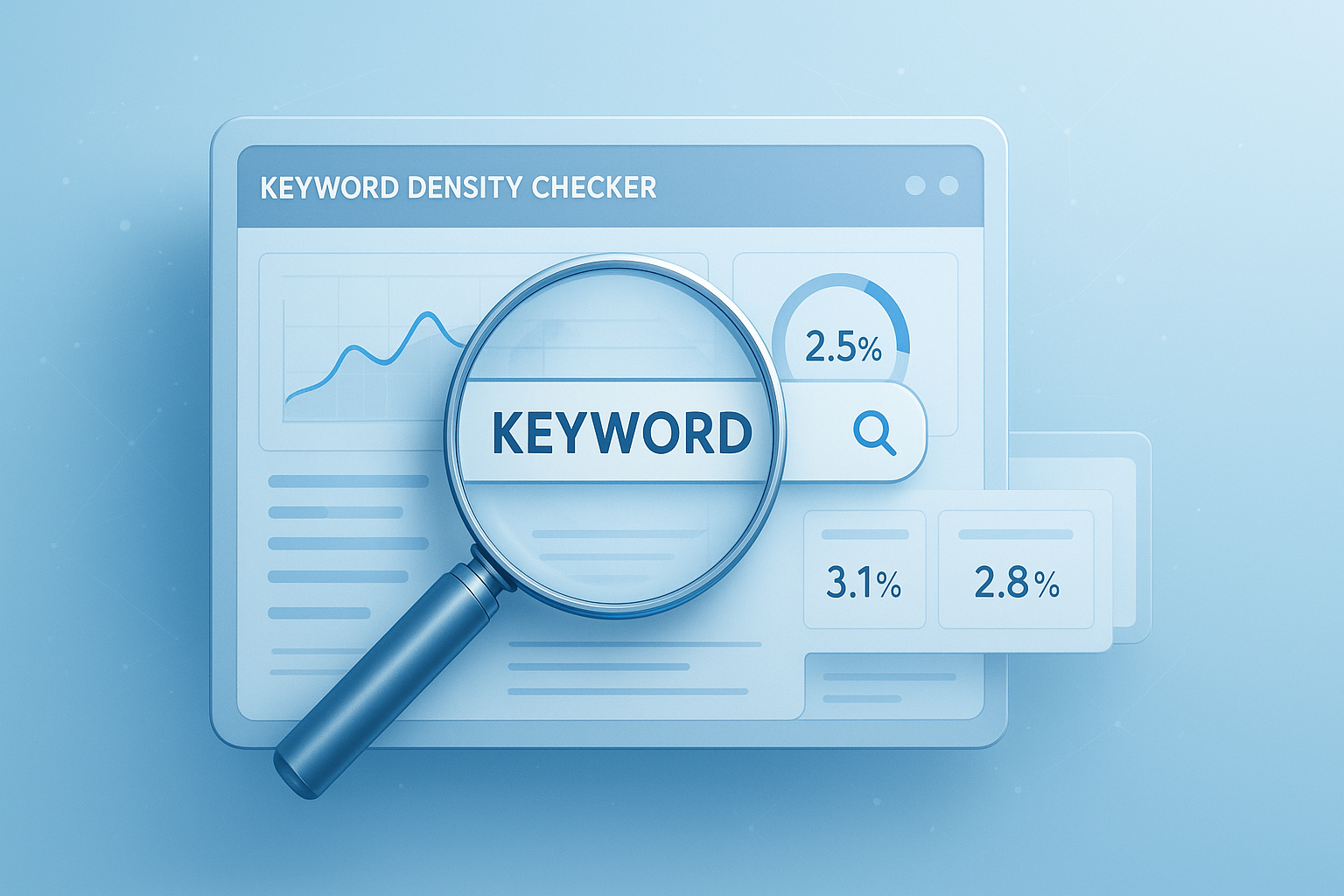
Suggested Image: Technology concept showing SEO analytics dashboard with keyword frequency and content optimization metrics
What is a keyword density checker?
A keyword density checker is a tool that measures how often a word or phrase appears in a piece of content compared with the total word count. It helps marketers spot overuse, underuse, and uneven keyword distribution before publishing.
In simple terms, it answers a basic question: “Am I using this term enough to signal relevance, but not so much that it sounds unnatural?” That’s useful for blog posts, landing pages, category pages, and product descriptions.
If you’re reviewing SEO text manually, you can pair this process with a quick word counter tool to verify total word count and compare content drafts more accurately.
How keyword density is calculated
The formula is straightforward:
Keyword density = (number of times a keyword appears ÷ total word count) × 100
Example:
- Total article length: 1,000 words
- Target phrase appears: 10 times
- Density: 1%
This number is not a ranking score. It’s only a measurement. The real value comes from interpretation.
Why marketers still use it
Even though Google does not recommend chasing keyword percentages, density checks are still useful for quality control. They help you:
- Identify keyword stuffing
- Keep pages tightly focused
- Compare competing drafts
- Improve topical consistency
- Catch awkward repetition introduced by AI writing tools
For broader context on how Google evaluates content quality, review Google’s guidance on creating helpful, reliable, people-first content.
Why keyword density still matters for SEO and AI search
Keyword density is no longer a primary ranking tactic, but it still matters as a content quality signal. Search engines and AI search systems use context, entities, structure, and relevance. Repetition alone won’t help, yet completely missing key terms can weaken page clarity.
Here’s the problem. Many marketers swung from “use the keyword everywhere” to “ignore keyword frequency entirely.” Neither extreme works well. A keyword density checker helps you stay in the middle where content reads naturally and still stays on topic.
- For traditional SEO: It supports topical relevance and on-page alignment
- For AI Overviews and answer engines: It helps the system quickly identify the page’s core subject
- For users: It reduces awkward repetition and improves readability
If you’re also optimizing page assets, related technical elements matter too. Large media files can slow delivery, so teams often combine content review with an image compressor to improve load speed.
What is a good keyword density percentage?
There is no official ideal percentage. For most pages, a natural keyword density often falls somewhere around 0.5% to 2%, but context matters more than the number itself. The best range is the one that keeps the page clear, readable, and relevant.
This is where many people struggle. They want a universal benchmark, but search engines do not use a public “perfect density” rule. A 500-word service page behaves differently from a 2,500-word guide.
| Density Range | What It Usually Suggests |
|---|---|
| Below 0.3% | Keyword may be too weak or barely present |
| 0.5% to 1.5% | Often natural for informative content |
| 1.5% to 2.5% | Can be acceptable if the topic is narrow and wording still feels natural |
| Above 3% | Often a sign of over-optimization or repetitive writing |
Think of density as a warning light, not a destination. If you want to review raw text before publishing, a text to HTML converter can also help clean formatting when moving optimized copy into CMS workflows.
How to use a keyword density checker correctly
The best way to use a keyword density checker is after your first draft is written for humans. Start with useful content, then use the tool to catch excess repetition, missing terms, and weak topical signals. Don’t build the article around the percentage.
- Write the draft first. Focus on answering the user’s question clearly.
- Choose one primary keyword. In this case, that might be “keyword density checker.”
- Add related phrases naturally. Include terms like keyword frequency, keyword stuffing, on-page SEO, semantic relevance, and content optimization.
- Run the checker. Review single words and multi-word phrases.
- Inspect placement. Make sure the primary term appears in the title, introduction, at least one subheading, and conclusion where relevant.
- Edit for flow. Replace repeated exact-match phrases with pronouns, synonyms, or clearer sentence structure.
- Recheck the draft. Confirm the content still sounds human.
For SEO teams working with pasted content from different writers or tools, a remove duplicate lines tool can help clean repetitive blocks before final optimization.
What to check beyond raw frequency
Now comes the important part. The count alone never tells the whole story. Review these page-level signals too:
- Keyword use in the title and headings
- Natural use in the first 100 to 150 words
- Presence of related terms and subtopics
- Anchor text relevance
- Image alt text where appropriate
- Meta description clarity
- Internal linking to related pages
Google’s search result snippet documentation is also worth reviewing when refining titles and descriptions.
Keyword density vs keyword stuffing
Keyword density is a measurement. Keyword stuffing is a harmful tactic. The difference comes down to intent and readability. If a phrase appears repeatedly in a way that feels forced, distracting, or manipulative, you’ve crossed the line.
Search engines have warned against this for years. Google specifically lists keyword stuffing as a spam practice in its spam policies for Google web search.
| Keyword Density Review | Keyword Stuffing |
|---|---|
| Used to evaluate balance | Used to manipulate rankings |
| Supports editing and clarity | Hurts readability and trust |
| Works with semantic language | Repeats exact phrases excessively |
| People-first approach | Search-engine-first approach |
Quick example
Natural: “A keyword density checker helps editors spot repeated phrases and improve on-page SEO without over-optimizing the draft.”
Stuffed: “A keyword density checker is the best keyword density checker because a keyword density checker improves keyword density checker SEO.”
The second version might include the target phrase, but it damages credibility instantly.
Best practices for modern on-page optimization
A keyword density checker works best when it supports broader SEO, not when it replaces it. Strong content in 2026 is built around intent, structure, and depth. Keyword frequency is just one small part of that system.
- Start with search intent. Know whether the query is informational, transactional, navigational, or commercial.
- Use primary and secondary terms. Cover the topic naturally instead of repeating one phrase.
- Answer the main question early. This increases the chance of appearing in featured snippets and AI summaries.
- Build clear heading structure. Make the article easy to scan.
- Add supporting examples. Real-world use improves clarity.
- Keep sentences varied. This reduces AI-like repetition.
- Review readability. If the page sounds mechanical, ranking gains rarely last.
When optimizing headings, slugs, or short SEO elements, a character counter is useful for keeping titles and snippets concise.
Google also recommends writing useful page titles and descriptions that help users understand the page before clicking. Their official title links guidance is a good reference.
How marketers can use keyword density checkers in real workflows
Experienced marketers rarely use one tool in isolation. A keyword density checker fits into editorial review, content refreshes, SEO audits, and AI-generated draft cleanup. Its real value shows up when used as a checkpoint inside a repeatable process.
1. Blog content optimization
You publish a 1,800-word article targeting a mid-funnel keyword. Rankings stall. The piece is informative, but the target topic appears only twice. A density check reveals weak topical focus. You add the phrase in the intro, one heading, image alt text, and conclusion. That small adjustment improves clarity without rewriting the whole article.
2. AI draft cleanup
AI writing tools often overuse exact-match phrases because they mirror prompt language. A density checker quickly highlights loops and repeated wording. This is one of the easiest ways to make AI-assisted content sound more human.
For messy imported copy, content teams may also use a case converter when standardizing headings and formatting in editorial drafts.
3. Competitor benchmarking
You can compare your page with top-ranking pages to understand topical coverage. Not to copy them, but to notice patterns. If every strong page references related entities, questions, and supporting concepts while yours is narrowly repetitive, the density number alone won’t save it.
4. Refreshing old content
Older posts often underperform because they’re thin, not because density is wrong. Still, a density check can reveal missing terms after expansion. It’s a useful final pass after updating examples, facts, and structure.
Suggested Screenshot: Example of a keyword density report highlighting primary keyword, related phrases, and repetition warnings
Common mistakes when using a keyword density checker
Most keyword density problems come from misuse, not from the tool itself. Marketers either obsess over percentages or ignore context completely. The fix is simple: use the data to edit, not to force language.
- Chasing an exact percentage: There is no magic benchmark that guarantees rankings.
- Ignoring related terms: Semantic breadth matters more than repeating one phrase.
- Checking only the body copy: Titles, headings, alt text, and metadata matter too.
- Over-correcting AI drafts: Replacing every repeated phrase can make the copy vague.
- Forgetting user intent: A well-balanced article can still fail if it answers the wrong question.
- Confusing density with quality: Helpful information still comes first.
If you’re refining article structure for cleaner publishing, a HTML to text converter can simplify raw content review before final edits.
What a keyword density checker cannot do
A keyword density checker is useful, but limited. It cannot measure search intent accuracy, expertise, trustworthiness, originality, or whether the page truly deserves to rank. It shows repetition, not quality.
Here’s what it won’t tell you:
- Whether the content is factually correct
- Whether the page matches user intent
- Whether the topic is covered deeply enough
- Whether the page has strong backlinks
- Whether the site experience is good
- Whether your brand voice sounds credible
For that broader picture, marketers should pair on-page review with technical SEO, user research, analytics, and content performance tracking. Microsoft’s Microsoft search documentation and Google’s Search Central resources are both useful starting points for multi-engine optimization.
How to make content AI-search friendly without overusing keywords
AI search systems prefer content that is clear, structured, and easy to extract. That does not mean stuffing exact-match phrases. It means writing in a way that makes the topic obvious through definitions, examples, headings, and relationships between ideas.
Here’s what experienced professionals do differently:
- Define the main concept early
- Use question-based subheadings
- Add concise answers right after headings
- Include examples, comparisons, and steps
- Use related terms naturally across the page
- Keep formatting clean and scannable
- Update examples so the content feels current
This matches how AI systems summarize pages for users. Structured content also improves accessibility and readability. For web content structure standards, MDN’s documentation on page structure is a practical reference.
Frequently Asked Questions
Is keyword density still important for SEO?
Yes, but not in the old-fashioned way. Search engines no longer reward pages simply for repeating a keyword more often. Still, keyword density helps you confirm that the page stays clearly focused on its topic. It works best as a diagnostic tool, not a ranking trick. Think of it as a way to catch imbalance, especially in AI-assisted drafts or pages that drift off-topic during editing.
What is the ideal keyword density for a blog post?
There is no official ideal number. Many well-written pages naturally land between 0.5% and 2%, but the right amount depends on the topic, page length, and search intent. A narrow topic may use the term more often without sounding repetitive. A broader guide may rely more on related phrases. The safest rule is this: if the page reads smoothly and the topic is clear, you’re probably in a good range.
Can a high keyword density hurt rankings?
Yes, it can. If your target phrase appears too often, the content may feel manipulative or hard to read. That can reduce trust with readers and raise quality concerns with search engines. High density is not always a problem by itself, but repeated exact-match phrasing often signals keyword stuffing. When in doubt, read the page out loud. If it sounds forced, rewrite it.
Should I use exact-match keywords or related terms?
You should use both, but with balance. Exact-match keywords help clarify the main topic, especially in titles, introductions, and some headings. Related terms help search engines understand context and help the writing sound natural. A strong page usually combines one clear primary phrase with semantic support such as synonyms, subtopics, and commonly associated questions. That approach is safer and more effective than repeating one phrase over and over.
Do keyword density checkers work for product pages and landing pages?
Yes. They can be especially useful on short pages where repeated terms become obvious very quickly. On product pages, they help prevent awkward overuse of the product name or category keyword. On landing pages, they help you keep messaging focused without making the copy feel robotic. Because these pages are shorter, even a few extra repetitions can push density too high, so review matters more.
Are free keyword density checker tools accurate?
Many free tools are accurate enough for practical SEO use, especially for basic frequency analysis. The main differences are usually in features, such as phrase matching, stop-word filtering, and readability support. Accuracy also depends on how the tool handles punctuation, stemming, and multi-word phrases. Use the results as guidance rather than a rulebook. If the content reads naturally and supports the page goal, that matters more than tiny percentage differences.
How often should I check keyword density during content creation?
Usually once after the first draft and once after final edits is enough. Checking too early can interrupt the writing process and lead to forced phrasing. Start by writing a useful draft. Then run a density check to find missing terms or excessive repetition. After revising, do one final review to make sure the page still sounds human. This workflow is faster and produces better content.
Can a keyword density checker improve AI-generated content?
Absolutely. One of the biggest problems with AI-generated drafts is repetitive wording. A keyword density checker makes that visible quickly. It can reveal exact-match loops, overused brand terms, and awkward repetition that weakens quality. After identifying the problem areas, rewrite those sections with better transitions, varied sentence structure, and related language. That simple cleanup can make AI-assisted content feel far more natural and trustworthy.
Final thoughts
A keyword density checker is not a shortcut to rankings, but it is a useful editing tool for better SEO. It helps marketers keep content focused, avoid keyword stuffing, and improve clarity for both search engines and readers. That matters for Google Search, AI Overviews, ChatGPT-style discovery, and every system that relies on clean topical signals.
The next practical step is simple: review one underperforming page, check its keyword balance, and then improve the content for intent, structure, and readability at the same time. If you want to tighten your workflow, tools like the word counter tool, character counter, text to HTML converter, and image compressor can help you finish the job more cleanly.