Long reading can feel impossible when you’re in 2nd grade. A page looks big. The words feel hard. And even when the topic is interesting, the meaning can get lost fast. That’s where an AI summarizer can help.
If you need to turn complex text into a 2nd grade reading level summary, the goal is not just to make it shorter. It’s to make it clearer, simpler, and easier to understand without losing the main idea. That matters for students, parents helping with homework, and teachers adapting classroom material.
In this guide, you’ll learn how an AI summarizer for 2nd grade reading level works, when to use it, what to watch out for, and how to get better summaries in less time. You’ll also see examples, best practices, and simple ways to check if the final result is actually child-friendly.
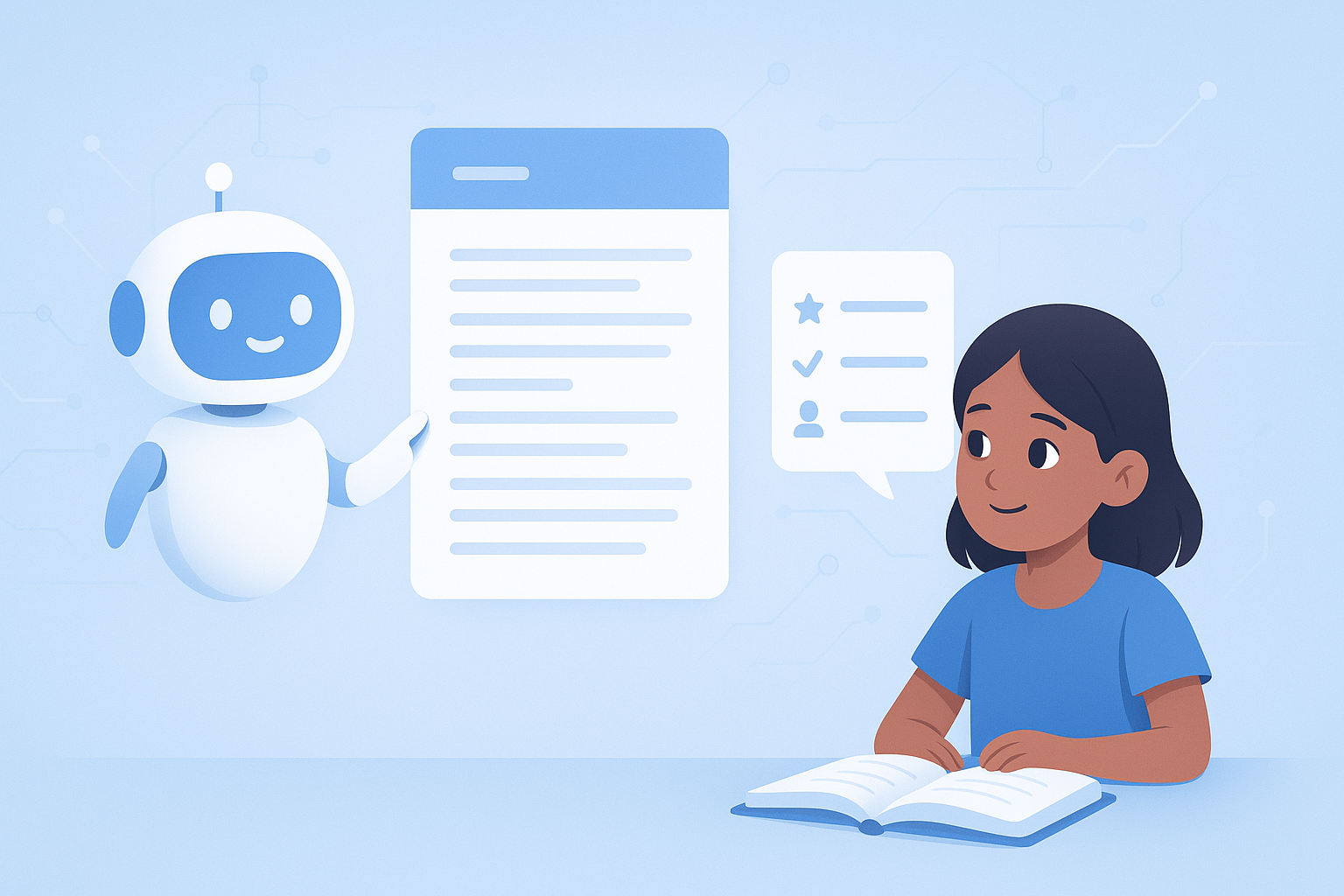
Suggested Image: Modern illustration of a child reading a simplified summary beside a robot assistant
What is an AI summarizer for 2nd grade reading level?
An AI summarizer for 2nd grade reading level is a tool that shortens text and rewrites it using simpler words, shorter sentences, and easy-to-follow ideas. The aim is to make reading more accessible for young learners who are still building vocabulary and comprehension skills.
A standard summary tool may only make text shorter. A child-friendly summary tool goes further by trying to:
- Reduce difficult vocabulary
- Use short, direct sentences
- Keep one idea at a time
- Remove extra details
- Preserve the main meaning
This can be useful when simplifying short stories, science passages, homework instructions, or classroom handouts. If you also work with study materials in document form, a related PDF summarizer tool can help when the original content comes from worksheets or longer PDFs.
Why students, parents, and teachers use an AI summarizer
The biggest reason is simple: many learning materials are written above a young child’s reading level. An AI summarizer helps bridge that gap so a student can focus on understanding the lesson instead of struggling through every line.
Here’s how different people use it:
For students
Students can use simplified summaries to understand reading assignments faster. This is especially helpful when the original text feels too dense or unfamiliar.
For parents
Parents often need a quick way to explain school content at home. A simplified summary gives them a starting point for reading together and discussing the topic in plain language.
For teachers
Teachers may need different reading versions of the same content. A summary at a 2nd grade level can support differentiated instruction, intervention work, and reading practice.
When lessons include concepts that need quick rewriting or paraphrasing, tools like an AI paraphraser can also help reshape sentences before final review.
| User | How the tool helps |
|---|---|
| Student | Makes reading easier to understand and less overwhelming |
| Parent | Helps explain homework in simple language |
| Teacher | Supports differentiated reading materials and classroom accessibility |
How an AI summarizer simplifies text for young readers
An AI summarizer usually analyzes the original text, identifies the main points, removes less important details, and rewrites the result in a simpler form. For 2nd grade reading level output, the wording matters as much as the length.
Here’s what good simplification usually looks like:
- Complex words are replaced with familiar words
- Long sentences are split into short ones
- Abstract ideas are explained in concrete terms
- Extra examples are removed unless they help understanding
- The summary follows a clear beginning, middle, and end
For example, this original sentence:
The water cycle is a continuous process in which water evaporates, condenses, and returns to Earth as precipitation.
Might become:
Water moves in a circle. It goes up into the air. Then it comes back down as rain or snow.
That second version is not just shorter. It is easier for a young reader to picture and understand.
If you’re comparing different text versions side by side, an word counter can help you quickly measure how much the summary has been reduced.
What makes a summary truly appropriate for 2nd grade?
A 2nd grade summary should be easy to read aloud, easy to follow, and easy to explain. Shorter does not always mean better. The key is whether a child can understand the meaning without getting stuck on the language.
Good 2nd grade summaries usually have these traits:
- Sentences are short, often under 10 to 12 words
- Words are familiar and concrete
- The main idea appears early
- There are very few side details
- Ideas follow a simple order
- Pronouns are clear so children know who or what is being discussed
This is where many people struggle. They simplify vocabulary but keep the same complicated structure. That often still feels hard to a young reader.
Reading expectations for early elementary students vary, but trusted sources such as the National Center for Education Statistics and classroom literacy guidance from organizations like the Reading Rockets literacy resource make one thing clear: comprehension matters more than just decoding words.
When using an AI summarizer is a smart idea
An AI summarizer works best when you need a fast first draft of simpler reading material. It can save time, especially when the original text is too advanced for the child reading it.
It’s a smart choice when you need to:
- Simplify nonfiction reading passages
- Shorten homework instructions
- Adjust articles for reading practice
- Create parent-friendly versions of classroom content
- Support students learning English
- Prepare quick review sheets before a lesson
Now comes the important part. The tool should help with the first draft, not replace human judgment. Children at this age need clarity, accuracy, and age-appropriate wording. AI can help create the base, but an adult should still review the result.
If you’re working from online articles, a broader AI summarizer tool may help extract the main ideas before you simplify them further for younger readers.
When an AI summarizer may not be enough
Some texts are too nuanced, too emotional, or too technical to trust entirely to automation. In those cases, a human review is essential. That’s especially true for health, safety, and sensitive school topics.
Be careful when summarizing:
- Medical or mental health information
- Legal or school policy documents
- Stories where tone and emotion matter a lot
- Historical topics with important context
- Science topics where exact accuracy is critical
For educational accuracy, trusted sources such as the U.S. Department of Education and Common Sense Education offer useful guidance on responsible classroom technology use and digital learning support.
How to get better summaries from an AI summarizer
The quality of the result often depends on the instructions you give. If you only ask for a summary, you may get a short paragraph that is still too hard for a 2nd grader. Better prompts usually create much better output.
Here’s what experienced professionals do differently. They tell the tool exactly how simple the text should be.
Helpful prompt elements
- Ask for a 2nd grade reading level
- Request short sentences
- Ask for simple words
- Limit the summary to key facts only
- Tell the tool to avoid jargon
- Ask for a child-friendly tone
Example prompt
Summarize this passage for a 2nd grade student. Use short sentences, simple words, and only the most important ideas. Make it easy to read aloud.
If your first version still feels too hard, you can rewrite it again. That’s where a related text simplifier tool may help reduce complexity even further.
Step by step: how to simplify a passage for 2nd graders
A clear process gives better results than guessing. If you follow a few simple steps, you’ll usually end up with a summary that is both easier and more accurate.
- Start with the original text. Choose the exact paragraph, article, or instructions you want to simplify.
- Find the main idea. Ask what the child truly needs to know.
- Use the AI summarizer. Request a short summary written for a 2nd grade reading level.
- Check the vocabulary. Replace words a child may not know.
- Shorten the sentences. Break long lines into smaller ones.
- Read it out loud. If it sounds awkward, simplify again.
- Test comprehension. Ask the child to explain it back in their own words.
This small detail changes everything: reading aloud is one of the fastest ways to spot summaries that still sound too advanced.
Suggested Infographic: 7-step workflow for turning difficult text into a 2nd grade summary
Example: original text vs 2nd grade summary
Examples make this easier to judge. A good summary should keep the core meaning while making the language much more approachable.
| Original text | 2nd grade summary |
|---|---|
| Plants need sunlight, water, and nutrients from the soil to grow properly. | Plants need sun, water, and good soil to grow. |
| Communities work best when people cooperate and help one another. | A town is better when people help each other. |
| Recycling reduces waste and helps protect natural resources. | Recycling means using things again. It helps the Earth. |
If you are preparing school writing or simplified responses from scratch, an AI writer can help draft a basic version before you refine it for child readability.
Best practices for students, parents, and teachers
The best summaries are not only simple. They are also accurate, useful, and matched to the child’s needs. A little review makes a big difference.
For students
- Use summaries to understand the topic first
- Go back to the original text if your teacher asks for details
- Highlight words you still do not know
For parents
- Read the summary together
- Ask simple follow-up questions
- Connect ideas to everyday life
For teachers
- Review AI output before sharing it
- Adjust reading levels for different students
- Keep original meaning and key vocabulary where needed
- Use simplified summaries as support, not replacement
For accessibility and readable digital content, practical writing guidance from the Plain Language Guidelines and web readability standards from the W3C Web Accessibility Initiative can be surprisingly useful, even in education settings.
Common mistakes to avoid
Many summaries fail for one reason: they are shorter, but not actually simpler. Young readers need clarity, not just fewer words.
- Keeping difficult vocabulary: Short text with hard words is still hard.
- Using long sentences: Children can lose the main idea halfway through.
- Removing too much meaning: A summary should stay accurate.
- Skipping review: AI output can sound simple while still being confusing.
- Using it as the only learning tool: Discussion and explanation still matter.
If you want to check whether a sentence feels too dense, a simple readability workflow with a sentence counter can help you spot long passages that need breaking up.
How to check if the summary is really easy enough
The best test is not the tool. It’s the child reading it. If they can read the summary, explain it, and answer a simple question about it, the level is probably close to right.
Use this quick checklist:
- Can a child read most words without stopping?
- Is each sentence brief and direct?
- Does the summary stay on one main idea at a time?
- Can the child tell you what it means?
- Are there any words that need replacing?
You can also compare the original and summary length using a character counter if you want a quick, simple way to measure how much the text was reduced.
AI summarizer vs paraphrasing vs simplification
These terms often get mixed up, but they do different jobs. Knowing the difference helps you choose the right tool for the task.
| Tool type | Main purpose | Best use case |
|---|---|---|
| AI summarizer | Shortens content to the main ideas | Turning long passages into short review text |
| Paraphraser | Rewords ideas without necessarily shortening them | Rewriting a sentence in a different way |
| Text simplifier | Makes language easier to read | Adapting material for younger readers |
The answer depends on one thing: do you need shorter text, easier text, or both? For 2nd grade use, the best result often combines summarizing and simplification.
Frequently asked questions
Is an AI summarizer accurate enough for school use?
It can be helpful for school use, but it should not be trusted without review. AI summarizers often capture the main idea well, yet they may leave out context or oversimplify important details. For younger students, an adult should read the summary, check the facts, and make sure the wording fits the child’s reading level and the teacher’s expectations.
Can a 2nd grader use an AI summarizer alone?
Some children may be able to use it with basic guidance, but most will benefit from adult help. A parent or teacher can choose the right text, review the summary, and explain any words that remain difficult. The tool works best as support, not as a fully independent reading solution for young children.
What kind of text can be simplified with an AI summarizer?
You can simplify many types of content, including short stories, nonfiction passages, homework directions, science explanations, and social studies reading. It also helps with classroom notes and parent handouts. Still, texts with complex emotions, sensitive topics, or highly technical facts should always be checked carefully by an adult before use.
Does shorter always mean better for 2nd grade reading?
No. A very short summary can still be too hard if it uses unfamiliar words or confusing sentence structure. What matters most is whether the child understands the meaning. A slightly longer summary with simple words and clear ideas is often more helpful than a very brief one packed with difficult language.
How do I know if the reading level is right?
The most practical test is comprehension. Ask the child to read the summary and explain it back in their own words. If they can do that with little help, the level is probably close to right. If they stumble on many words or seem confused about the meaning, simplify again and shorten the sentences further.
Are AI summarizer tools free?
Some are free, some have limits, and some offer paid features. Free tools are often enough for quick classroom or homework use, especially for short passages. Before relying on one tool regularly, check how much text it allows, whether it handles pasted content well, and whether you can guide the output toward a younger reading level.
Is it safe to paste school text into an AI summarizer?
Usually, short public or general learning content is fine, but you should be careful with private student information, graded documents, or sensitive records. Avoid pasting personal details or confidential school data into online tools. Review the site’s privacy practices when needed, especially in classroom or school-supported settings.
What should I do if the summary is still too hard?
Start by replacing difficult words, breaking long sentences into shorter ones, and removing extra details. Then read the text aloud. If it still sounds advanced, ask the tool to rewrite it again using simpler vocabulary and a younger reading level. In many cases, two rounds of simplification work better than one.
Final thoughts on using an AI summarizer for 2nd grade reading level
An AI summarizer can be a practical way to turn difficult reading into something a young student can actually understand. The best results come when you treat the tool as a helper, not the final judge. Shorter text is useful, but clear meaning is what really matters.
If you’re simplifying school content, start with the main idea, ask for short child-friendly sentences, and always review the final version out loud. That one habit catches most problems quickly.
For the next step, you may also find these tools useful: AI summarizer for 2nd grader, PDF summarizer tool, text simplifier tool, and AI paraphraser. Used together, they can make reading support faster, clearer, and easier to adapt for young learners.