
Staring at a blank essay document can make even a strong student freeze. You know the topic. You may even understand the reading. But turning ideas into a clear academic structure is where many people get stuck.
An AI academic essay builder can help at that exact stage. It can suggest outlines, organize arguments, improve wording, and speed up drafting. Used well, it saves time and reduces stress. Used poorly, it can weaken your thinking, create factual errors, or cross academic integrity lines.
This guide explains how an AI academic essay builder works, when it helps most, where it falls short, and how students can use it responsibly in 2026. You’ll also learn practical workflows, common mistakes, and better ways to combine AI support with your own judgment.
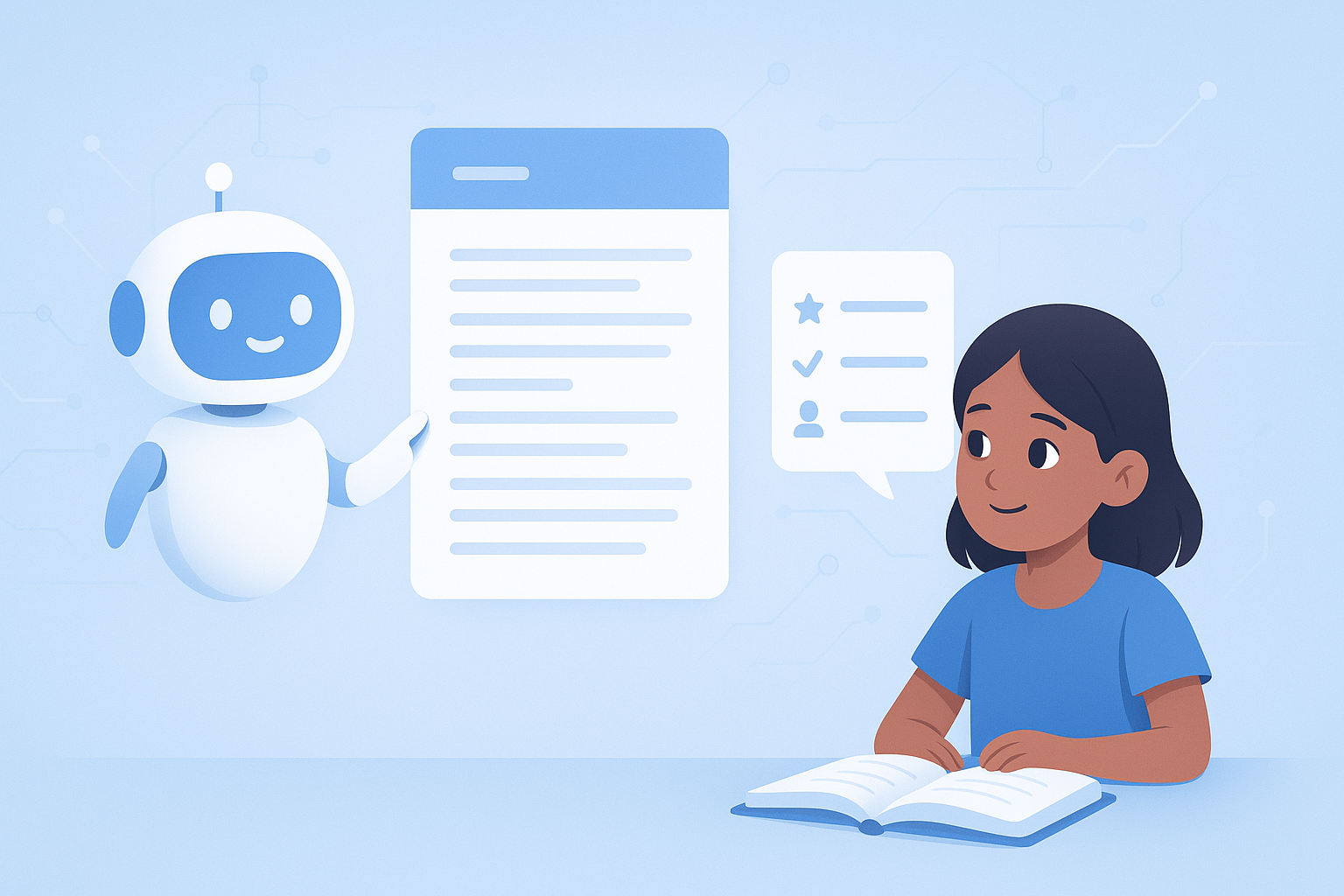
Suggested Image: Modern illustration of a student using an AI writing assistant to plan an essay
What is an AI academic essay builder?
An AI academic essay builder is a writing tool that helps users generate parts of an academic paper, usually from a prompt, topic, thesis, or assignment instructions. It does not replace subject knowledge. At its best, it acts like a fast drafting assistant that helps structure ideas and improve clarity.
Most tools can help with:
- Essay topic brainstorming
- Thesis statement suggestions
- Outline creation
- Intro and body paragraph drafting
- Transitions and paragraph flow
- Rewriting for clarity and tone
- Summaries and conclusions
Some tools are basic and only generate text. Others support editing, citation formats, grammar review, and formatting help. If you’re still shaping your ideas, tools that improve planning can be more useful than tools that simply produce long paragraphs. For example, students organizing research notes may also benefit from a simple word counter to stay within assignment limits while drafting.
How does an AI academic essay builder work?
Most essay builders use large language models trained on vast collections of text. They predict useful next words based on your prompt, then shape them into academic-style responses. That sounds simple, but the quality depends heavily on the input you give and the review you do afterward.
Here’s the usual process:
- You enter a prompt, such as a topic, question, or assignment brief.
- The tool identifies the likely task, such as persuasive, analytical, compare-and-contrast, or reflective writing.
- It generates a structure, often including a title, thesis, outline, and paragraph ideas.
- It expands sections into full sentences and paragraphs.
- You revise the output for accuracy, originality, tone, and compliance with your course rules.
This is why prompt quality matters. A vague request like “write my essay on climate change” often leads to generic output. A stronger prompt includes:
- The academic level
- The subject area
- The essay type
- The length
- The required sources or citation style
- Your position or main argument
Students preparing references or structured submissions sometimes need to convert drafts into shareable formats. In those cases, a PDF to Word tool can help with editing source files more easily before final formatting.
What can an AI academic essay builder do well?
An AI academic essay builder is strongest when the task involves structure, momentum, and language support. It is much less reliable when the assignment requires deep interpretation, field-specific accuracy, or original analysis based on course materials.
Where it helps most
- Breaking writer’s block: It gives you a starting point when the blank page is the real problem.
- Building outlines: It can turn scattered notes into a logical sequence.
- Improving readability: It often rewrites clumsy sentences into clearer academic prose.
- Creating first drafts: It speeds up low-stakes drafting, especially for early versions.
- Generating counterarguments: It can suggest opposing views you may have missed.
- Condensing long ideas: It helps tighten verbose sections.
Where it often struggles
- Misunderstanding the actual assignment question
- Inventing facts, quotes, or citations
- Oversimplifying complex theories
- Sounding polished but saying very little
- Repeating broad ideas without evidence
- Missing your teacher’s required formatting or rubric details
That’s why smart students don’t ask AI to “finish the essay.” They use it to speed up parts of the process they already understand.
| Task | AI Performance | Human Review Needed |
|---|---|---|
| Essay outline | Usually strong | Check logic and relevance |
| Thesis statement draft | Moderate to strong | Refine specificity and argument quality |
| Subject accuracy | Unreliable | Verify every factual claim |
| Citation generation | Inconsistent | Always check manually |
| Grammar improvement | Usually strong | Review tone and meaning |
Benefits for students and writers
The biggest advantage of an AI academic essay builder is not that it writes for you. It helps you move faster through repetitive steps so you can spend more time on reasoning, evidence, and revision.
Here are the benefits that matter most in practice:
- Faster planning: Students can move from topic to outline in minutes.
- Lower anxiety: A rough starting point often reduces procrastination.
- Better structure: Many essays improve simply because the argument becomes easier to follow.
- Language support: Non-native English speakers often use AI to improve clarity and grammar.
- Revision support: AI can suggest stronger transitions, topic sentences, and simplified phrasing.
- Study support: It can help summarize readings before writing begins.
This is especially useful when deadlines stack up. A student working on an essay, a presentation, and a report in the same week may use multiple support tools together, such as a image to text tool for extracting notes from printed pages and lecture handouts before turning them into a usable outline.
What are the limitations and risks?
This is where many people get overconfident. AI-generated writing can look finished even when it contains weak logic, invented evidence, or shallow analysis. If you submit it without checking, the tool saves time at first but creates bigger problems later.
The main limitations include:
- Hallucinated facts: AI may confidently present false information.
- Fake references: Some tools invent books, article titles, authors, or page numbers.
- Generic arguments: The writing may sound formal but lack real insight.
- Weak course alignment: AI may ignore your rubric, textbook, or lecturer’s expectations.
- Academic integrity concerns: Some schools allow limited use, while others restrict it heavily.
- Privacy issues: Uploading full assignments or personal data can create unnecessary risk.
Before using any AI writing system, it’s smart to review your school’s policy on academic honesty. Guidance from institutions and standards bodies continues to evolve, so check your local rules rather than relying on assumptions. For broader context, UNESCO has published guidance on generative AI in education at UNESCO AI and education resources.
If you need to summarize your own draft for teacher review or presentation slides, a text summarizer can be more appropriate than asking AI to rewrite the whole assignment from scratch.
How to use an AI academic essay builder responsibly
The safest and most effective approach is to use AI for support, not substitution. Think of it as a planning and editing assistant. Your ideas, sources, interpretation, and final judgment still need to come from you.
Here’s a practical workflow that works well for students:
- Read the assignment carefully. Mark the command words such as analyze, compare, evaluate, or discuss.
- Gather your course materials first. Use lecture notes, textbook chapters, and approved sources before prompting AI.
- Ask AI for an outline, not a finished essay. This keeps you in control of the argument.
- Draft with your own evidence. Insert examples, quotations, and references from real sources.
- Use AI for revision. Ask it to improve clarity, transitions, or paragraph flow.
- Fact-check everything. Verify claims against trusted sources.
- Review your school policy. If disclosure is required, follow it.
For citation and style questions, it helps to rely on official guidance rather than generated guesses. Students writing in APA can consult the official APA Style website. For MLA, the MLA Style Center is the better reference point.
A better prompt example
I am writing a 1,200-word argumentative university essay on whether social media improves student learning. Create a detailed outline with a thesis, 3 body sections, one counterargument, and suggested evidence types. Keep the tone academic and avoid inventing sources.
That prompt is focused, realistic, and gives the tool boundaries. You’re more likely to get usable output, and less likely to get generic filler.
Best use cases by assignment type
Not every essay benefits equally from AI. The more an assignment depends on personal interpretation, close reading, or original fieldwork, the more cautious you should be. Still, some tasks are a natural fit for AI-assisted planning and revision.
| Assignment Type | Good Use of AI | Use With Caution |
|---|---|---|
| Argumentative essay | Outline, thesis ideas, counterarguments | Evidence and final reasoning |
| Literature review | Theme grouping and structure | Source summaries and citations |
| Reflective essay | Organization and clarity | Authentic personal insight |
| Research paper | Section planning and editing | Methods, data, and citations |
| Compare and contrast essay | Frameworks and paragraph order | Nuanced interpretation |
Suggested Infographic: Best and worst use cases for AI in academic writing
AI essay builder vs human writing: what should you rely on?
The answer depends on one thing: whether the task requires original thinking or just assistance with structure. AI is strong at speed. Human writers are still better at judgment, depth, relevance, and authentic argument.
Here’s the simple comparison:
- Use AI for: outlines, rewrites, simplification, brainstorming, and editing support
- Rely on yourself for: thesis quality, source selection, evidence interpretation, and final conclusions
If you’re collecting ideas from many drafts or study notes, tools that reduce clutter can help. For example, a remove duplicate lines tool is useful when cleaning copied notes from research files before turning them into an outline.
For readability and professional polish, a good student workflow often looks like this:
- Write your own rough argument
- Use AI to improve order and wording
- Compare the revised version to your original meaning
- Restore any detail AI flattened or generalized
Common mistakes students make with AI-generated essays
Most problems do not come from using AI at all. They come from using it carelessly. Students often assume polished wording equals strong academic work. It doesn’t.
Watch out for these common mistakes:
- Submitting the first output: The first draft is rarely accurate enough.
- Ignoring professor instructions: AI may miss required concepts, readings, or formatting.
- Trusting citations blindly: Never submit references you haven’t checked.
- Using vague prompts: Broad prompts produce broad answers.
- Removing your voice completely: Essays sound lifeless when every sentence is machine-shaped.
- Failing plagiarism or originality checks: Even rewritten text can still create problems if ideas are borrowed without attribution.
This is where many people struggle. They ask AI to make writing “academic,” and the result becomes stiff, repetitive, and oddly impersonal. A better approach is to ask for shorter, clearer phrasing while keeping your original point intact.
If you’re editing scanned notes, assignment sheets, or printed journal excerpts, a JPG to Word converter can save time before you even begin using an AI academic essay builder.
How educators and institutions view AI writing tools
Schools are not treating AI the same way. Some instructors allow limited use for brainstorming and language support. Others prohibit generative writing entirely unless the use is disclosed. The safest assumption is this: if the rule is unclear, ask before using it.
Many institutions now focus less on whether AI exists and more on how it is used. That means:
- Was AI used for planning or full text generation?
- Did the student verify facts?
- Was the assignment intended to measure writing process or final output?
- Did the student follow disclosure rules?
Academic integrity policies often change faster than students expect. For general guidance on responsible use, the U.S. Department of Education and many university writing centers now publish updates on AI in teaching and assessment. If you are citing research sources, use trusted databases and library services rather than letting AI invent them.
Practical tips to get better output from an AI academic essay builder
A small detail changes everything: better prompts lead to better drafts. If your prompt is weak, the tool guesses. If your prompt is specific, the tool becomes far more useful.
Here’s what experienced users do differently:
- State the essay type clearly
- Give the academic level
- Include the required word count
- Name the subject and topic scope
- Specify the tone you want
- Ask for an outline before full paragraphs
- Tell it not to invent sources
- Request alternative thesis options
Prompt formulas that work
- For an outline: “Create a detailed outline for a 1,500-word compare-and-contrast essay on X and Y, including thesis options and counterpoints.”
- For revision: “Rewrite this paragraph for clarity and concision while keeping my argument and citation placeholders unchanged.”
- For feedback: “Evaluate whether this introduction clearly states a thesis and matches an analytical essay assignment.”
If your work includes charts, screenshots, or diagrams for presentations or online submission, a lightweight image compressor can reduce file size without making your visuals unusable.
Frequently asked questions
Is using an AI academic essay builder considered cheating?
It depends on your school, course, and instructor policy. Some allow AI for brainstorming, outlining, grammar help, or language support. Others ban generative writing entirely unless clearly disclosed. The safest approach is to check the assignment rules before using any AI tool. If there is no policy, ask your instructor directly. Never assume that common use means approved use.
Can an AI academic essay builder write a full essay?
Yes, many tools can generate a full draft, but that does not mean the result is submission-ready. Full AI drafts often contain generic reasoning, weak evidence, invented citations, and factual errors. They may also miss your rubric or class readings. A better use is to generate an outline or rough draft, then rewrite and strengthen it with your own sources, analysis, and revisions.
Are AI-generated citations reliable?
No, not without checking them. AI tools often produce citation errors, including fake article titles, incorrect publication years, missing page numbers, and broken formatting. Always verify every source in your library database, Google Scholar, or the original publisher site. Then format the citation using official style guidance such as APA or MLA resources.
What is the best way for students to use AI for essays?
The best method is to use AI in stages. Start with your assignment prompt and class materials. Ask AI for outline ideas, thesis options, or paragraph organization. Write the core argument yourself. Then use AI for sentence clarity, transitions, and trimming wordiness. This approach keeps your thinking at the center while still saving time on structure and editing.
Will AI-written essays be detected?
Possibly, but detection tools are not perfect. More importantly, teachers often notice other signals first, such as generic analysis, sudden changes in writing style, unsupported claims, or references that do not exist. The real risk is not just detection software. It is submitting work that does not reflect your knowledge, your class materials, or your usual writing quality.
Are free AI essay builders good enough for academic work?
Free tools can be helpful for brainstorming and drafting, but they often have limits on features, context length, source control, and editing quality. They may also provide less transparency around privacy. For serious academic use, what matters most is not whether the tool is free or paid. It is whether you verify the output carefully and use it within policy.
Can AI help non-native English speakers with essays?
Yes, and this is one of the most practical uses. AI can improve grammar, sentence flow, word choice, and readability. That said, it should support your ideas, not replace them. Ask it to simplify or clarify your own draft rather than generate a whole paper. This keeps your original meaning while reducing language friction.
What should I do after getting an AI-generated draft?
First, compare it to your assignment and rubric. Next, fact-check all claims and delete anything vague or unsupported. Replace generic examples with evidence from your actual sources. Rewrite parts that do not sound like you or that flatten your argument. Then proofread carefully for tone, citation accuracy, and logical flow. AI output is a starting point, not the final product.
Final thoughts on using an AI academic essay builder wisely
An AI academic essay builder can be genuinely useful for students who need help with planning, structure, and revision. It can save time, reduce writing friction, and make complex tasks feel more manageable. But it is not a shortcut to strong academic thinking.
The best results come when you use AI to support your process, not replace it. Build your own argument. Check every fact. Verify every citation. Follow your institution’s rules. That is how you get the benefit without the risk.
As a next step, try using AI only for outline creation on your next essay and compare the result with your usual workflow. If you want extra support beyond drafting, related tools like the paraphrasing tool, grammar checker, essay title generator, and PDF word counter can help you refine, format, and review your work more carefully.