
Most readers decide within seconds whether a blog post is worth their time. That means your opening paragraph has one job: pull them in fast. If it feels vague, bloated, or generic, they leave.
That’s why AI blog intros have become such a practical topic for marketers. Used well, AI can help you draft stronger openings, sharpen your angle, and overcome blank-page syndrome. Used badly, it creates the same lifeless introductions readers skip.
This guide shows how to write AI blog intros that sound human, support SEO, and lead naturally into the rest of your article. You’ll learn what makes an opening work, where AI helps, where it fails, and how to turn rough outputs into paragraphs people actually want to read.
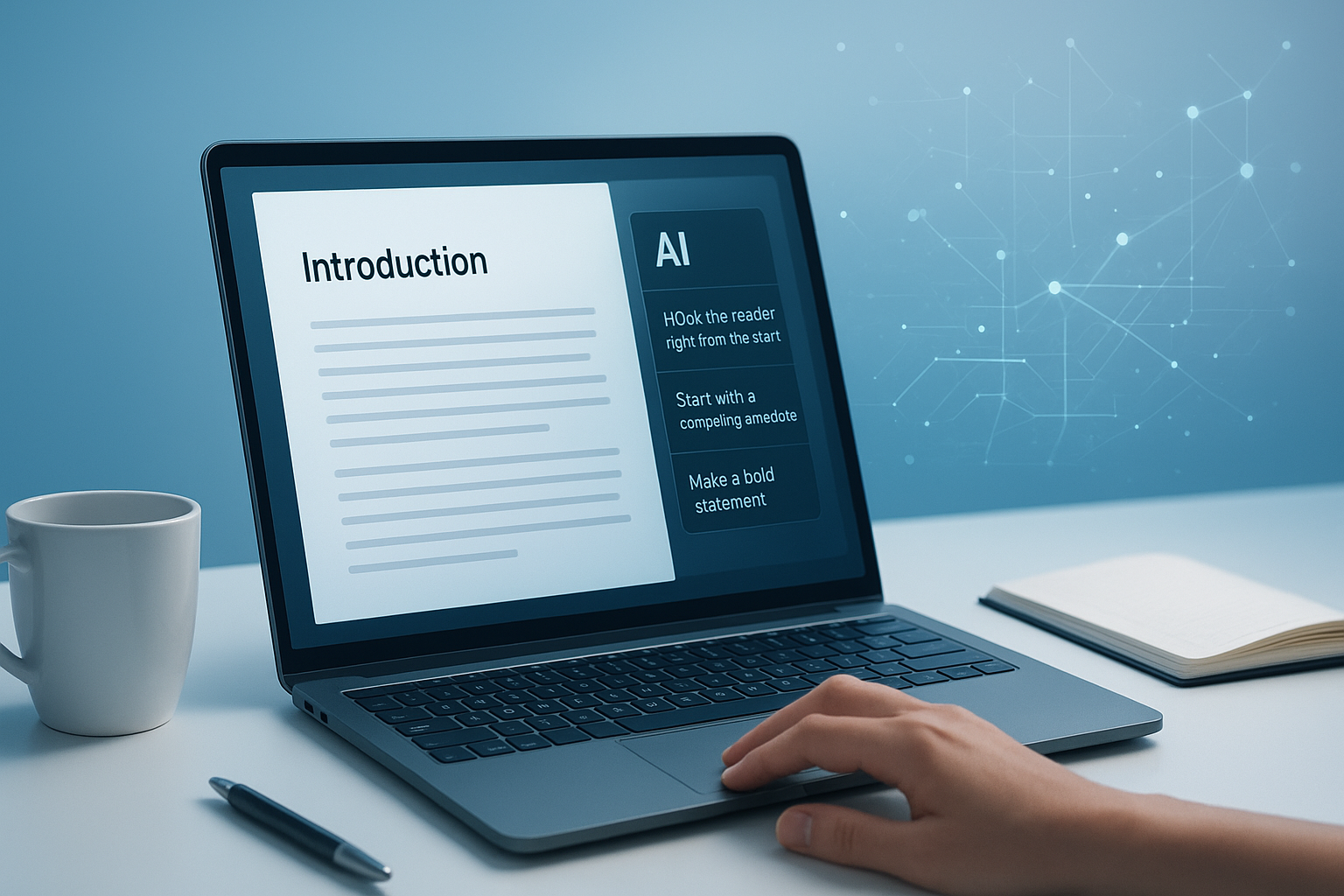
Suggested Image: Technology concept showing AI-assisted writing workflow for blog introductions
What are AI blog intros?
AI blog intros are opening paragraphs drafted, shaped, or improved with the help of artificial intelligence tools. Their purpose is simple: help writers create a relevant, engaging start that gives readers a reason to continue.
In practice, AI can help with several parts of the intro-writing process:
- Generating first-draft opening lines
- Suggesting hooks based on audience intent
- Rewriting weak paragraphs for clarity
- Matching tone to a brand or publication style
- Condensing long openings into tighter intros
- Producing multiple intro variations for testing
The key point is this: AI should support your thinking, not replace it. If you want the full article to feel polished, your intro needs to connect with search intent, tone, and structure from the first sentence. That same principle also applies to article formatting and readability, which is why tools like the Word Counter and Case Converter can help tighten rough drafts before publishing.
Why opening paragraphs matter more than most marketers think
Your intro does more than welcome readers. It frames the topic, confirms relevance, and sets expectations. A strong opening improves engagement signals, while a weak one increases bounce risk and breaks trust before the article even begins.
Here’s why intros matter so much:
- They confirm search relevance. Readers want immediate proof they landed on the right page.
- They set the reading experience. A clear intro signals a clear article.
- They influence scrolling behavior. If the opening is flat, users may never reach your core insights.
- They support SEO indirectly. Better engagement can strengthen content performance over time.
- They shape brand perception. Good intros sound intentional, not mass-produced.
Google’s own guidance emphasizes creating helpful, people-first content rather than pages built mainly to game rankings. You can review that principle in Google’s helpful content guidance. That is especially relevant for AI blog intros, because introductions are often the first place generic, low-value AI writing shows up.
What makes an intro actually work?
A good opening paragraph does three things quickly: it grabs attention, proves relevance, and creates a reason to keep reading. That sounds simple, but this is where many marketers struggle.
The strongest intros usually include these elements:
- A focused hook that speaks to a real problem, question, or pain point
- Clear topic alignment so the reader instantly knows what the article is about
- Audience fit based on the reader’s role, awareness level, and goals
- Forward momentum that makes the next paragraph feel worth reading
The 5-part formula for stronger AI blog intros
If you want a reliable structure, use this simple framework. It helps AI produce better outputs and gives you a clean editing checklist afterward.
- Lead with a specific problem. Name the frustration, friction, or missed opportunity.
- Show why it matters. Connect the problem to traffic, engagement, conversions, or reader trust.
- Introduce the topic clearly. Mention the article’s subject in plain language.
- Promise practical value. Tell readers what they’ll learn or fix.
- Create a natural bridge. Make the next section feel like the obvious next step.
For example, compare these two approaches:
| Weak intro style | Effective intro style |
|---|---|
| Starts broad and generic | Starts with a concrete reader problem |
| Talks about AI in vague terms | Explains exactly how AI helps intro writing |
| Uses filler before the main point | Gets to the point within the first few lines |
| Feels interchangeable with any article | Feels tailored to a specific audience and topic |
If you’re refining article structure beyond the intro, the SEO and digital marketing category can help you build stronger supporting content around your opening.
Where AI helps, and where it usually fails
AI is excellent at speed, variation, and pattern recognition. It is weaker at judgment, originality, and emotional precision. Once you understand that split, AI becomes much more useful.
Here’s where AI usually helps:
- Creating multiple intro options fast
- Breaking writer’s block
- Reframing a topic for different audience segments
- Adjusting tone from formal to conversational
- Summarizing article content into a concise opening
Now comes the important part. Here’s where AI often fails:
- Using empty phrases that say little
- Writing introductions that sound polished but forgettable
- Repeating the same hook patterns across topics
- Misreading search intent
- Overpromising what the article doesn’t deliver
- Sounding too broad for niche B2B or expert audiences
That’s one reason quality review matters. Google explains that transparency, originality, and clear value are central to high-quality content in its self-assessment questions for content creators. If your intro could fit a hundred unrelated blog posts, it needs more work.
How to prompt AI for better blog intros
The quality of an AI intro depends heavily on what you ask for. Weak prompts produce bland openings. Strong prompts give the tool enough context to create something useful.
Here’s what experienced professionals include in an intro prompt:
- Target audience
- Primary keyword
- Search intent
- Article title or working topic
- Desired tone
- What the reader is struggling with
- What the article will help them do
- What to avoid, such as clichés or generic openings
A practical AI intro prompt template
Use a prompt like this:
Write 3 opening paragraph options for a blog post titled “AI Blog Intros: How to Write Better Opening Paragraphs.” The audience is marketers. Search intent is informational. Use a conversational but authoritative tone. Start with a specific reader problem or frustration. Mention AI blog intros naturally. Keep each intro under 120 words. Avoid clichés, broad statements, and generic phrases. Make readers want to continue.
You can then refine the output further:
- Ask for a sharper hook
- Request a more specific audience angle
- Shorten by 20%
- Remove repetitive phrasing
- Sound less formal
- Make the benefit more concrete
Writers who want tighter control often clean up AI-generated copy using utility tools first. For example, the Remove Duplicate Lines tool can help spot repeated AI phrasing, while the Text to Slug tool is useful once your title and intro direction are finalized.
How to edit AI blog intros so they sound human
Editing is where average AI content becomes publishable. The first draft is rarely the final draft. Your job is to add specificity, rhythm, and real reader awareness.
Use this editing checklist:
- Cut the first sentence if it’s generic. AI often warms up before saying anything useful.
- Add a real-world problem. Make the opening feel grounded in actual reader experience.
- Replace abstract verbs. Choose words that show action and consequence.
- Remove filler. If a phrase doesn’t earn its place, delete it.
- Check the transition into the article. The intro should open the door to the next section naturally.
- Read it aloud. If it sounds stiff, it reads stiff.
This small detail changes everything: human intros often include tension. They don’t just describe a topic. They highlight a gap, a mistake, or a missed result.
Before-and-after editing example
AI draft: AI has changed the way marketers create content. Writing introductions can be challenging, but AI tools can make the process easier and faster for many users.
Edited version: Writing the first paragraph is where many blog posts lose momentum. Marketers know the topic, but the opening still comes out flat. That’s where AI can help, not by replacing your voice, but by giving you a faster path to a sharper, more engaging intro.
The second version works better because it is more specific, more readable, and more connected to the reader’s problem.
If you’re polishing publish-ready copy, even small presentation details matter. Tools like the HTML Formatter can help clean article markup before posting, especially when formatting longer content in WordPress.
Best intro angles for different marketing goals
Not every article should begin the same way. The best intro angle depends on what the page is trying to achieve and what the reader needs in that moment.
Here are several intro styles that work well for marketers:
1. Problem-first intro
Best for SEO blog posts, how-to guides, and solution-led content. Start with a visible pain point the audience already recognizes.
2. Mistake-first intro
Best for educational content. Call out a common error that hurts results, then show how the article corrects it.
3. Question-led intro
Best when the search intent is highly curiosity-driven. This works well if the question is specific and not overused.
4. Scenario-based intro
Best for making abstract topics feel real. Describe a believable work situation the audience faces.
5. Contrarian intro
Best when you have evidence or practical experience to back it up. Challenge a bad assumption, then explain the better approach.
| Intro angle | Best use case | Main strength |
|---|---|---|
| Problem-first | How-to and SEO guides | Immediate relevance |
| Mistake-first | Educational and advisory content | Creates curiosity through tension |
| Question-led | Awareness-stage content | Strong reader engagement |
| Scenario-based | B2B and practical workflows | Feels concrete and relatable |
| Contrarian | Thought leadership and opinion-backed analysis | Grabs attention fast |
Suggested Infographic: Intro style chooser based on search intent and content goal
Common mistakes that make AI-generated intros weak
Most poor AI blog intros fail for predictable reasons. The wording may sound fluent, but the paragraph still feels empty because it misses relevance, detail, or purpose.
Watch for these issues:
- Starting too broad. If the opening could fit any article, it will not hold attention.
- Overusing tired phrases. Readers tune out generic wording instantly.
- Keyword loading. Mentioning the primary keyword unnaturally makes the copy feel forced.
- Repeating the headline. The intro should expand on the title, not echo it.
- Ignoring audience maturity. Beginners and experienced marketers need different framing.
- Giving away everything too early. Good intros create momentum without summarizing the full article in one breath.
Readability also matters. Simple, skimmable writing tends to perform better online because it reduces friction. For web writing and accessibility basics, MDN’s accessibility guidance is a useful reference when shaping content that people can actually consume.
How AI blog intros support SEO without sounding forced
AI blog intros can support SEO when they align with intent, introduce the topic clearly, and improve engagement. They hurt SEO when they exist only to squeeze keywords into the opening paragraph.
Here’s the balance that works:
- Use the primary keyword naturally in the first 100 to 150 words when it fits
- Include related terms instead of repeating one phrase mechanically
- Match the promise of the title quickly
- Answer the reader’s likely first question early
- Make the rest of the article feel worth reading
This matters for AI-powered search as well. Systems that summarize content, such as Google AI Overviews and answer engines, benefit from clear structure and obvious topical relevance. Google explains how structured, understandable pages help its systems interpret content in the SEO Starter Guide.
If your workflow includes image-heavy blog publishing, page quality and performance also matter. Compressing visuals before upload with the Image Compressor can support a cleaner user experience, especially on mobile.
A simple workflow marketers can use in 2026
The best workflow is not “let AI write the intro and publish it.” It’s “use AI to accelerate thinking, then apply human judgment.” That process is faster and better.
- Define the article’s real angle. What specific problem is this post solving?
- Clarify the audience. New marketer, content lead, SEO manager, founder, or agency strategist?
- Identify intent. Are readers learning, comparing, evaluating, or fixing something?
- Prompt AI for 3 to 5 intro styles. Ask for different angles, not near-duplicates.
- Select the strongest hook. Choose relevance over cleverness.
- Edit for specificity. Add details tied to the reader’s actual situation.
- Check keyword placement. Keep it natural and early, not forced.
- Read the intro beside the next section. Make sure the transition works.
- Test performance over time. Watch engagement, scroll depth, and on-page behavior if available.
This workflow gets even easier if you create reusable editorial templates. For teams that work across multiple formats, the Markdown to HTML tool can be useful for moving structured drafts into publishing-ready markup.
Examples of stronger AI blog intros by use case
Examples make this easier to see. The wording will vary by brand, but the underlying logic stays consistent: clear problem, fast relevance, and a reason to keep reading.
Example 1: SEO how-to article
Ranking isn’t just about publishing useful content. If your opening paragraph feels generic, readers may bounce before they reach the value. AI blog intros can help you create a stronger start, but only if you guide the tool properly and edit the result with search intent in mind.
Example 2: Content marketing article
Many marketers don’t struggle with ideas. They struggle with beginnings. The topic is there, the outline is there, but the first paragraph still sounds flat. AI blog intros can speed up that early draft stage and help you shape openings that feel sharper, more relevant, and less painful to write.
Example 3: B2B thought-leadership article
Most AI-generated intros fail for one reason: they sound acceptable but say almost nothing. For B2B marketers, that’s a real problem. If the opening doesn’t signal expertise or insight right away, the article loses credibility before the argument even starts.
Suggested Screenshot: Side-by-side comparison of generic AI intro vs edited human-reviewed intro
Frequently asked questions
Can AI write blog intros that rank well in search?
Yes, but ranking depends on much more than the intro alone. AI can help produce relevant, keyword-aware opening paragraphs, yet the final quality still depends on search intent, article depth, originality, and user experience. A strong intro improves the page’s chances by confirming relevance quickly and encouraging readers to continue, but it must still sound natural and match the promise of the title.
How long should an AI-generated blog intro be?
For most blog posts, 80 to 150 words is a practical range. That gives you enough space to hook the reader, introduce the topic, and set expectations without slowing down the page. Some topics need a shorter opening, especially if the reader wants fast answers. The best length is the shortest one that creates clarity and momentum.
Should the primary keyword appear in the first paragraph?
Usually, yes, if it fits naturally. Including the primary keyword early helps search engines and readers confirm topical relevance. The mistake is forcing it in awkwardly or repeating it too often. A clean, readable opening matters more than exact-match placement. In most cases, one natural mention near the start is enough.
What is the biggest mistake marketers make with AI blog intros?
The biggest mistake is publishing the first output without editing it. AI often produces smooth but generic writing, especially in openings. Marketers assume that because the grammar is fine, the intro is strong. In reality, it may lack specificity, emotional pull, or audience fit. The best results come from shaping the prompt and then revising the draft carefully.
Are AI blog intros safe to use for brand content?
They can be, as long as there is human review. AI is useful for drafting and ideation, but it should not be trusted blindly with brand voice, accuracy, or positioning. Check intros for vague claims, repetitive phrasing, and statements that don’t match your article. For regulated industries or high-trust topics, editorial review is especially important.
How many intro variations should I generate with AI?
Three to five versions is usually enough. Fewer than that may limit your options, while too many can create unnecessary noise. Ask for meaningful variation, such as a problem-first intro, a question-led intro, and a scenario-based intro. Then choose the one that best fits the audience and article angle instead of mixing them all together.
Do AI-written intros hurt content authenticity?
Not necessarily. What hurts authenticity is generic, unedited writing that feels disconnected from real experience. If you use AI to speed up ideation and then add judgment, clarity, and audience insight, authenticity does not disappear. It improves because you spend less time staring at a blank page and more time refining the message.
What tools help improve intros after AI generates them?
Useful tools depend on your workflow. A word counter helps tighten bloated intros. A duplicate line remover can catch repeated phrasing in rough drafts. HTML formatting tools help prepare clean publishing output. If you’re adding images to support the article, compression tools can improve page performance. The best setup is one that helps you edit for clarity, not just speed.
Final thoughts on writing better AI blog intros
AI blog intros work best when you stop treating AI like an autopilot and start using it like a skilled assistant. It can speed up brainstorming, generate useful angles, and help you break through weak first drafts. But the opening paragraph still needs human judgment to feel sharp, relevant, and worth reading.
If you want better results, start with one real reader problem, give AI clear instructions, and edit every draft for specificity and flow. That approach improves the intro and often strengthens the entire article.
As a next step, refine your draft with the Word Counter, clean repeated phrasing with the Remove Duplicate Lines tool, prepare clean publishing markup with the HTML Formatter, and optimize visuals using the Image Compressor. Small improvements at each stage often lead to noticeably stronger content.