
What could a fixed monthly investment become after five, ten, or twenty years? That question is easier to answer when you can see the numbers before committing your money. A SIP calculator helps you estimate how regular mutual fund investments may grow, how much you could accumulate, and how much of the final value comes from your own contributions versus estimated returns.
Use the calculator to test different monthly amounts, investment periods, and expected return rates. This article explains how SIP calculations work, how to interpret the results, what the estimates leave out, and how to use them when creating a practical investment plan in 2026.
Suggested Image: Finance illustration showing monthly SIP contributions growing into a long-term investment portfolio.
What Is a SIP Calculator?
A SIP calculator is an online financial planning tool that estimates the future value of periodic mutual fund investments. You enter a monthly contribution, expected annual return, and investment duration. The calculator then shows your total investment, estimated gains, and potential maturity value.
SIP stands for Systematic Investment Plan. It is a method of investing a fixed amount into a mutual fund at regular intervals, usually once a month. The investment amount buys mutual fund units at the prevailing Net Asset Value, or NAV. Since the NAV changes over time, you may buy more units when prices are lower and fewer when prices are higher.
For a quick estimate, enter your details into the SIP Calculator before comparing different investment scenarios.
How Does a SIP Calculator Work?
A SIP calculator uses a mathematical projection based on your contribution, estimated rate of return, and the number of investment periods. It assumes that returns compound over time, but it does not predict the actual performance of a mutual fund.
The commonly used future value formula for monthly SIP investments is:
FV = P × [((1 + r)n - 1) ÷ r] × (1 + r)
- FV: Estimated future value
- P: Monthly investment amount
- r: Monthly expected rate of return
- n: Total number of monthly investments
The additional multiplication by (1 + r) is generally used when the monthly contribution is assumed to be invested at the beginning of each period. Some calculators use an end-of-month convention, so small differences between tools are possible.
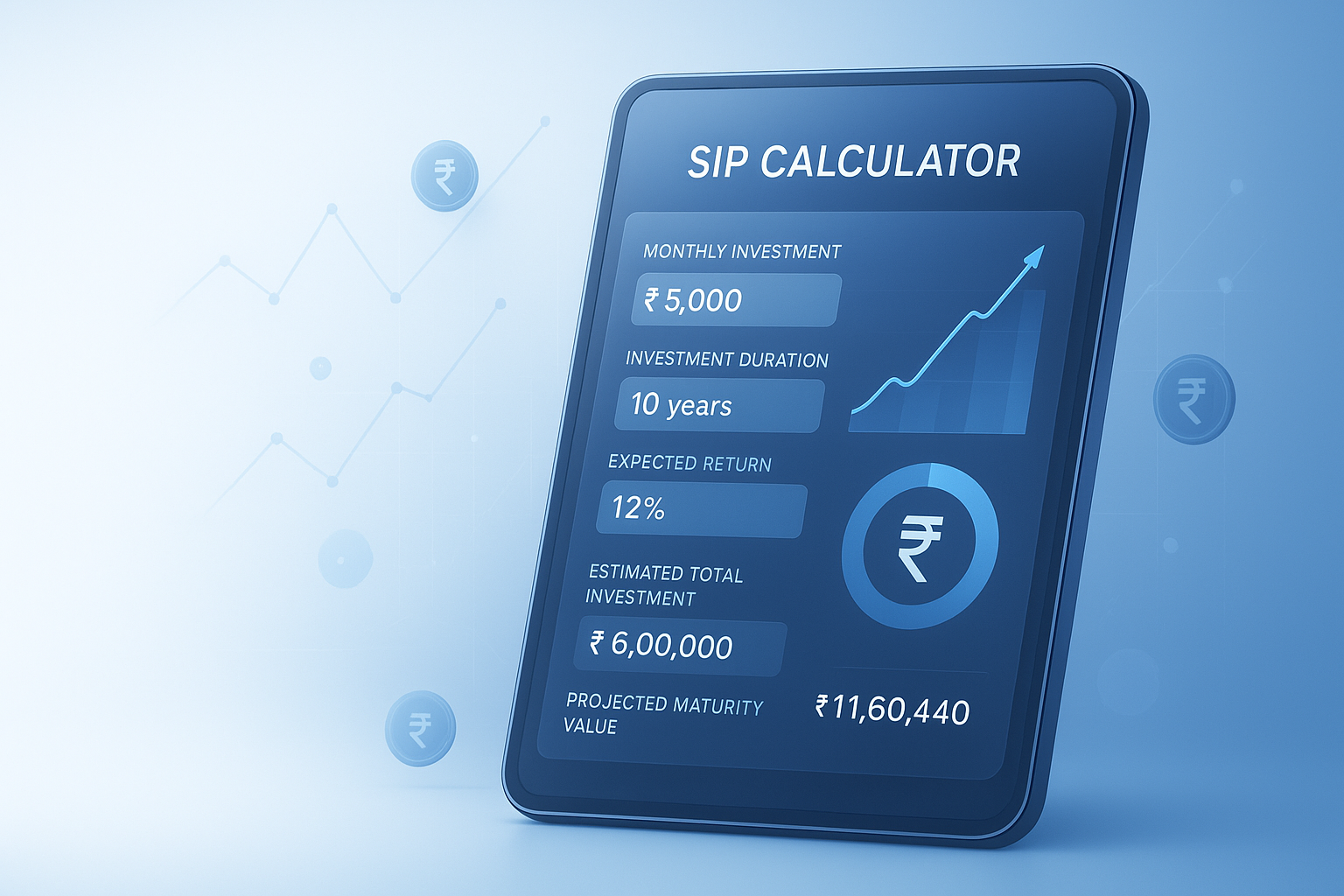
For example, suppose you invest ₹5,000 per month for 10 years and use an assumed annual return of 12 percent:
| Input or result | Approximate value |
|---|---|
| Monthly investment | ₹5,000 |
| Investment period | 10 years |
| Total amount invested | ₹6,00,000 |
| Estimated final value at 12 percent | About ₹11.6 lakh |
| Estimated gain | About ₹5.6 lakh |
This is an illustration, not a promise. Actual returns will depend on the fund, market conditions, expenses, taxes, timing, and the length of time you remain invested.
What Information Do You Need to Use a SIP Calculator?
You only need a few inputs, but each one affects the projection significantly. Use realistic numbers rather than choosing assumptions that make the final corpus look attractive.
- Monthly SIP amount: The amount you plan to invest regularly.
- Expected annual return: An estimated average return, not a guaranteed result.
- Investment duration: The number of years or months you expect to continue investing.
- Step-up percentage, if available: The annual increase in your monthly contribution.
- Investment frequency: Some tools support monthly, quarterly, or other intervals.
Your monthly contribution should fit comfortably within your budget. A projection is useful only when you can continue the investment through market declines and changing personal circumstances. Use the Budget Planner to check how much room remains after essential expenses, debt payments, insurance, and emergency savings.
Why Do Investors Use SIPs?
SIPs are popular because they turn investing into a repeatable habit. Instead of waiting for the “perfect” market entry point, you invest a set amount at regular intervals. That approach can reduce the pressure of making one large investment decision.
- Regular investing: Automated contributions encourage consistency.
- Flexible starting point: You can begin with an amount that suits your cash flow.
- Compounding potential: Returns may generate further returns when money remains invested.
- Rupee-cost averaging: Fixed contributions purchase more units at lower NAVs and fewer at higher NAVs.
- Long-term suitability: SIPs can support goals such as education, a home down payment, or retirement.
Systematic investing does not remove market risk. It also does not guarantee a profit or prevent losses. The Association of Mutual Funds in India’s SIP guidance explains the basic structure and considerations for investors.
SIP Calculator Versus Lump-Sum Calculator
The main difference is the timing of the investment. A SIP calculator estimates the growth of repeated contributions, while a lump-sum calculation starts with one amount invested at the beginning.
| Factor | SIP investment | Lump-sum investment |
|---|---|---|
| Investment pattern | Multiple regular contributions | One initial contribution |
| Cash-flow requirement | Smaller recurring amount | Larger amount available upfront |
| Market timing exposure | Spread across several dates | More concentrated on the investment date |
| Useful for | Salary-based or regular income | Bonuses, inheritances, or existing savings |
Neither method is automatically better. The right choice depends on your cash flow, time horizon, risk tolerance, and financial goal. To see how regular contributions and compounding interact, compare the result with the Compound Interest Calculator.
How to Read the Results
A good SIP projection separates your own contributions from the estimated growth. Looking only at the final number can make the result seem more certain than it really is.
- Total investment: The sum of all monthly contributions.
- Estimated returns: The projected gain based on the assumed rate.
- Future value: Your contributions plus the estimated gain.
- Investment duration: The period over which compounding is assumed.
- Return rate: The assumption that has the greatest effect on the projection alongside time.
Run the calculation at several return rates. For example, compare 8 percent, 10 percent, and 12 percent instead of relying on a single figure. This creates a range of possible outcomes and helps you avoid planning around an overly optimistic estimate.
How Much Should You Invest in a SIP?
There is no universal monthly SIP amount. A sensible contribution is one that supports your goal without weakening your financial safety net. Begin with your take-home income, subtract unavoidable costs, and reserve money for short-term needs before deciding what can be invested.
- List essential monthly expenses and existing loan payments.
- Build or maintain an emergency fund appropriate to your circumstances.
- Account for insurance premiums, annual bills, and irregular expenses.
- Set aside money for near-term goals that should not depend on equity market returns.
- Invest the remaining amount according to your time horizon and risk capacity.
A retirement goal may justify a longer duration and annual SIP increases. A goal due in two or three years may require a more conservative approach rather than an aggressive equity-oriented assumption. The Savings and Retirement Planner can help connect a monthly contribution with a future retirement target.
What Is a Step-Up SIP?
A step-up SIP increases your monthly contribution periodically, often once a year. This can be useful when your income is expected to rise. Even a modest annual increase can make a substantial difference over a long investment period because additional contributions also have more time to compound.
For example, an investor might start with ₹5,000 per month and increase the contribution by 10 percent every year. The initial amount is manageable, while future investments grow with salary increases. A step-up calculation is more realistic for many working investors than assuming the monthly amount will remain unchanged for twenty years.
Check whether the calculator supports annual increases. If it does not, calculate several stages separately or use a spreadsheet. Do not increase your SIP automatically if doing so would leave you short of cash for essential obligations.
What a SIP Calculator Cannot Tell You
A calculator provides a projection, not a personalised investment recommendation. It cannot identify the right mutual fund, guarantee a return, or predict when markets will rise or fall.
It also may not account for every practical factor. Depending on the tool, the displayed result may exclude fund expense ratios, exit loads, taxes, inflation, missed instalments, and changes in contribution amounts.
- Returns are variable: Mutual fund performance changes with market conditions.
- Inflation reduces purchasing power: A future corpus may buy less than the same amount today.
- Taxes affect the net result: The amount you keep may differ from the displayed maturity value.
- Charges reduce growth: Fund expenses and transaction-related costs can affect outcomes.
- Behaviour matters: Stopping during a downturn can change the long-term result.
Before making a decision, read the scheme documents and understand the product’s risk level. The SEBI investor resources provide official information about investor awareness, mutual funds, and market-related precautions.
How Inflation Changes Your Target
Inflation is one of the most overlooked parts of long-term planning. If you need ₹50 lakh for a goal today, you may need considerably more in fifteen or twenty years to purchase the same goods and services.
Suppose inflation averages 6 percent. A goal costing ₹10 lakh today would require approximately ₹17.9 lakh after 10 years, before considering investment returns. This does not mean inflation will follow that exact path, but it shows why a target should be reviewed in future-value terms rather than copied from today’s prices.
When planning a goal, estimate its future cost first. Then use the SIP calculator to test the monthly amount required under different return assumptions. For tax-related planning, cross-check your assumptions with the official Income Tax Department resources because tax rules and personal circumstances can change.
Common SIP Calculation Mistakes
The calculator is simple to use, but the assumptions often create misleading results. These are the mistakes worth checking before you rely on a projection.
Using an unrealistically high return
A higher assumed return makes the final corpus look better, but it also increases the risk of falling short. Use a range of reasonable assumptions and treat the result as an estimate.
Ignoring the investment period
Compounding needs time. Increasing the monthly amount may help, but extending the period can also have a powerful effect because earlier contributions remain invested for longer.
Planning without inflation
A nominal target can appear sufficient while losing purchasing power. Convert today’s goal into an estimated future amount before calculating the SIP.
Stopping investments during market declines
Market falls are uncomfortable, but selling or pausing without reviewing the original goal can damage a long-term plan. Review the fund and your risk capacity instead of reacting only to recent performance.
Confusing SIP with a guaranteed deposit
A mutual fund SIP is market-linked. It is not the same as a fixed deposit or recurring deposit, where the return structure and risk characteristics differ. Compare options with the FD and RD Calculator when deciding how to allocate money across different products.
How to Use a SIP Calculator Step by Step
Use the calculator as a planning worksheet rather than as a promise of future wealth. The following process produces a more useful estimate.
- Choose a specific financial goal and target date.
- Estimate what that goal may cost in the future after allowing for inflation.
- Enter a monthly amount that fits your current budget.
- Set a conservative expected return and run at least two additional scenarios.
- Compare a fixed SIP with a possible annual step-up.
- Check whether the investment duration matches the risk level of the selected fund category.
- Review the plan at least once a year or after a major income or expense change.
You can also use the Rule of 72 Calculator for a quick illustration of how long an assumed return might take to double money. It is a rough educational shortcut, not a substitute for detailed financial planning.
SIP Planning Best Practices
Good results usually come from consistency and suitable assumptions rather than from finding a perfect calculation. Keep the process simple enough to follow through different market conditions.
- Automate contributions close to your income date.
- Keep a separate emergency reserve so you are less likely to redeem investments unexpectedly.
- Increase contributions when your income rises, but avoid unaffordable commitments.
- Match the fund category to your goal’s time horizon and your ability to tolerate losses.
- Review costs, tax treatment, and the fund’s stated investment objective.
- Rebalance when your overall asset allocation moves far from your intended mix.
- Do not select a fund solely because it produced the highest recent return.
For general investor education, the U.S. Securities and Exchange Commission’s explanation of compound interest offers a clear description of how returns can build on earlier returns. The principles are educational, although local tax and investment rules may differ.
Frequently Asked Questions About SIP Calculators
Is a SIP calculator accurate?
A SIP calculator is mathematically accurate for the assumptions entered, but its future-value estimate is not guaranteed to match your actual investment result. The return rate is usually an assumed average, while mutual fund returns vary from month to month and year to year. Charges, taxes, inflation, missed payments, and changing contributions can also affect the final amount. Use the result to compare scenarios and plan contributions, not to promise a specific corpus.
What return rate should I enter in a SIP calculator?
Choose a reasonable long-term assumption and test a range rather than relying on one optimistic number. The appropriate figure depends on the fund category, investment period, market conditions, and your risk tolerance. A diversified equity investment may have a different expected range from a debt-oriented fund, but neither provides a guaranteed return. Reviewing results at low, moderate, and high assumptions gives you a more useful picture of potential outcomes.
Can I use a SIP calculator for mutual funds and stocks?
A SIP calculator is primarily designed for regular investments with an assumed average return, which makes it more suitable for mutual fund planning. It can illustrate a recurring investment in another asset, but individual stocks may experience much greater variation and do not necessarily fit a smooth compounding model. For direct stocks, use the calculation only as a rough contribution-and-growth illustration, not as a forecast of a particular company’s performance.
Does a SIP guarantee profit?
No. A SIP only describes the method and timing of investing. If the underlying mutual fund is market-linked, its value can rise or fall, and losses are possible. Regular investing may spread purchase dates, but it cannot eliminate market risk. Read the fund documents, understand the risk label, and choose an investment period that gives the selected asset category enough time to work through market fluctuations.
Is it better to invest a large amount or start a SIP?
The answer depends on your available money, goal, and comfort with market timing. A lump-sum investment puts the money to work immediately, while a SIP spreads contributions across time. A person with regular salary income may find a SIP easier to maintain. Someone with a large amount already available may consider a lump sum, a phased approach, or a combination. Compare both approaches using the same time horizon and return assumptions.
Can I withdraw a SIP investment whenever I want?
Many mutual fund schemes allow redemption, but the exact rules depend on the scheme. Some products may have an exit load for withdrawals within a specified period, and tax consequences may apply. Certain funds can also have lock-in periods. Check the scheme information before investing and avoid using long-term market investments for expenses that are likely to arise soon. Liquidity should be considered alongside the projected return.
How often should I review my SIP plan?
An annual review is usually enough for a long-term goal unless your income, expenses, risk tolerance, or target date changes significantly. Review whether the monthly contribution remains affordable, whether inflation has changed the goal amount, and whether your asset allocation still suits the time horizon. Avoid changing investments solely because of a short-term market decline or a recent headline. A review should improve the plan, not encourage constant trading.
Final Takeaway
A SIP calculator helps turn a vague investment intention into a measurable plan. Enter a realistic monthly contribution, time period, and range of expected returns. Then account for inflation, taxes, costs, market risk, and your ability to continue investing.
The most useful next step is to calculate your target using conservative and moderate assumptions, check the monthly amount against your budget, and revisit the plan once a year. Related tools such as the Tax Calculator, Compound Interest Calculator, Savings and Retirement Planner, and Budget Planner can help you examine the wider financial picture before you begin.