
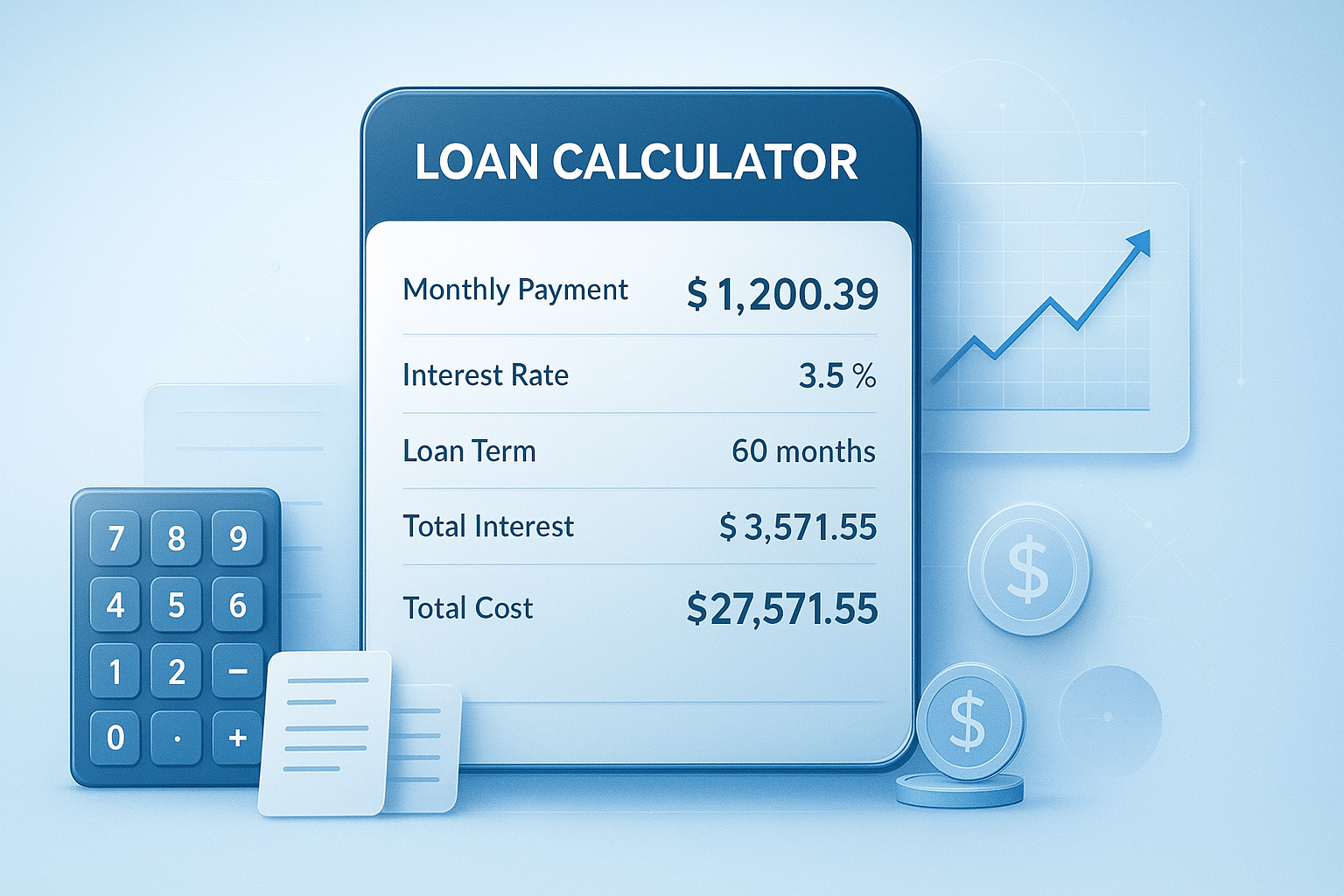
A loan can look affordable when you focus only on the monthly payment. The problem is that a lower payment may come from a longer repayment period, which can increase the total interest substantially. A loan calculator helps you see the full cost before you apply or sign an agreement.
Enter the amount you want to borrow, interest rate, and repayment term to estimate your monthly payment, total interest, and overall repayment cost. This guide explains how to use the calculator, how the results are determined, and how to compare borrowing options more responsibly in 2026.
Suggested Image: Finance illustration showing a borrower comparing loan amount, monthly payment, interest, and total repayment cost.
What does a loan calculator show?
A loan calculator estimates the regular payment and total cost of a fixed rate loan. It usually separates principal, which is the amount borrowed, from interest, which is the lender’s charge for providing the money. The estimate can help you compare terms before requesting an official quote.
Most calculators show three core results:
- Monthly payment: The amount scheduled for each regular payment.
- Total interest: The estimated interest paid over the full repayment period.
- Total repayment: The principal plus estimated interest across all payments.
Some loan products also include application fees, origination fees, late charges, insurance, taxes, or other costs. A basic calculator may not include these items, so treat its result as a planning estimate rather than a final loan offer.
For a payment breakdown by month, use the Loan Amortization Calculator. An amortization schedule shows how each payment is divided between principal and interest as the balance declines.
How to use the loan calculator
To estimate a loan payment, enter the amount you plan to borrow, the annual interest rate, and the repayment term. Check that the term is expressed in months or years as required by the tool, then review both the monthly payment and total repayment before comparing offers.
- Enter the loan amount. Use the amount you expect to finance, not necessarily the item’s full price. For an auto loan, this may be the vehicle price after your down payment and trade in value.
- Add the interest rate. Use the annual percentage rate when available. If the lender provides only a nominal interest rate, understand that fees may not be reflected in the estimate.
- Select the repayment term. A 36 month term and a 60 month term can produce very different results, even with the same loan amount and rate.
- Review the monthly payment. Confirm that it fits comfortably within your budget after housing, utilities, food, savings, and other obligations.
- Compare total interest. The lowest monthly payment is not automatically the least expensive option.
- Test different scenarios. Change the amount, rate, term, or down payment to see which factor has the largest effect.
If you are working out a percentage based down payment or comparing fee changes, the Percentage Calculator can help with the supporting figures.
Loan payment formula explained simply
For a standard fixed rate loan with regular monthly payments, the payment estimate is based on the principal, monthly interest rate, and number of monthly payments. The calculation assumes the rate does not change and that payments are made on schedule.
The common formula is:
M = P × [r(1 + r)^n] ÷ [(1 + r)^n − 1]
- M is the estimated monthly payment.
- P is the starting principal.
- r is the monthly interest rate, calculated by dividing the annual rate by 12.
- n is the total number of monthly payments.
For example, suppose you borrow $20,000 at a fixed annual rate of 8% for 48 months. The monthly rate is approximately 0.006667, and the repayment period contains 48 payments. A calculator applies these values to estimate the payment, then multiplies the result by 48 to determine the approximate total repayment. Subtracting the original $20,000 gives the estimated interest.
You do not need to calculate this manually. The formula is useful because it explains why a longer term generally lowers the required monthly payment but increases the time during which interest accumulates.
Monthly payment versus total loan cost
Monthly affordability and total affordability are different questions. A payment may fit your current budget while the full repayment cost remains high. Compare both figures before deciding, particularly when a lender offers several repayment terms.
| What to compare | Why it matters |
|---|---|
| Monthly payment | Shows the regular cash flow required to keep the account current. |
| Total interest | Shows how much the borrowing costs over the full term. |
| Total repayment | Combines principal and interest into the overall scheduled cost. |
| APR and fees | May reveal costs that are not visible in the advertised interest rate. |
Consider a borrower who needs $15,000. A three year loan might require a higher monthly payment but finish sooner. A five year loan could reduce the monthly obligation, yet the borrower may pay more interest over the additional two years. The right choice depends on both the total cost and the payment that can be maintained without financial strain.
The Budget Planner can help you place a proposed loan payment alongside your regular expenses and savings goals. This is especially useful when a payment looks manageable in isolation but becomes difficult after adding insurance, fuel, rent, subscriptions, or childcare.
How loan term and interest rate change the result
Two inputs usually have the greatest impact on a fixed rate loan estimate: the interest rate and the repayment term. The amount borrowed matters too, but changing the term can alter both the payment size and the amount of interest paid.
Shorter term, higher payment, less interest
A shorter term normally means larger monthly payments because the principal must be repaid faster. The advantage is that interest has less time to accumulate. This may reduce the total cost if the payment remains comfortable.
Longer term, lower payment, more interest
A longer term spreads repayment across more months. That can make the payment easier to manage, but the balance remains outstanding for longer. Even a modest interest rate can produce a noticeably higher total cost over an extended term.
Lower rate, lower borrowing cost
A lower interest rate generally reduces both the monthly payment and total interest, assuming the loan amount and term stay the same. However, a low advertised rate may require excellent credit, automatic payments, a large down payment, or other conditions. Compare the offer you are likely to qualify for, not only the promotional rate.
| Change | Typical payment effect | Typical total cost effect |
|---|---|---|
| Borrow more | Payment increases | Interest usually increases |
| Choose a longer term | Payment decreases | Interest usually increases |
| Choose a shorter term | Payment increases | Interest usually decreases |
| Reduce the interest rate | Payment usually decreases | Interest usually decreases |
When comparing a mortgage or home loan, use the Mortgage Calculator because housing costs may involve property taxes, insurance, and other components that a general loan calculator does not include.
Which loans can you estimate?
A general loan calculator works best for installment loans with a defined amount, interest rate, and repayment schedule. It can support early planning for several common borrowing decisions, although the final lender calculation may use additional terms.
- Personal loans: Compare payment options for debt consolidation, home projects, emergencies, or major purchases.
- Auto loans: Estimate the effect of a down payment, trade in value, vehicle price, and repayment term.
- Student loans: Model a repayment amount, but check whether the loan has variable rates, deferment, or income based repayment features.
- Business loans: Estimate scheduled installments before reviewing lender fees, collateral requirements, and cash flow implications.
- Home improvement loans: Compare financing costs with the project’s expected budget and timeline.
It is less suitable for credit cards, revolving credit lines, adjustable rate loans, interest only loans, balloon payment loans, and products with irregular payment schedules. Those products need a calculation that reflects changing balances or rates.
For loans involving savings growth, investment returns, or interest earned over time, compare the result with the Compound Interest Calculator. Borrowing interest and savings interest are related concepts, but they should not be treated as identical financial products.
How to compare loan offers responsibly
A calculator is most useful when you compare realistic offers under the same assumptions. Do not compare one lender’s monthly payment with another lender’s payment if the amounts, rates, terms, or fees differ.
- Keep the principal consistent. Compare the same amount borrowed after accounting for deposits, trade ins, or fees added to the balance.
- Use the same term. A 48 month offer should not be compared only with a 72 month offer because the lower payment may hide a higher total cost.
- Compare APR where available. APR may include certain finance charges and can provide a broader comparison than the interest rate alone.
- List every upfront cost. Include origination fees, documentation charges, application fees, closing costs, and required insurance where applicable.
- Check whether the rate is fixed. A variable rate can change future payments, so a fixed rate estimate may not describe the entire repayment period.
- Review early repayment rules. Confirm whether extra payments are allowed and whether a prepayment penalty could apply.
- Read the official disclosure. Treat the calculator as a planning aid and the lender’s written agreement as the controlling document.
The Consumer Financial Protection Bureau guide to auto loans explains practical points such as loan terms, dealer financing, and comparing offers. For broader borrowing guidance, the CFPB personal loan resources are also useful.
Common mistakes borrowers make
Many loan estimates go wrong because the borrower enters incomplete information or focuses on one attractive number. A few careful checks can make the estimate much more useful.
Using the purchase price instead of the financed amount
If you pay a deposit, trade in an asset, or receive a credit, the amount financed may be lower than the purchase price. Conversely, taxes, fees, and optional products may increase the balance if they are included in the loan.
Ignoring fees
A loan with a slightly lower interest rate may not be cheaper after origination or administrative fees. Add known charges to your comparison and review the lender’s APR disclosure.
Choosing a term only because the payment is lower
A longer term can create room in the monthly budget, but it may also increase the cost and keep you in debt longer. Ask whether the lower payment solves a genuine affordability issue or simply makes a larger loan appear manageable.
Assuming the estimate is a guarantee
Your approved rate can depend on credit history, income, debt obligations, collateral, loan purpose, and lender policies. The calculator cannot confirm approval or predict every underwriting decision.
Forgetting irregular costs
Auto borrowers should consider insurance, fuel, maintenance, registration, and repairs. Homeowners may need to account for taxes, insurance, maintenance, and association fees. These expenses do not always appear in the loan payment.
The FDIC financial education resources offer general guidance on budgeting, saving, and managing financial products. You can also review the FTC information about credit reports before applying, since checking your credit details may help you spot errors or prepare for lender questions.
How to reduce the cost of borrowing
The best way to reduce loan costs is to compare the full offer and avoid borrowing more than necessary. Small changes can have a meaningful effect when the balance or repayment period is large.
- Make a larger down payment when doing so does not exhaust your emergency savings.
- Improve your credit profile before applying if your borrowing decision is not urgent.
- Compare offers from banks, credit unions, and other legitimate lenders.
- Choose the shortest practical term that leaves enough room for essential expenses.
- Ask whether automatic payments qualify for a rate reduction.
- Make extra principal payments only after checking the agreement for restrictions or penalties.
- Avoid rolling optional add ons into the loan unless you understand their total cost.
- Be cautious of lenders promising guaranteed approval without reviewing your finances.
The CFPB explanation of annual percentage rate can help you understand why APR is often more useful for comparing borrowing offers than the stated interest rate by itself.
Loan calculator results: an example
Imagine that you are considering a $12,000 personal loan at a fixed annual rate of 9% and want to compare a three year term with a five year term. Enter the same loan amount and rate for both scenarios, then change only the term.
| Scenario | Monthly payment | Repayment pattern |
|---|---|---|
| 36 month term | Higher | Paid off sooner, generally less interest |
| 60 month term | Lower | Paid off later, generally more interest |
The exact figures depend on the calculator’s rounding method and whether fees are included. The useful comparison is not simply which payment is smaller. Ask which option fits your monthly budget while keeping the total repayment cost reasonable.
For a more detailed view, run both scenarios through an amortization schedule. Early payments usually contain a larger interest portion, while later payments generally apply more toward principal. The pattern depends on the loan terms and payment schedule.
What a loan calculator cannot tell you
A calculator can estimate mathematics, but it cannot evaluate whether borrowing is appropriate for your situation. It does not know your income stability, emergency savings, other debts, financial goals, or tolerance for payment changes.
It also may not account for:
- Variable interest rates or future rate adjustments
- Late payment charges and returned payment fees
- Insurance, taxes, or required protection products
- Origination fees and other lender charges
- Payment due date differences and daily interest calculations
- Deferred payments, balloon payments, or interest only periods
- Changes to your income or expenses during the loan term
Use the result to ask better questions. Before accepting an offer, request a written breakdown of the amount financed, interest rate, APR, payment schedule, total payments, fees, and consequences of late or early repayment.
Frequently asked questions about loan calculators
Is a loan calculator accurate?
A loan calculator can be mathematically accurate for the inputs and assumptions provided. However, it may not match a lender’s final figure because lenders can use different rounding rules, payment dates, fees, rate structures, or daily interest methods. It is best used for comparison and planning. Once you receive an official disclosure, compare its payment and total cost with the calculator estimate and investigate any meaningful difference.
Should I use the interest rate or APR in a loan calculator?
Use the input requested by the calculator and label the result clearly. If the tool asks for an interest rate, enter the stated rate. APR may include certain fees and can therefore be higher than the nominal rate. For comparing actual offers, review both figures and read the lender’s disclosure. Do not enter APR into an interest rate field unless the calculator specifically says it is designed for APR based estimates.
Does a longer loan term always cost more?
Not always in every possible loan structure, but for a standard fixed rate installment loan with the same principal and rate, a longer term usually leads to more total interest. It lowers the required payment by spreading repayment across more months. A shorter term normally costs less overall but requires a larger payment. Compare the total repayment and make sure the shorter term does not leave you unable to cover essential expenses.
Can a loan calculator include fees and a down payment?
Some calculators provide fields for fees, deposits, or trade in values, while simpler tools may calculate only principal and interest. If fees are added to the balance, include them in the amount financed. If you pay them upfront, keep them separate when comparing total cash required. A down payment usually reduces the amount borrowed, but it does not automatically reduce every cost associated with the purchase.
Can I use this calculator for a credit card?
A standard fixed rate loan calculator is usually not the right tool for a credit card. Credit cards are revolving accounts, and their balances, minimum payments, rates, and new purchases can change from month to month. A fixed installment calculator assumes a defined principal and regular repayment schedule. For a credit card estimate, use a tool designed to model revolving balances, or request a payoff schedule based on the card’s actual terms.
How much should my monthly loan payment be?
There is no universal payment limit that works for every borrower. A sensible payment should fit after essential living costs, existing debt, insurance, savings, and an emergency reserve. Consider the total cost of the asset as well. For example, a vehicle payment is only one part of transportation spending. Test the proposed payment in your budget for several months when possible, rather than relying only on a lender’s maximum approval amount.
Is it safe to enter my information into an online loan calculator?
A basic calculator should need only general figures such as the loan amount, rate, and term. Do not enter passwords, bank login details, full account numbers, or unnecessary personal information. Check that the site uses a secure connection and review its privacy practices. An online estimate does not require permission to access your credit report. If a site asks for sensitive information merely to show a basic calculation, consider using another tool.
Final takeaway
A loan calculator gives you a clearer view of monthly payments, total interest, and the full repayment cost before you borrow. Use it to compare the same loan amount across different rates and terms, then account for fees and real life expenses that the basic estimate may not include.
Start with a realistic borrowing amount, test at least two repayment terms, and review the official lender disclosure before making a decision. For the next step, use the EMI & Loan Calculator, review the month by month figures with the Loan Amortization Calculator, and check the proposed payment against your household plan.