Some pages rank well with fewer backlinks than you’d expect. Others have solid content and still struggle to gain visibility. A big reason is page-level authority, not just domain strength.
If you’ve used a page authority checker and wondered what that score actually tells you, you’re asking the right question. The number can be useful, but only if you know how to interpret it and what to do next.
This guide explains how page authority works, what a page authority checker measures, where people misread the score, and how marketers can improve page authority in practical, measurable ways in 2026. You’ll also see how page authority compares with other SEO metrics and how to use it without falling into vanity-metric thinking.
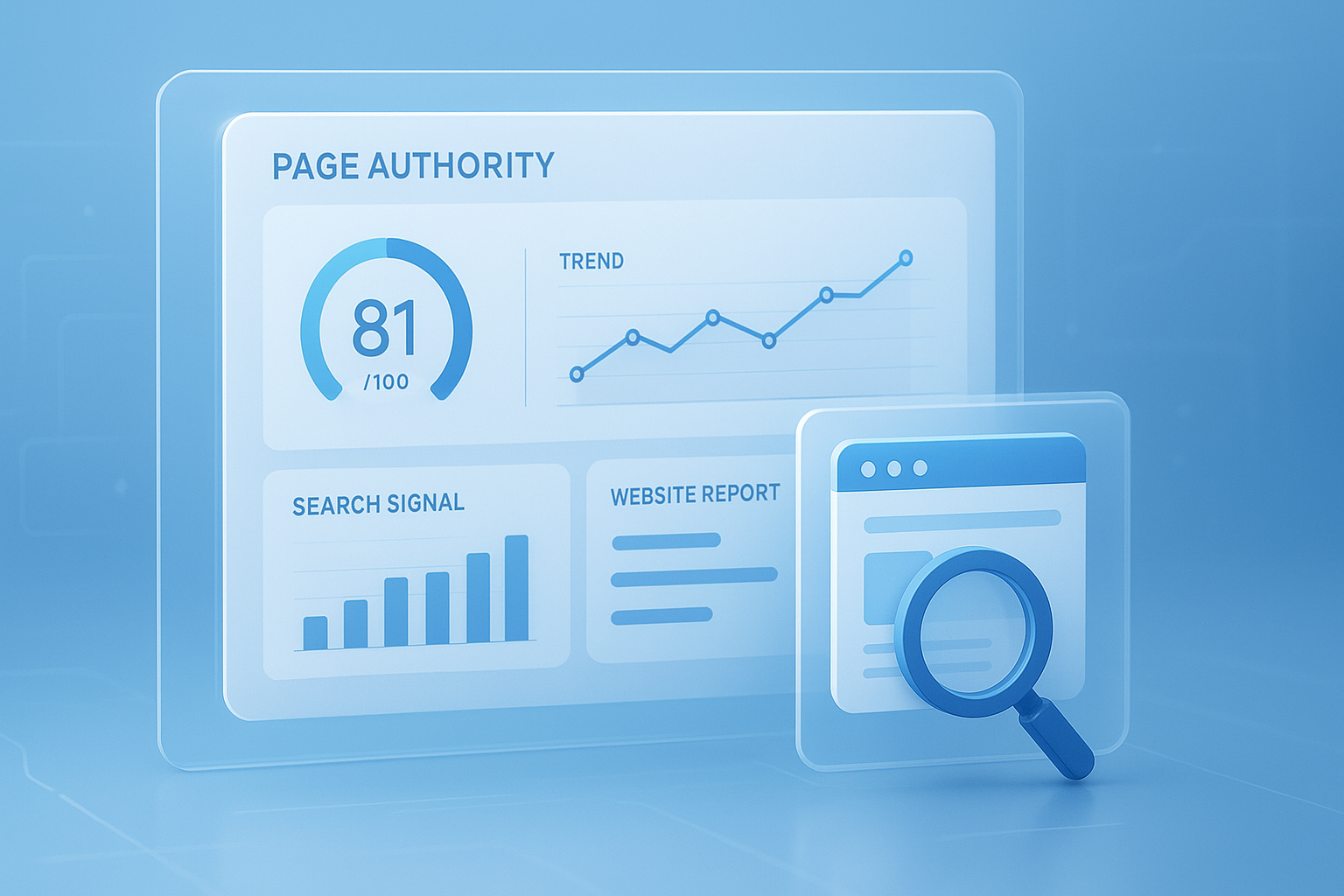
Suggested Image: Technology-style dashboard showing page authority, backlinks, internal links, and ranking signals
What is a page authority checker?
A page authority checker is a tool that estimates how likely a specific web page is to perform well in search results compared with other pages. It does not show a Google score. Instead, it provides a third-party predictive metric based on link-related and page-level signals.
That distinction matters. Google has never published a public “page authority” score for your content. Tools use their own models to estimate authority based on data they can crawl and analyze. For a broader measurement workflow, many marketers pair authority checks with support tools like an meta tag analyzer to review on-page signals at the same time.
- Page authority focuses on one URL
- Domain authority estimates the strength of an entire site or domain
- Keyword rankings show actual performance for specific queries
- Traffic metrics show real user outcomes, not just potential
So a page authority checker is best used as a directional benchmark. It helps you compare pages, spot weak URLs, and prioritize SEO work.
What does page authority actually measure?
Page authority is an estimate of ranking potential. Most tools calculate it using link quality, link quantity, relevance, and other signals that suggest whether a page can compete in organic search.
The exact formula varies by provider, but most models look at several common inputs:
- The number of backlinks pointing to the page
- The quality and trust level of linking sites
- The relevance of those links to the page topic
- Internal links pointing to the page
- The strength of the overall domain
- Link diversity, including different referring domains
- Spam patterns or manipulative link signals
Some tools also weigh machine learning models trained on search result patterns. That’s why a page authority score may shift even if you did not change the page recently.
For technical SEO context, Google’s official guidance on how crawling and ranking work is still the best starting point: Google Search Central SEO Starter Guide.
What page authority does not measure well
This is where many marketers get tripped up. A page authority checker can be useful, but it is not a full proxy for SEO success.
- It does not directly measure content quality the way users experience it
- It does not guarantee rankings
- It does not reflect conversion rate
- It may miss brand signals and user behavior patterns
- It may understate newer pages that have strong topical relevance but fewer links
That’s why authority should be evaluated alongside content quality, search intent alignment, page experience, and indexing status.
How page authority differs from domain authority
Page authority and domain authority are related, but they answer different questions. Page authority asks, “How strong is this exact URL?” Domain authority asks, “How strong is this site overall?”
| Metric | What It Evaluates | Best Use |
|---|---|---|
| Page Authority | Ranking potential of one specific page | Comparing individual URLs and prioritizing page-level SEO |
| Domain Authority | Overall strength of an entire domain | Benchmarking site-wide competitiveness |
| Keyword Rankings | Real search positions for target queries | Measuring actual organic visibility |
| Organic Traffic | Visits from search engines | Evaluating business impact |
Here’s a quick example. A high-authority site can publish a new page that starts with low page authority because that exact URL has not earned many links yet. At the same time, an older page on a mid-sized site can have stronger page authority because it has attracted relevant links over time.
If you’re managing a growing content library, this is why page-level analysis often reveals more actionable opportunities than domain-level metrics alone.
Why marketers use a page authority checker
Marketers use a page authority checker to make faster SEO decisions. It helps identify where a page stands relative to competitors and whether it likely needs more links, stronger internal linking, or content improvements.
Common use cases include:
- Comparing your page against ranking competitors
- Finding which pages deserve link-building first
- Spotting underperforming landing pages
- Auditing blog content before a refresh
- Evaluating outreach targets and partnership opportunities
- Estimating whether a page can realistically rank for a harder keyword
For example, if two articles target similar intent but one has much lower page authority and fewer internal links, you may be able to improve it without rewriting the whole piece. Sometimes structure and link flow matter more than adding 2,000 extra words.
When auditing multiple URLs, a simple workflow document helps. Many teams use a quick word counter to compare content depth across top-ranking pages without overcomplicating the process.
How to use a page authority checker the right way
The best way to use a page authority checker is as a comparison tool, not a final verdict. Look at patterns across similar pages instead of obsessing over one score in isolation.
- Check the exact URL
Use the canonical version of the page, including the correct protocol and path. - Compare pages targeting the same search intent
A product page should not be compared with a news article or a homepage. - Review competing URLs in the current search results
The score is most useful when tied to actual SERP competitors. - Look at internal and external links together
A page may need authority passed internally before you invest in outreach. - Track changes over time
One snapshot is less useful than trend data over several weeks or months.
Now comes the important part. A score only matters if it leads to action. If your page authority is low, the next question is not “How do I increase the number?” It should be “What specific signals are preventing this page from competing?”
A practical review checklist
Before changing the page, check these fundamentals:
- Is the page indexed?
- Does it match the intent of the query?
- Does it earn internal links from relevant high-value pages?
- Has it attracted any editorial backlinks?
- Is the page technically accessible and fast enough?
- Does the title and description improve click potential?
For quick URL handling during audits, tools such as a URL encoder decoder can help when working with complex parameters, crawl exports, or reporting sheets.
What is a good page authority score?
A good page authority score is relative to your competition, not absolute. A score of 25 may be strong in a niche with weak competitors, while 45 may be too low in a highly competitive software category.
That said, marketers often use rough benchmarks like these:
| Score Range | General Interpretation | What to Keep in Mind |
|---|---|---|
| 1–20 | Low authority | Common for new pages or pages with few links |
| 21–40 | Moderate authority | Can compete in many niche or mid-level SERPs |
| 41–60 | Strong authority | Often supported by quality links and strong site context |
| 61+ | Very strong authority | Usually seen on well-established pages with strong link equity |
These are only rough ranges. Different tool providers use different scales and datasets. The real benchmark is this: how does your page compare to the URLs already ranking on page one?
To understand page quality alongside authority, Google’s guidance on creating helpful, reliable, people-first content is more useful than chasing target scores alone.
Factors that influence page authority most
The strongest influence on page authority is usually links, especially the quality and relevance of referring pages. But links are not the whole story. Internal structure and topical alignment also shape how much authority a page can accumulate.
1. High-quality backlinks
Editorial links from relevant, trusted websites carry more weight than large volumes of weak directory or profile links. One link from a respected industry publication can outperform dozens of low-value mentions.
2. Internal linking
This is one of the most overlooked opportunities. When important pages on your site link to a target page using useful, descriptive anchor text, they pass context and authority signals. If your best pages ignore your newest strategic content, that content often stays weak.
When reviewing anchor text for clarity and search relevance, a text to HTML entities tool can also help content teams clean special characters before publishing or migrating content.
3. Topical relevance
A backlink from a relevant source is usually more valuable than a link from an unrelated page. The same applies internally. Pages should sit within a logical topical cluster, not as isolated assets.
4. Content usefulness
Even though page authority metrics are often link-heavy, helpful content still matters because it attracts links, earns citations, and gets referenced by other publishers. That indirectly improves authority over time.
5. Crawlability and technical SEO
If search engines cannot efficiently access, understand, or consolidate your page signals, authority can be diluted. Canonicals, redirects, indexation issues, and duplicate versions all matter. You can review technical best practices in MDN web documentation for foundational site handling and secure implementation practices.
How to improve page authority in practical ways
To improve page authority, focus on earning better links, distributing internal authority more strategically, and making the page worth citing. The fastest gains usually come from strengthening what already exists instead of publishing more weak pages.
- Build internal links from your strongest pages
Find pages that already earn traffic or backlinks, then link them naturally to the target page. - Refresh thin or outdated content
Add missing insights, examples, definitions, visuals, and recent information. - Earn editorial backlinks
Create content worth referencing, then promote it to relevant publishers, partners, and communities. - Fix duplicate and competing URLs
Consolidate split equity caused by similar pages targeting the same intent. - Improve title tags and snippet appeal
More visibility and engagement can increase the page’s reach and natural link potential. - Support the page with related cluster content
Topical ecosystems often strengthen page performance over time.
Internal linking strategy that actually works
Here’s what experienced professionals do differently. They do not just add random links from blog posts. They map authority flow intentionally.
- Link from pages that already have backlinks
- Use anchors that describe the destination clearly
- Place links where they help the reader naturally
- Update old content, not just new posts
- Point multiple relevant pages to the same strategic URL
If you’re updating content manually, quick productivity tools like an case converter can speed up formatting and cleanup during large editorial refreshes.
Link earning ideas for marketers
If your page deserves stronger authority, give people a reason to cite it. Some durable tactics still work well in 2026:
- Publish original data or benchmarks
- Create practical templates or checklists
- Build free tools that solve a small but common problem
- Turn internal expertise into quotable guides
- Update old industry resources with current examples
For teams producing downloadable assets or lead magnets, a clean presentation matters. A simple PDF to JPG tool can help repurpose reports or one-pagers into image assets for outreach and social amplification.
Common mistakes when checking page authority
Most mistakes come from treating page authority like a ranking guarantee. That leads teams to ignore content intent, SERP competition, and technical problems that matter just as much.
- Comparing unrelated pages
A blog post, category page, and homepage do not compete on equal terms. - Using one tool as absolute truth
Each provider has its own index and calculation model. - Ignoring search intent
A high-authority page can still fail if it targets the wrong intent. - Chasing low-quality backlinks
More links do not automatically mean better authority. - Forgetting internal links
Pages often underperform simply because no site structure supports them. - Expecting instant movement
Authority builds over time as links and signals accumulate.
This small detail changes everything: authority is comparative. If the current top results are all deeply established resources, a modest bump in page authority may not be enough unless content and intent also improve.
Page authority vs rankings: which matters more?
Rankings matter more because they reflect real performance. Page authority matters because it helps explain why a page may or may not be able to compete.
Think of it this way:
- Page authority is a predictive metric
- Rankings are an actual outcome
- Traffic and conversions are the business result
So if a low-authority page ranks well, do not panic. It may be winning because it matches intent better, answers the query more clearly, or serves a less competitive niche. Google’s systems evaluate far more than links, including quality and usability signals discussed in the W3C accessibility guidance, which can also support better user experience.
A smart review combines:
- Current rankings
- Click-through rate
- Search intent fit
- Backlink quality
- Internal links
- Indexation and technical health
How to audit a low-authority page step by step
If a page has weak authority and poor rankings, start with diagnosis before making changes. The goal is to identify whether the problem is backlinks, internal support, content quality, or a mismatch with search intent.
- Check whether the page is indexed
If it is not indexed properly, authority work may have limited effect. - Review the top search results
Compare content type, depth, structure, and backlink profiles. - Assess internal link support
See whether strong site pages link to it meaningfully. - Evaluate the page’s unique value
Ask what it offers that the current top results do not. - Identify linkable assets on the page
Data, charts, frameworks, tools, and original examples attract links. - Refresh and relaunch
Update the page, improve its positioning, and promote it again.
Suggested Screenshot: Example SEO audit workflow showing page authority, referring domains, and internal links for a target URL
When reporting updates to stakeholders, consistent formatting makes reviews easier. A quick remove line breaks tool can help clean exported notes, copy blocks, or pasted audit comments before sharing.
Best practices for using page authority in 2026
In 2026, the most effective marketers use page authority as one data point inside a bigger SEO system. They do not optimize for the score directly. They optimize the conditions that typically improve it.
- Benchmark against real SERP competitors, not random sites
- Use page authority to prioritize pages, not judge content quality alone
- Strengthen internal links before starting expensive outreach
- Focus on link relevance and editorial value
- Update aging pages that already have some authority instead of always starting from zero
- Combine authority analysis with search intent and conversion goals
For performance measurement, Google’s official Search Console performance reports documentation is essential because it shows real impressions, clicks, and average positions. That helps you avoid overvaluing proxy metrics.
Frequently asked questions
Is page authority a Google ranking factor?
No. Page authority is not a public Google metric. It is a third-party estimate created by SEO tool providers to predict how competitive a page may be in search. Google uses many signals in ranking systems, but it does not publish a page authority score for your URLs. That’s why this metric is most useful for comparison and prioritization, not as a direct ranking factor you can optimize in isolation.
How often should I check page authority?
Monthly is enough for most marketers, especially when reviewing key landing pages, blog posts, and campaign content. If you are actively building links or updating important pages, checking every two to four weeks can help you spot trends. Daily checks are rarely useful because authority metrics do not always change quickly and can vary based on tool index updates rather than meaningful SEO improvements.
Can a page with low authority still rank well?
Yes. A page can rank well with relatively low authority if search intent is easier to satisfy, the keyword is less competitive, or the content is more useful than what is currently ranking. This happens often in niche topics, local searches, and fresh emerging queries. Authority helps, but relevance, clarity, and technical accessibility can still make a page outperform stronger competitors in the right conditions.
What is more important, page authority or backlinks?
Backlinks are usually the stronger underlying signal because they help influence page authority in the first place. But not all backlinks are valuable. A smaller number of relevant, editorial links usually helps more than many weak links. Page authority gives you a summary estimate, while backlink analysis shows the actual source signals. In practice, you should review both together rather than choosing one over the other.
Do internal links increase page authority?
They can help significantly. Internal links do not replace external backlinks, but they improve how authority flows through your site and help search engines understand page importance and topic relationships. Strategic internal linking is one of the easiest wins for sites with existing content. Pages with no meaningful internal support often remain weaker than they should, even when the content itself is solid.
Why do different tools show different page authority scores?
Because each tool uses a different link index, crawl coverage, and scoring model. One provider may discover more referring domains, weigh spam signals differently, or update its data at a different pace than another. That means score differences are normal. The better approach is to use one tool consistently for comparisons over time rather than jumping between platforms and trying to reconcile every numeric difference.
How long does it take to improve page authority?
It depends on how competitive the topic is and what improvements you make. Internal linking changes can help relatively quickly, while earning quality backlinks often takes weeks or months. If a page already has some traction, a strong refresh and relaunch may produce visible gains faster than building a new page from scratch. Authority growth is usually gradual, especially in competitive markets.
Should I improve page authority on every page?
No. Focus on pages that matter most to your goals. These might include revenue-driving landing pages, strategic service pages, high-potential blog content, and pages already ranking on page two or the bottom of page one. Some pages do not need aggressive authority building at all. Prioritizing the right URLs gives a better return than spreading effort across every page equally.
Conclusion
A page authority checker is most useful when it helps you make better decisions, not when it becomes the goal itself. The score can reveal competitive gaps, highlight weak pages, and guide internal linking or outreach priorities. But it only becomes valuable when paired with search intent, content quality, and real performance data.
If you want to improve page authority, start with pages that already have business value. Strengthen internal links, refresh outdated content, and earn citations from relevant sources. Then measure progress against the pages actually ranking for your target terms.
For your next step, review one important URL using a page authority checker, then pair that audit with a meta tag analyzer, a word counter, and a remove line breaks tool to clean, compare, and improve the page efficiently.