Ever checked a site’s backlinks and wondered why one domain seems to carry more weight than another? That’s where a mozrank checker becomes useful. It gives you a quick way to estimate how strong a page or domain looks based on link popularity and link quality.
For marketers, this matters for a simple reason: links still influence visibility. A strong link profile can support rankings, help content get discovered faster, and make outreach decisions less of a guessing game. But many people look at MozRank in isolation and draw the wrong conclusion.
In this guide, you’ll learn what MozRank means, how a mozrank checker works, how to interpret the score properly, and what to do if your number is lower than expected. We’ll also look at the limits of the metric so you can use it like a professional, not just as a vanity number.
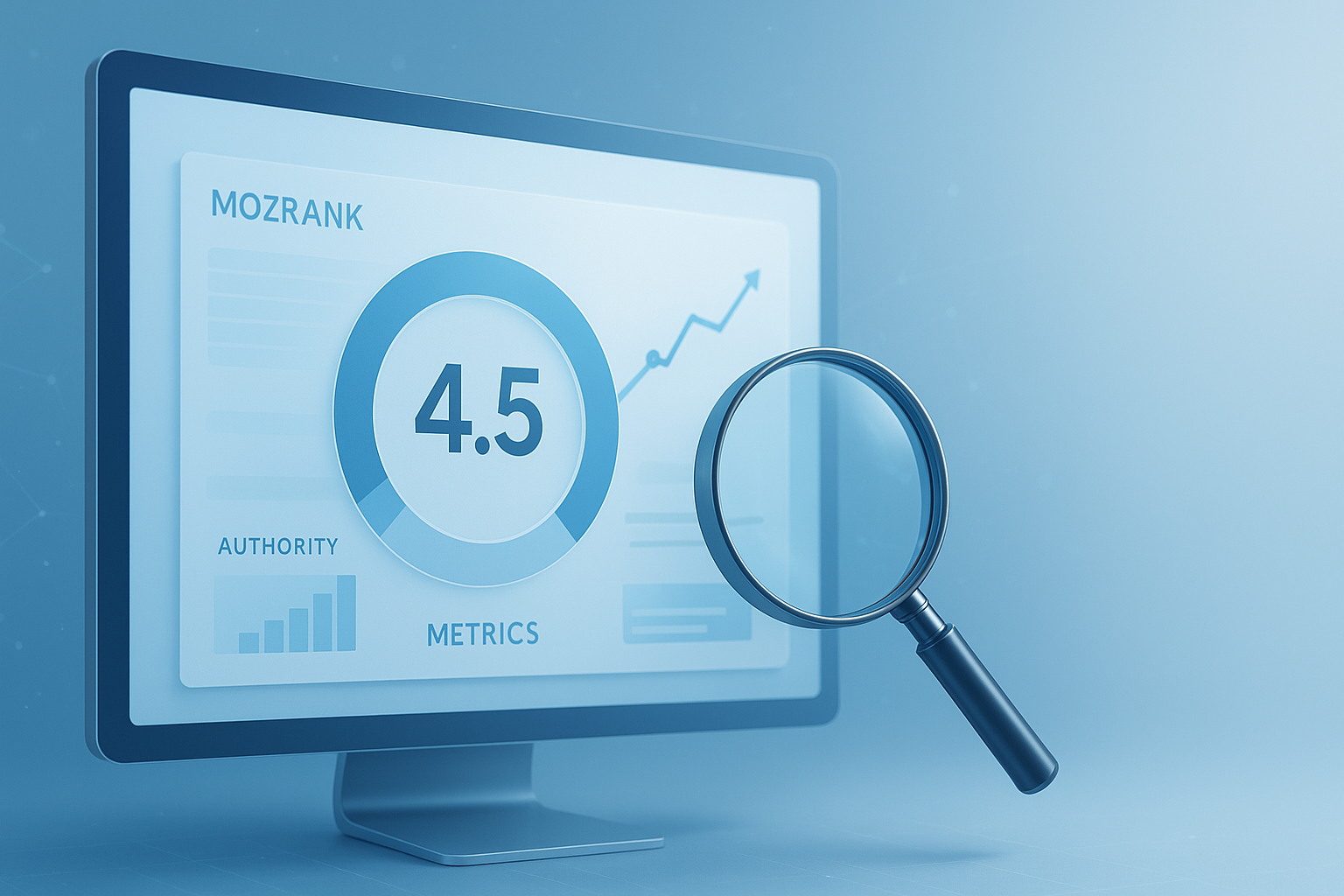
Suggested Image: Technology-style dashboard showing domain authority, backlinks, and MozRank score indicators
What is MozRank?
MozRank is a link-based SEO metric created to estimate the authority of a webpage or domain based on the quantity and quality of links pointing to it. In simple terms, it tries to measure how much ranking strength a page may gain from backlinks.
The core idea is straightforward. A link from a trusted, well-linked page typically passes more value than a link from a weak or obscure page. That makes MozRank useful when comparing pages, evaluating outreach opportunities, or spotting link authority gaps between competitors.
It helps to think of MozRank as one data point, not a final verdict. Search engines use far more signals than link popularity alone. If you want a broader workflow for evaluating search performance, a dedicated SEO and digital marketing tools collection can help you pair authority metrics with content, technical, and conversion analysis.
What does the score usually look like?
MozRank is commonly shown on a logarithmic scale, often from 0 to 10. That small detail changes everything. Moving from 2 to 3 is much easier than moving from 6 to 7 because higher scores require substantially stronger link equity.
- Lower scores often belong to new or lightly linked pages
- Mid-range scores are common for established websites with steady backlinks
- Higher scores usually appear on pages with strong authority and powerful inbound links
How does a mozrank checker work?
A mozrank checker analyzes the backlinks associated with a page or domain and estimates link authority using Moz’s scoring model. The output usually presents a score that reflects both the number of incoming links and the authority of the linking sources.
Most tools simplify the process into a few user actions. You enter a URL, submit it, and review the score. Some checkers also surface related information such as linking domains, page strength, or comparative authority signals.
- Enter the page URL or root domain
- Run the analysis in the tool
- Review the reported MozRank score
- Compare it with competing pages in your niche
- Use the result alongside other SEO indicators
Before checking, it helps to clean up the URL format. For example, make sure you’re consistent about http vs https and whether you’re evaluating the homepage or a specific page. If you frequently validate page paths or campaign URLs, a utility like Text to Slug can help standardize naming conventions for cleaner SEO workflows.
Suggested Screenshot: MozRank checker input field with URL entry and resulting score panel
What a MozRank score actually tells you
A MozRank score tells you how strong a page or domain appears from a link authority perspective. It does not directly tell you whether the page is well optimized, helpful to users, or likely to rank for a specific keyword on its own.
This is where many people struggle. They see a decent authority score and assume rankings should follow automatically. In reality, search performance depends on a mix of signals including relevance, intent match, content quality, internal linking, crawlability, user experience, and page speed.
| What MozRank Helps With | What MozRank Does Not Confirm |
|---|---|
| Comparing link strength between pages | Exact Google ranking position |
| Evaluating backlink authority trends | Search intent alignment |
| Spotting stronger outreach targets | Content quality or usefulness |
| Tracking relative authority growth over time | Technical SEO health |
Google itself explains that ranking systems evaluate many signals beyond links. For a reliable foundation, review the Google guidance on creating helpful, reliable, people-first content and the broader SEO Starter Guide.
Why marketers still use MozRank in 2026
MozRank remains useful because marketers need quick comparison metrics. Even though it isn’t a Google metric, it helps teams estimate off-page strength, prioritize link-building opportunities, and benchmark authority without manually inspecting every backlink.
Here’s why it still earns a place in SEO workflows:
- It gives a fast directional view of link equity
- It helps compare pages when planning outreach
- It supports competitor gap analysis
- It can reveal whether authority is growing over time
- It simplifies communication with clients or non-technical stakeholders
That said, experienced professionals rarely use MozRank alone. They combine it with organic traffic, keyword overlap, content depth, crawl status, and engagement signals. If you’re organizing source URLs from multiple campaigns or audits, a tool like URL Encoder Decoder can be handy when handling parameters and clean reporting links.
MozRank vs other SEO authority metrics
MozRank is just one authority signal among many. Different platforms use different methodologies, so scores are not interchangeable. That means a page with a strong MozRank may not show the same relative strength in another tool’s model.
Let’s break this down with a practical comparison.
| Metric | What It Measures | Best Use |
|---|---|---|
| MozRank | Link popularity and authority strength | Backlink quality comparison |
| Domain-level authority metrics | Relative authority of a whole site | Prospecting and competitor analysis |
| Page-level authority metrics | Strength of a specific URL | Landing page comparisons |
| Organic traffic metrics | Estimated or actual search visits | Performance validation |
| Technical audit scores | Site health and crawlability | Fixing SEO blockers |
The practical takeaway is simple: compare like with like. Use MozRank to compare pages inside a similar competitive context, not as an absolute pass-or-fail number.
How to check your MozRank score the right way
The best way to use a mozrank checker is to evaluate pages with a clear purpose. Don’t just check your homepage and stop there. Look at the pages that actually matter for rankings, leads, or revenue.
- Choose the correct URL. Check the exact blog post, service page, product page, or homepage you want to evaluate.
- Use a consistent version. Stick to the canonical format if possible.
- Record the score. Keep a running log so you can track changes over time.
- Compare with direct competitors. Focus on pages targeting the same topic or intent.
- Pair with backlink review. A score alone won’t show why results differ.
- Re-check after campaigns. Review again after digital PR, guest posting, or link reclamation work.
If you document SEO audits internally, consistency matters. Even small formatting issues across lists of URLs, titles, and descriptions can create reporting mess. Many teams use simple formatting tools such as Case Converter to clean labels, exports, and campaign naming before sharing reports.
What pages should you check first?
Start with pages that influence business outcomes. These usually include:
- Your homepage
- Top-converting service or product pages
- High-potential blog posts
- Pages that rank on page two or three of search results
- Competitor pages outranking you for important terms
How to interpret low, average, and high scores
A MozRank score only becomes meaningful when you evaluate it in context. A “good” score for a local business website may be very different from a “good” score in SaaS, finance, publishing, or ecommerce.
Here’s a practical way to read the number:
- Low score: Often indicates a weak backlink profile, a new page, or limited visibility
- Average score: Suggests some link authority but room to grow
- High score: Usually reflects strong inbound links, better page reputation, or significant domain support
Now comes the important part. A low score does not automatically mean your page cannot rank. If search intent is underserved and your content is highly relevant, you can still compete, especially in less saturated niches. Google’s ranking systems focus on usefulness and relevance too, as explained in Google’s overview of how Search works.
Why your MozRank may be lower than expected
If your score looks underwhelming, the answer usually depends on one thing: link equity. Either you don’t have enough quality backlinks, or the links you do have aren’t passing much authority.
Common causes include:
- Very few referring domains
- Links from weak or irrelevant websites
- Too much dependence on one source
- New pages with little link exposure
- Poor internal linking from stronger pages
- Lost backlinks that were never reclaimed
- Canonical or redirect issues that split equity
This is also where technical factors can muddy the picture. If your site has inconsistent URL structures, duplicate paths, or redirect chains, authority can be diluted. The Google documentation on site structure is useful for understanding how clean architecture supports discoverability.
If you’re auditing duplicate versions of content or URL-level page exports, a utility like Text Compare Tool can help you spot differences quickly when reviewing page variants, metadata drafts, or rewritten content assets.
How to improve your MozRank score
The most reliable way to improve MozRank is to earn better backlinks and strengthen internal link flow. Shortcuts don’t hold up well. Sustainable gains come from authority-building activities that make sense for users and for search engines.
1. Earn links from relevant, trusted websites
A few strong links often help more than dozens of weak ones. Relevance matters. A backlink from a respected site in your industry tends to carry more meaningful SEO value than links from unrelated websites.
- Create original research, templates, or data-driven content
- Publish tools, checklists, or calculators people naturally reference
- Pitch expert commentary to journalists and niche publishers
- Contribute guest content to genuinely relevant sites
- Build partnerships that produce editorial mentions
2. Improve internal linking
Many teams chase new backlinks while ignoring the authority already inside their site. Internal links help distribute link equity and guide both users and crawlers toward important pages.
- Link from high-authority pages to strategic targets
- Use descriptive anchor text
- Avoid orphan pages
- Keep navigation logical and shallow where possible
If you publish SEO articles, naming and organizing content assets clearly helps your internal linking process. A simple Word Counter can also support editorial QA when you want to keep pillar pages, cluster posts, and outreach copy aligned with planned content depth.
3. Reclaim lost backlinks
Here’s what experienced professionals do differently. They don’t focus only on new link acquisition. They also recover value that has already been earned.
- Find broken pages with backlinks and redirect them properly
- Reach out when brand mentions are unlinked
- Update moved resources and old campaign URLs
- Fix 404s on linked assets
4. Publish link-worthy content, not just optimized content
Some pages rank briefly. Others attract links for years. The difference is often utility. Pages that teach, simplify, compare, or provide original evidence are far more likely to earn citations.
Good link-magnet formats include:
- Original statistics roundups
- Free tools and calculators
- Industry benchmark reports
- Definitive guides
- Templates and frameworks
- Strong visual explainers
When producing visuals for SEO posts, file size and loading speed matter. If your design team creates charts or screenshots, using an Image Compressor can help reduce page weight without sacrificing clarity.
5. Strengthen page quality so links work harder
Backlinks can help a page compete, but they work better when the destination page is actually worth ranking. That means clear intent match, useful explanations, readable formatting, and solid user experience.
Moz itself is not Google, and Google has repeatedly emphasized quality and usefulness. Review the Google documentation on search snippets and on-page presentation if you want content that performs well in search and clicks better in results.
Common mistakes when using a mozrank checker
A mozrank checker is helpful, but it’s easy to misuse. Most bad decisions happen when marketers turn a directional metric into a final judgment about SEO performance.
- Comparing unrelated pages: A local landing page and a major media article are not fair comparisons
- Ignoring intent: A stronger page may still lose if it doesn’t match what searchers want
- Obsessing over one score: SEO is multi-factor, not single-metric
- Chasing low-quality links: Volume without relevance rarely helps much
- Forgetting internal links: Authority can stall when strong pages don’t support target pages
- Expecting instant change: Link signals take time to accumulate and be reflected in tools
A practical workflow marketers can follow
If you want better use from MozRank, build it into a repeatable review process. That keeps the metric useful and prevents overreaction to a single reading.
- List your top priority URLs
- Check each page’s MozRank
- Compare the same type of pages from direct competitors
- Review linking domains behind the stronger pages
- Identify content gaps and outreach opportunities
- Improve internal links to priority pages
- Track changes monthly or after campaigns
When creating SEO summaries or stakeholder updates, clear written communication matters almost as much as the analysis. For polishing article outlines, meta drafts, or reporting notes, an Grammar Checker can help tighten explanations before they go to clients or leadership.
Suggested Infographic: Workflow from MozRank check to backlink audit, content improvement, and authority growth
FAQs about MozRank and mozrank checker tools
Is MozRank a Google ranking factor?
No. MozRank is a third-party metric created by Moz. Google does not use MozRank directly in its ranking systems. That said, MozRank tries to model part of what matters in search by estimating link authority. It can be useful for analysis, but it should never be treated as a direct Google score or a guaranteed predictor of rankings.
What is a good MozRank score?
There is no universal “good” number because industries vary so much. A score that looks strong for a local services page may be weak in a competitive publishing niche. The best approach is to compare your score against similar pages targeting similar keywords. Context matters far more than the raw number.
Can a page rank well with a low MozRank?
Yes. A page can still rank if it closely matches search intent, answers the query well, and competes in a lower-authority search landscape. MozRank reflects link strength, not total ranking ability. Some pages perform well simply because they are more relevant, clearer, or more useful than stronger-linked alternatives.
How often should I check MozRank?
For most marketers, monthly checks are enough. You might also review scores after a link-building campaign, digital PR push, or major content refresh. Daily monitoring usually isn’t necessary because authority changes do not happen meaningfully overnight. Focus on trend lines and campaign-driven checkpoints instead of constant score watching.
Does MozRank measure domain authority or page authority?
MozRank is primarily associated with link authority at the page level, though some tools may also present domain-related signals alongside it. Always verify whether you are checking a specific URL or the root domain. Mixing those views can lead to bad conclusions, especially during competitor analysis.
Can bad backlinks hurt my MozRank analysis?
They can make the profile look noisier, but the bigger issue is interpretation. A site may have many backlinks and still show weak real-world performance if those links are low quality or irrelevant. That’s why backlink quality matters more than simple counts. Reviewing referring domains and link relevance gives a much clearer picture than totals alone.
Are free mozrank checker tools accurate enough?
Free tools can be useful for quick direction, basic comparisons, and early-stage audits. However, they may not always provide the same depth, freshness, or backlink detail as paid platforms. For everyday marketers, free checks are often enough to identify patterns. For high-stakes SEO planning, pair them with broader backlink and performance analysis.
What should I improve first if my MozRank is low?
Start with your most important pages. Improve internal links, reclaim lost backlinks, and create more link-worthy assets around topics people naturally cite. Then build targeted outreach around relevant publishers and industry resources. It’s usually better to earn a few strong, relevant links to strategic pages than collect many weak ones across your site.
Final thoughts on using a mozrank checker well
A mozrank checker is best used as a decision-making aid, not a scoreboard. It helps you estimate link authority, compare pages more intelligently, and prioritize SEO work that can move the needle. But the real value comes from what you do after checking the score.
If your number is low, focus on the fundamentals: better backlinks, smarter internal linking, stronger pages, and cleaner site structure. If your number is high but rankings are weak, look beyond authority and fix relevance, technical SEO, or content quality.
Your next step is simple. Check your key pages, compare them with direct competitors, and identify one realistic authority improvement action this month. As you refine your workflow, related tools like the Text to Slug tool, Image Compressor, Word Counter, and Grammar Checker can support cleaner publishing, better content assets, and more organized SEO execution.