Pages can be live on your site and still be invisible in Google. That’s the frustrating part. You publish, share, and even optimize the page, but it never shows up in search results because it hasn’t been indexed.
A good google index checker helps you confirm whether Google has actually added your pages to its index. For marketers, that matters more than most reporting dashboards. If a page isn’t indexed, it can’t earn organic traffic no matter how strong the content is.
In this guide, you’ll learn how to check indexed pages quickly, what a Google index result really means, how to spot common indexing issues, and what to do next when important URLs are missing. If you work in SEO, content, or growth, this is one of the fastest checks you can build into your workflow.
Suggested Image: Technology concept showing website pages being scanned and indexed by a search engine
What is a Google Index Checker?
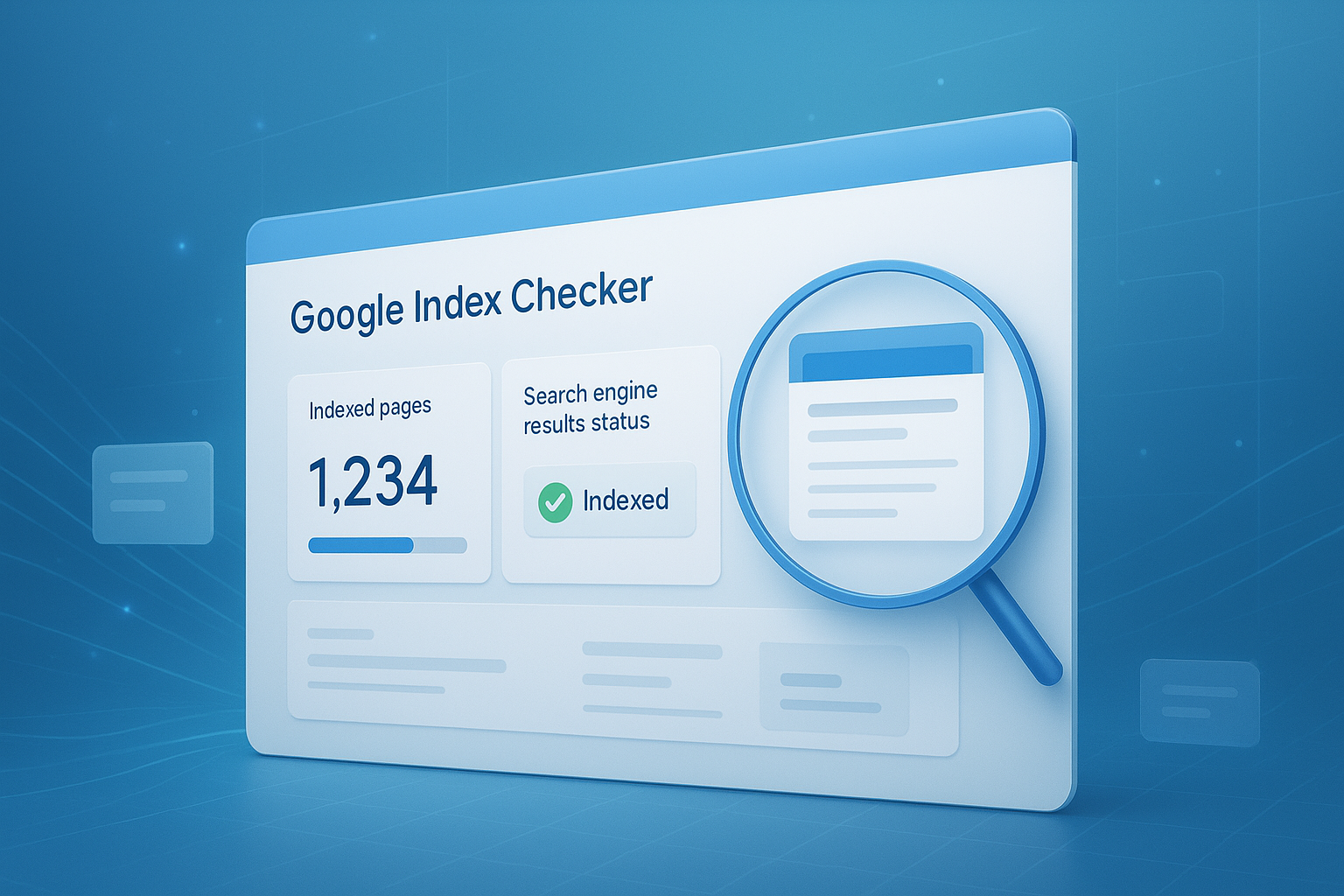
A Google Index Checker is a tool or method used to verify whether a specific page has been indexed by Google. In simple terms, it tells you if Google knows the page exists and has stored it in its search database.
That sounds basic, but it answers a critical question. A page can be crawlable without being indexed. It can also be indexed but not ranking well. Those are different problems, and experienced marketers separate them early.
There are a few common ways to check index status:
- Using the URL Inspection feature in Google Search Console
- Searching Google with the
site:operator - Using a dedicated google index checker tool for quick URL checks
- Reviewing indexing reports in bulk through Search Console exports
If you’re reviewing lots of landing pages, keeping a clean URL list matters. A simple helper like the Text to List tool can make batches easier to prepare before checking them.
Why indexed pages matter for SEO and marketing
If a page isn’t indexed, it has no chance of appearing in Google Search. That makes indexing one of the first checkpoints in any SEO or content performance review.
Here’s why marketers pay close attention to index coverage:
- Organic visibility starts here. No indexation means no rankings.
- Campaign pages need confirmation. Product launches, lead magnets, and local pages often underperform simply because they were never indexed.
- Technical SEO issues show up early. Index gaps can reveal noindex tags, canonicals, crawl blocks, duplicate content, or poor internal linking.
- Content ROI becomes clearer. You can’t judge a page’s SEO value until you know Google has processed it.
Google explains the relationship between crawling, indexing, and serving in its How Search works documentation. That distinction is important because many marketers assume “published” means “search-ready.” It doesn’t.
When auditing page inventory, it also helps to estimate how much content is actually getting discovered versus how much exists on the site. If you’re comparing growth periods or content production rates, tools like the Percentage Calculator can help you quickly calculate indexation ratios and reporting summaries.
How to check if a page is indexed in Google
The fastest way to check a page depends on whether you want a quick spot check or a reliable diagnostic result. For most marketers, there are three practical options.
1. Use Google Search Console URL Inspection
This is the most accurate method for owned websites. Paste the exact URL into the inspection field, and Google will tell you whether the page is indexed, indexable, canonicalized, or blocked.
- Open Google Search Console
- Select the correct property
- Paste the full page URL into URL Inspection
- Review the indexing status
- Check details such as last crawl, canonical URL, robots status, and enhancements
Google’s official URL Inspection documentation explains each result type clearly.
2. Use the site operator in Google Search
Search for site:yourdomain.com/page-url. If the page appears, it is likely indexed. If it doesn’t, the page may not be indexed or Google may be choosing not to show it for that query format.
This method is useful for quick checks, but it has limits. It’s not as reliable as Search Console, especially for pages with canonical conflicts or recent publication dates.
3. Use a Google index checker tool
A dedicated tool is useful when you want speed and simplicity. It’s especially helpful for marketers who need a quick answer without digging through multiple Search Console reports.
A workflow tip: if your URL format contains tracking parameters or messy path structures, clean them first with a readable conversion step. Tools like the URL Encoder Decoder can help verify that you’re checking the correct version of the URL.
Google Index Checker methods compared
Not every method gives the same level of certainty. Some are fast for a spot check, while others are better for technical diagnosis and reporting.
| Method | Best For | Speed | Reliability |
|---|---|---|---|
| Google Search Console URL Inspection | Owned websites and technical diagnosis | Medium | High |
| site: search operator | Quick manual checks | Fast | Moderate |
| Google index checker tool | Fast verification and workflow convenience | Fast | Moderate to high, depending on source data |
| Pages report in Search Console | Bulk analysis and issue trends | Medium | High |
What “indexed” really means and what it does not mean
Indexed means Google has stored the page in its search index. It does not mean the page ranks well, drives traffic, or appears for your target keywords.
This is where many people get confused. A URL can be:
- Indexed but buried beyond page one
- Indexed but excluded for some queries due to duplicate content signals
- Indexed but weak because of thin content or poor relevance
- Not indexed because Google decided the page adds little value
So think of indexing as the first gate, not the finish line. After confirming index status, you still need to evaluate quality, internal links, user intent match, and page performance.
If you’re improving page readiness, supporting assets matter too. Heavy graphics can slow important landing pages, so a tool like the Image Compressor can help reduce file size before republishing updated content.
Why pages fail to get indexed
Most indexing problems come down to access, duplication, quality, or weak discovery signals. The fix depends on the actual cause, so don’t guess too early.
Here are the most common reasons a page stays out of Google’s index:
- Noindex tag present. The page explicitly tells search engines not to index it.
- Blocked by robots.txt. Crawlers can’t access the content properly. Google documents this in its robots.txt guidance.
- Canonical points elsewhere. Google may treat another page as the preferred version.
- Duplicate or near-duplicate content. Similar pages often get consolidated.
- Thin or low-value content. Google may crawl it but decide not to index it.
- Orphan page. The page has little or no internal linking support.
- New page, low authority site. Discovery and trust signals may simply be weak.
- Soft 404 behavior. The page exists but offers little meaningful content.
- Server or rendering issues. Googlebot may fail to process the page correctly.
Here’s what experienced professionals do differently: they verify the technical signals first, then evaluate the content itself. That order saves time.
How to fix indexing issues step by step
If an important page isn’t indexed, start with the basics. The goal is to make the URL accessible, unique, valuable, and easy for Google to discover.
- Check for noindex directives. Review the page source and CMS settings.
- Confirm robots access. Make sure the URL is not blocked in robots.txt.
- Review canonical tags. Ensure the page points to itself if it should be indexed.
- Improve the content. Expand thin sections, clarify the search intent, and add original value.
- Add internal links. Link from relevant category pages, blogs, and high-authority pages.
- Include the page in the XML sitemap. Google provides sitemap guidance in its sitemap documentation.
- Request indexing in Search Console. Useful after major improvements or new publication.
- Wait and recheck. Indexing is not always immediate, even in 2026.
Suggested Screenshot: URL Inspection result showing indexed vs not indexed status in Google Search Console
How long does indexing take?
The answer depends on one thing: how easy the page is for Google to discover and trust. Some pages are indexed within hours. Others can take days or weeks, especially on smaller sites or pages with weak signals.
Factors that influence indexing speed include:
- Site authority and crawl frequency
- Internal linking strength
- Sitemap inclusion
- Content uniqueness
- Server performance
- Rendering complexity
If you’re maintaining structured campaign calendars, converting crawl and publish timelines into a simple checklist format helps. The Case Converter can also make exported labels, page titles, or workflow notes easier to standardize for reporting.
How marketers can use a Google index checker in everyday workflows
A google index checker is not just for technical SEOs. It’s useful anywhere content performance depends on discoverability.
Here are practical use cases:
- Content publishing QA: Confirm that new blog posts and landing pages enter the index
- Migration reviews: Check whether redirected or newly mapped URLs are being indexed correctly
- Lead generation pages: Verify that high-value commercial content is visible to Google
- Local SEO: Test city pages, service pages, and location hubs
- Content pruning projects: Decide which pages need improvement versus removal
- Client reporting: Separate “not indexed” problems from ranking problems
This small detail changes everything: when you split “indexing” from “ranking,” your recommendations become far more accurate. That leads to better prioritization, fewer wasted rewrites, and cleaner SEO reporting.
Common mistakes when checking indexed pages
Many false alarms happen because the wrong URL version is checked or the result is interpreted too quickly. A little precision goes a long way.
- Checking the wrong URL version. Test the exact canonical URL, including protocol and path.
- Relying only on the site operator. It’s useful, but not definitive for diagnostics.
- Ignoring canonicals. A page may be accessible but intentionally consolidated under another URL.
- Assuming a sitemap guarantees indexation. Sitemaps help discovery, not acceptance.
- Publishing thin location or tag pages. Google often skips low-value pages.
- Forgetting internal links. Orphan pages are much easier to miss.
- Confusing deindexing with ranking loss. A traffic drop does not always mean the page left the index.
If you’re cleaning export data from crawlers or spreadsheets before analysis, a utility like the Remove Duplicate Lines tool can speed up URL list reviews and prevent repeated checks.
Best practices to improve indexation rates
Better indexation usually comes from better site signals, not from repeatedly requesting indexing. Search engines respond best when pages are useful, connected, and technically clear.
- Create unique pages with clear search intent
- Use strong internal linking from relevant pages
- Keep XML sitemaps current and clean
- Avoid publishing large volumes of thin pages
- Consolidate duplicates where possible
- Use self-referencing canonicals where appropriate
- Improve page speed and mobile usability
- Fix soft 404s, server errors, and redirect chains
- Review the Page Indexing report regularly in Search Console
Google’s broader recommendations on quality and discoverability are covered in the SEO Starter Guide.
For large editorial teams, it also helps to prepare cleaner briefs and lightweight page assets before launch. If content collaborators share article drafts in document form, a utility like the PDF to Text tool can simplify extracting editable copy for republishing and optimization.
Google indexed pages vs submitted pages
Submitted pages are URLs you’ve included in a sitemap or otherwise presented to Google. Indexed pages are the ones Google actually accepted into the search index. Those numbers are often different.
| Metric | What It Means | Why It Matters |
|---|---|---|
| Submitted pages | URLs you want Google to consider | Shows intended coverage |
| Indexed pages | URLs Google accepted into the index | Shows actual searchable coverage |
| Excluded pages | URLs not indexed for specific reasons | Reveals technical or content issues |
Now comes the important part. A gap between submitted and indexed pages is not always bad. Some pages should be excluded. The real problem is when valuable pages are excluded for avoidable reasons.
When should you worry about non-indexed pages?
You should worry when high-value pages remain non-indexed after technical checks and reasonable waiting time. Not every URL needs to be in Google, but strategic pages absolutely do.
Pay attention if any of these are true:
- Money pages are not indexed
- New content stays excluded for weeks
- Category or service pages disappear after a migration
- Index coverage drops sharply without explanation
- Google chooses different canonicals than expected
- Important pages are marked crawled or discovered but not indexed
For trend analysis, many teams compare monthly index totals, exclusion rates, and recovery percentages. If you’re building simple performance snapshots, reference tools in the SEO and Digital Marketing category can support related optimization tasks without cluttering your workflow.
Frequently Asked Questions
Is a Google index checker the same as a rank tracker?
No. A Google index checker tells you whether a page exists in Google’s index. A rank tracker measures where that page appears for specific keywords. A page must usually be indexed before it can rank, so index checking comes earlier in the SEO process. If a page is not indexed, ranking reports for that URL are mostly irrelevant until the indexing issue is resolved.
Can a page be crawled but not indexed?
Yes, and it happens often. Google may access a page, process its content, and still decide not to index it. Common reasons include weak originality, duplicate content, soft 404 signals, or low perceived value. In Search Console, you may see statuses like “Crawled currently not indexed” or “Discovered currently not indexed,” which point to different discovery and quality situations.
How accurate is the site: operator for checking indexed pages?
It’s useful for quick manual checks, but it should not be treated as the final word. Google does not guarantee that the site: operator reflects a complete or current view of index status. For owned websites, URL Inspection and the Page Indexing report in Search Console provide better diagnostic information and are more reliable for decision-making.
Why is my page indexed but still getting no traffic?
Indexation only means the page is eligible to appear in search. It does not guarantee strong rankings, clicks, or impressions. The page may target low-demand keywords, fail to match search intent, have weak internal links, or compete with stronger pages on your own site. Once indexation is confirmed, the next step is content quality, SERP fit, and authority evaluation.
How often should marketers check index status?
That depends on publishing volume and site complexity. For active content teams, checking newly published pages weekly is sensible. For larger sites, monthly index coverage reviews in Search Console are usually the baseline, with extra checks after migrations, major template changes, or large content updates. High-value landing pages should be checked more frequently because indexing delays directly affect lead generation.
Do I need to request indexing for every new page?
No. Google can often discover pages naturally through internal links and XML sitemaps. The request indexing feature is best used selectively, such as for priority pages, recently fixed URLs, or urgent campaign content. If you need to request indexing repeatedly for routine pages, the bigger issue is usually poor discovery, weak site architecture, or inconsistent publishing signals.
What is the difference between “Discovered currently not indexed” and “Crawled currently not indexed”?
“Discovered currently not indexed” usually means Google knows the page exists but has not crawled it yet, often due to crawl prioritization or site-level efficiency issues. “Crawled currently not indexed” means Google already reviewed the page but chose not to add it to the index at this time. The second status more often points to content quality, duplication, or limited search value.
Are free index checking methods enough for most marketers?
In many cases, yes. Google Search Console, the site operator, and a straightforward google index checker are enough for routine monitoring. Larger teams may still need crawlers, log analysis, and custom dashboards for scale, but most marketers can diagnose common indexing issues using free tools if they know what signals to review and how to interpret them correctly.
Final thoughts
A google index checker is one of the simplest ways to verify whether your content can even compete in search. Before you analyze rankings, backlinks, or conversions, confirm that Google has actually indexed the page.
The practical process is simple: check the URL, confirm the technical signals, improve the page if needed, and monitor the result. That approach prevents wasted SEO work and helps you focus on the real obstacle.
If you want a sensible next step, review your most important landing pages first. Then clean your URL lists, compress heavy assets, and standardize your publishing workflow using useful tools like Text to List, Image Compressor, Remove Duplicate Lines, and the broader SEO and Digital Marketing category. Small checks like these often uncover the pages that matter most.