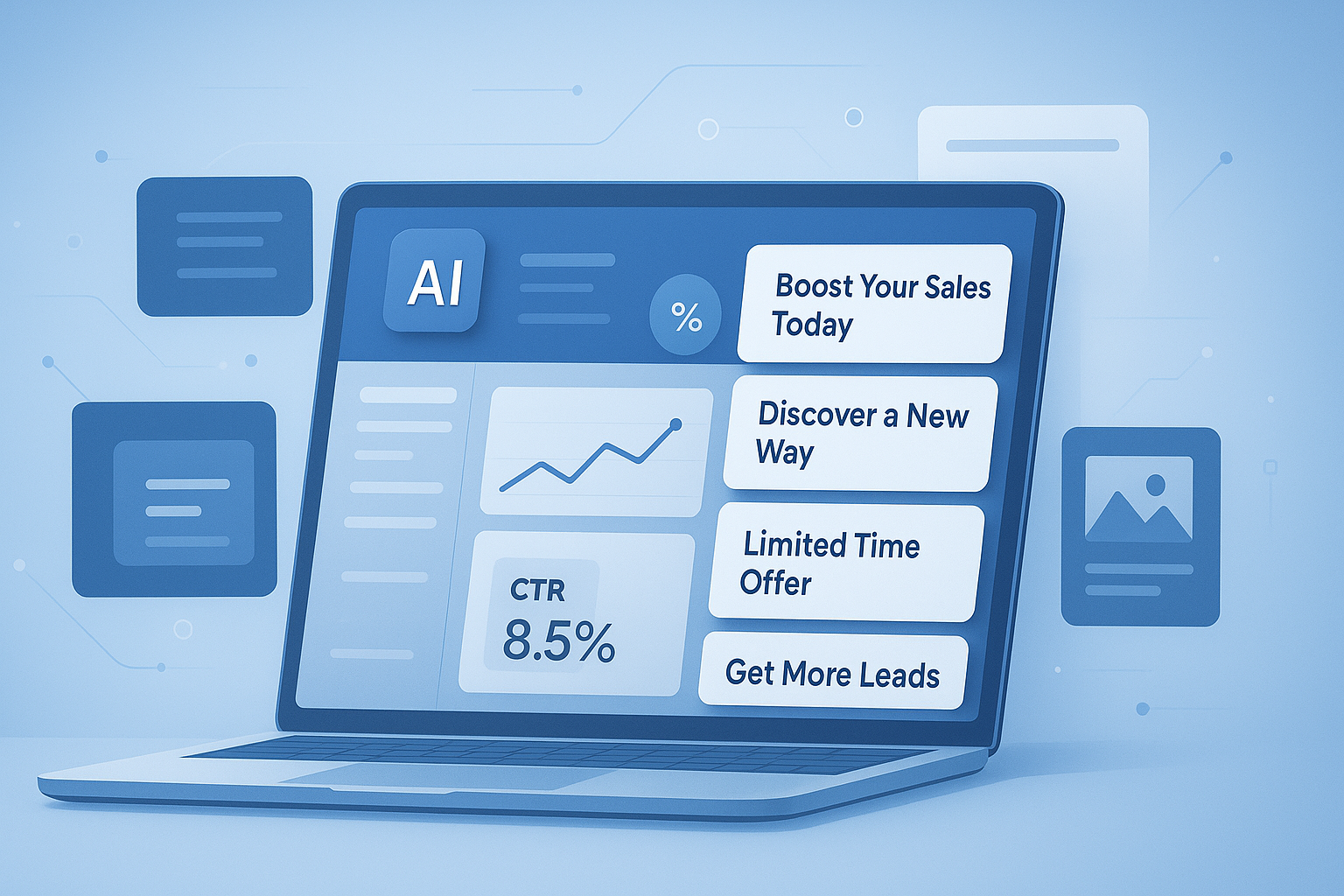
Most Facebook ads don’t fail because the offer is bad. They fail because the headline gives people no reason to stop scrolling.
That’s why AI Facebook ads headlines have become such a useful asset for marketers. Used well, AI can help you generate stronger headline angles, test more variations faster, and uncover messaging ideas you may not have considered on your own. Used poorly, it creates bland, repetitive copy that gets ignored.
This article shows you how to use AI to write Facebook ad headlines that improve click-through rates without sounding generic. You’ll learn what makes a headline work, how to prompt AI effectively, what examples to test, and how to refine the final copy for better performance in 2026.
Suggested Image: Modern illustration of a marketer testing multiple Facebook ad headline variations with AI assistance
What are AI Facebook ads headlines?
AI Facebook ads headlines are ad headline variations generated or improved with artificial intelligence tools. The goal is simple: create attention-grabbing, relevant, and testable text for Facebook and Instagram ads faster than writing every version from scratch.
In practice, AI helps with several headline tasks:
- Generating first-draft ideas
- Rewriting weak headlines into stronger ones
- Matching tone to audience segments
- Creating multiple hooks for A/B testing
- Condensing long ideas into shorter ad-ready lines
AI is most useful when you already understand your audience and offer. If your input is vague, the output usually is too. If you give AI clear context, it can become a fast ideation partner.
For marketers building ad assets alongside landing pages, audience research, and creatives, tools that simplify supporting tasks can help too. For example, if you need to clean up ad visuals before upload, an Image Compressor can make image files lighter without adding friction to your workflow.
Why headlines matter so much for Facebook ad CTR
Your headline is rarely the only reason someone clicks, but it often decides whether they pause long enough to notice the rest of the ad. On crowded feeds, that split second matters.
Here’s what a strong Facebook ad headline does:
- Signals relevance immediately
- Highlights a clear benefit
- Creates curiosity without being vague
- Supports the primary ad text and visual
- Points naturally toward the click
Meta’s ad system rewards relevance and user response over time. Better engagement can contribute to stronger delivery and lower wasted spend, although results always depend on your targeting, creative quality, offer, and conversion experience. For policy and ad setup guidance, it’s smart to review Meta Business Help Center.
Here’s the problem. Many marketers ask AI for “10 catchy Facebook headlines” and stop there. That usually produces surface-level copy. Higher CTR comes from angle testing, not from chasing one clever line.
What makes a Facebook ad headline convert?
The best-clicked headlines usually do one of four things well: promise a result, solve a problem, create urgency, or spotlight a clear difference. They don’t try to do everything at once.
A converting Facebook headline often includes these elements:
- Specificity: A concrete benefit beats a vague claim
- Clarity: People should understand the value in seconds
- Relevance: The message should fit the audience’s current need
- Emotional pull: Relief, excitement, confidence, or curiosity
- Consistency: It should match the image, primary text, and landing page
Let’s look at a quick comparison.
| Weak Headline | Why It Underperforms | Stronger Version |
|---|---|---|
| Grow Your Business Fast | Too broad and generic | Get More Qualified Leads This Month |
| Best Software for Teams | No clear outcome or audience pain point | Cut Project Delays With One Shared Dashboard |
| Try Our New Course | Focuses on the brand, not the user | Learn Paid Ads in 30 Minutes a Day |
This is also why message alignment matters. Google’s guidance on helpful, people-first content applies beyond SEO because useful, relevant messaging tends to perform better across channels. See Google’s helpful content guidance for a strong principles-based reference.
How to use AI to generate better Facebook ad headlines
AI works best when it has constraints. Instead of asking for random headlines, feed it the audience, offer, pain point, desired action, tone, and any limits such as character count or compliance concerns.
Here’s what experienced professionals do differently. They don’t ask AI to write the final answer. They ask AI to produce headline territories.
A simple framework for prompting AI
Use this structure when generating AI Facebook ads headlines:
- Describe the product or offer
- Name the target audience
- State the main pain point or desire
- Choose the tone
- Set the format rules
- Ask for varied angles, not minor rewrites
Prompt example:
Write 20 Facebook ad headlines for a time-tracking app designed for small agencies. Audience: agency owners and team leads. Main pain point: missed deadlines and poor visibility into billable hours. Tone: clear, practical, trustworthy. Keep each headline under 40 characters where possible. Create different angles including efficiency, profitability, team visibility, and stress reduction. Avoid hype and generic marketing phrases.
If you’re drafting supporting copy, an AI email writer can also help you adapt the same campaign message across email follow-ups, which improves consistency across the funnel.
Ask AI for categories, not just lines
One of the fastest ways to improve outputs is to request grouped headline types. For example:
- Benefit-led headlines
- Problem-solution headlines
- Curiosity-driven headlines
- Urgency-based headlines
- Social proof headlines
- Offer-led headlines
This makes testing easier because you can compare strategic angles instead of tiny wording changes.
7 headline formulas AI can generate well
If you want practical output fast, start with proven headline formulas. AI is good at remixing structures when you give it sound inputs and clear boundaries.
1. Benefit-first
Lead with the result the user wants most.
- Save 5 Hours Every Week
- Turn More Clicks Into Sales
- Track Every Lead in One Place
2. Problem-solution
Name the frustration, then hint at the fix.
- Still Losing Leads After the Click?
- Fix Slow Follow-Ups Automatically
- Stop Guessing Which Ads Convert
3. Curiosity without clickbait
Invite interest, but stay truthful.
- The Small Ad Change That Improved CTR
- Why Your Best Offer Isn’t Getting Clicks
- What High-CTR Ads Usually Get Right
4. Audience-specific
Call out the exact person you want to reach.
- For Coaches Who Want Better Leads
- Ecommerce Teams: Lower CPA Faster
- Built for Busy Agency Owners
5. Outcome plus timeframe
Time anchors often make results feel more concrete.
- Launch Better Ads in 15 Minutes
- Get Clearer Reporting This Week
- Improve Lead Quality This Month
6. Offer-led
Best when the incentive is genuinely strong.
- Start Your Free Audit Today
- Try It Free for 14 Days
- Get the Template Pack Now
7. Contrast-based
Compare the old way with the better way.
- Less Guesswork. Better Ad Results.
- From Manual Reports to Instant Insights
- Spend Smarter, Not More
Suggested Infographic: 7 Facebook ad headline formulas with example use cases
25 AI Facebook ads headlines you can adapt
These examples are designed to spark ideas, not replace testing. Each works better when matched to the right audience, creative, and offer.
- Get More Clicks Without Raising Budget
- Turn Scrolls Into Qualified Leads
- Stop Wasting Spend on Weak Ad Copy
- Write Better Ads in Less Time
- Headlines Built for Higher CTR
- Find the Message Your Audience Notices
- Create Facebook Ads People Actually Click
- Cut Ad Fatigue With Fresh Angles
- From Broad Messaging to Better Results
- Launch More Variations in One Session
- Make Every Headline Pull Its Weight
- Sharper Hooks for Faster Testing
- Reach the Right People With Clearer Copy
- Write Ads That Match Buyer Intent
- Your Next Winning Headline Starts Here
- Less Guessing. More Testing.
- Better Facebook Headlines, Better CTR
- When the Copy Clicks, Users Do Too
- Give Your Best Offer a Better Hook
- Test New Angles Before Costs Rise
- AI Ideas, Human-Level Ad Judgment
- Smarter Headlines for Busy Marketers
- Find What Makes Your Audience Click
- Turn Good Creatives Into Stronger Ads
- Write Headlines Built for Real Campaigns
If you need to rework ad copy for other channels or shorten long messaging into tighter phrases, trying an paragraph rewriter tool can help you create cleaner testing variations without rewriting everything manually.
How to prompt AI for different campaign goals
Not every campaign wants the same kind of headline. Lead generation, ecommerce, retargeting, and awareness campaigns each need different message priorities.
| Campaign Goal | What the Headline Should Emphasize | Prompt Direction |
|---|---|---|
| Lead Generation | Value, trust, clarity | Ask for practical, low-friction headlines |
| Ecommerce | Product benefit, differentiation, urgency | Ask for benefit-led and offer-led options |
| Retargeting | Reminder, trust, objection handling | Ask for headlines that reduce hesitation |
| Awareness | Curiosity, audience relevance | Ask for broad-interest hooks with clear relevance |
Prompt example for ecommerce
Create 15 Facebook ad headlines for a skincare product for sensitive skin. Focus on calm, trustworthy language. Highlight comfort, gentle ingredients, and visible results without making medical claims. Include 5 benefit-led headlines, 5 curiosity-based headlines, and 5 offer-led headlines.
Prompt example for retargeting
Write 12 retargeting Facebook ad headlines for users who viewed a pricing page but did not sign up. Emphasize simplicity, fast onboarding, and reduced risk. Avoid sounding pushy. Keep the tone confident but not aggressive.
When building campaign assets at scale, many teams also create landing page copy and ad descriptions in parallel. A clean SEO and digital marketing tools collection can help you organize related tasks more efficiently.
AI headline testing: what to measure after launch
Writing the headline is only half the job. The real value appears when you compare results and learn which message angle your audience responds to best.
For Facebook ad headline testing, watch these metrics closely:
- Click-through rate
- Outbound CTR
- Cost per click
- Conversion rate after click
- Cost per lead or cost per purchase
- Frequency and signs of ad fatigue
Now comes the important part. A high CTR is useful, but it’s not enough by itself. Some headlines attract low-intent clicks. The best headline is the one that brings qualified traffic at a sustainable cost.
For analytics setup and event tracking concepts, refer to Google Analytics documentation and Meta Pixel documentation.
A practical testing process
- Create 3 to 5 distinct headline angles
- Pair them with the same creative where possible
- Keep audience targeting stable during the test
- Run long enough to gather meaningful data
- Review CTR and post-click quality together
- Refine the top angle with closer variations
If you need to estimate percentages quickly while reviewing campaign changes, a percentage increase calculator is handy for comparing lifts in CTR, CPC, or conversion rate over baseline performance.
Common mistakes marketers make with AI-generated headlines
The biggest mistake isn’t using AI. It’s trusting the first output too quickly. Good ads still need human judgment, especially when audience nuance and brand credibility matter.
- Using vague prompts: AI can’t fix missing strategy
- Accepting generic phrasing: “Boost your business” rarely stands out
- Ignoring platform context: Feed ads need speed and clarity
- Testing tiny variations only: Compare different angles first
- Chasing CTR alone: Cheap clicks can hide poor lead quality
- Forgetting policy limits: Avoid misleading or non-compliant claims
- Not editing for voice: AI drafts often need sharper human refinement
Advertising claims matter. For truthful ad standards in the U.S., the FTC advertising and marketing guidance is a useful baseline reference, especially for regulated or sensitive categories.
How to make AI-generated headlines sound more human
AI often produces headlines that are technically fine but emotionally flat. A good editor can usually improve them in two or three passes.
Here’s how to humanize AI Facebook ads headlines:
- Remove empty adjectives
Words like innovative, powerful, ultimate, and revolutionary often weaken trust unless they are supported. - Use the customer’s language
Borrow phrases from reviews, sales calls, and support tickets. - Tighten the line
Shorter headlines often hit harder on social feeds. - Add a real outcome
Replace abstract value with a concrete result. - Keep one idea per headline
Trying to communicate too much reduces impact.
For readability and concise phrasing, reviewing plain-language principles from PlainLanguage.gov can actually improve ad clarity more than many copywriting gimmicks.
This small detail changes everything: a headline doesn’t need to sound creative first. It needs to sound immediately relevant.
AI Facebook ads headlines by audience type
A headline that wins with founders may flop with in-house marketing teams. Audience context shapes what feels urgent, credible, and worth clicking.
For small business owners
- Get More Leads Without More Admin
- Simple Ads for Busy Business Owners
- Spend Less Time Guessing What Works
For ecommerce marketers
- Turn Product Views Into More Sales
- Fresh Ad Angles for Better ROAS
- Make Your Best Seller Stand Out Again
For agencies
- Launch More Client Tests in Less Time
- Stronger Ad Copy for Faster Iteration
- Find New Hooks Before Performance Drops
For SaaS teams
- Show the Value Before the Demo
- Get More Qualified Trial Signups
- Clearer Messaging for Complex Products
If your workflow includes adapting campaign copy into longer blog or landing page sections, an AI text humanizer can help smooth out stiff wording before publication.
Should you use AI for headlines only, or for the full ad?
AI can support the full ad, but headlines are often the safest and most useful starting point. They are short, easy to compare, and quicker to improve with human editing.
| Use Case | AI Value | Human Review Needed |
|---|---|---|
| Headline ideation | Very high | Medium |
| Primary text drafting | High | High |
| Offer positioning | Moderate | Very high |
| Compliance-sensitive copy | Moderate | Essential |
For many marketers, the best setup is simple: use AI for volume and variation, then use human review for relevance, accuracy, tone, and compliance.
Frequently asked questions
Can AI really improve Facebook ad click-through rates?
AI can improve CTR when it helps you produce more relevant, testable headline angles faster. It does not guarantee better performance on its own. Results depend on the creative, audience targeting, offer quality, and landing page experience. AI is best used to expand ideation and speed up testing, while a human still chooses the strongest messaging.
How many AI-generated headlines should I test at once?
Most marketers should start with 3 to 5 distinct headline angles instead of testing dozens at the same time. That gives you enough variety to spot directional winners without spreading budget too thin. Once a strong angle emerges, create a second round with smaller variations in wording, specificity, or emotional framing.
What is the ideal Facebook ad headline length?
There is no single perfect length, but shorter headlines often perform better because they communicate quickly in a crowded feed. Aim for clarity first. In many cases, keeping the headline tight and focused on one benefit works better than trying to explain everything. Always preview how the full ad looks across placements before launching.
Are AI Facebook ads headlines safe for regulated industries?
They can be used carefully, but regulated industries such as finance, health, legal, and supplements require stricter review. AI may generate exaggerated, non-compliant, or misleading claims if prompted loosely. In these cases, treat AI as a drafting assistant only. Every headline should be reviewed against platform rules, legal standards, and your internal compliance process before use.
Should I optimize for CTR or conversions first?
The answer depends on campaign goals, but conversions usually matter more than CTR by itself. A headline that gets curiosity clicks but low-quality traffic can waste budget. Use CTR as an early signal of message resonance, then judge success by post-click outcomes such as lead quality, purchases, trial signups, or return on ad spend.
How do I know if my AI headline sounds too generic?
If the headline could fit almost any company, it’s too generic. Phrases like grow faster, boost results, and transform your business usually lack specificity. A stronger headline names a result, pain point, audience, or time frame. If it sounds like polished filler rather than something a customer would care about right now, rewrite it.
What’s better: curiosity headlines or benefit-driven headlines?
Neither is always better. Benefit-driven headlines often work well when the offer is clear and the audience already understands the problem. Curiosity headlines can help in awareness campaigns or crowded markets where you need attention first. The stronger option depends on audience awareness, buying intent, and how well the creative supports the promise.
What tools help beyond headline generation?
Marketers often need more than one tool to turn ideas into campaigns. Helpful next-step tools include an AI title generator for broader hook exploration, an AI meta description generator for