
Staring at a blank page is still one of the biggest time drains in content marketing. Not because marketers lack ideas, but because turning a rough topic into a clear, search-friendly structure takes real effort. That’s where AI article outlines can help.
Used well, AI article outlines speed up planning, reduce missed subtopics, and make it easier to create posts that match search intent. Used poorly, they can produce generic, repetitive drafts that never rank.
This guide breaks down how to use AI article outlines the smart way. You’ll learn when they save time, where they fall short, how to improve the output, and what experienced marketers do to turn an AI-generated structure into a useful, original article.
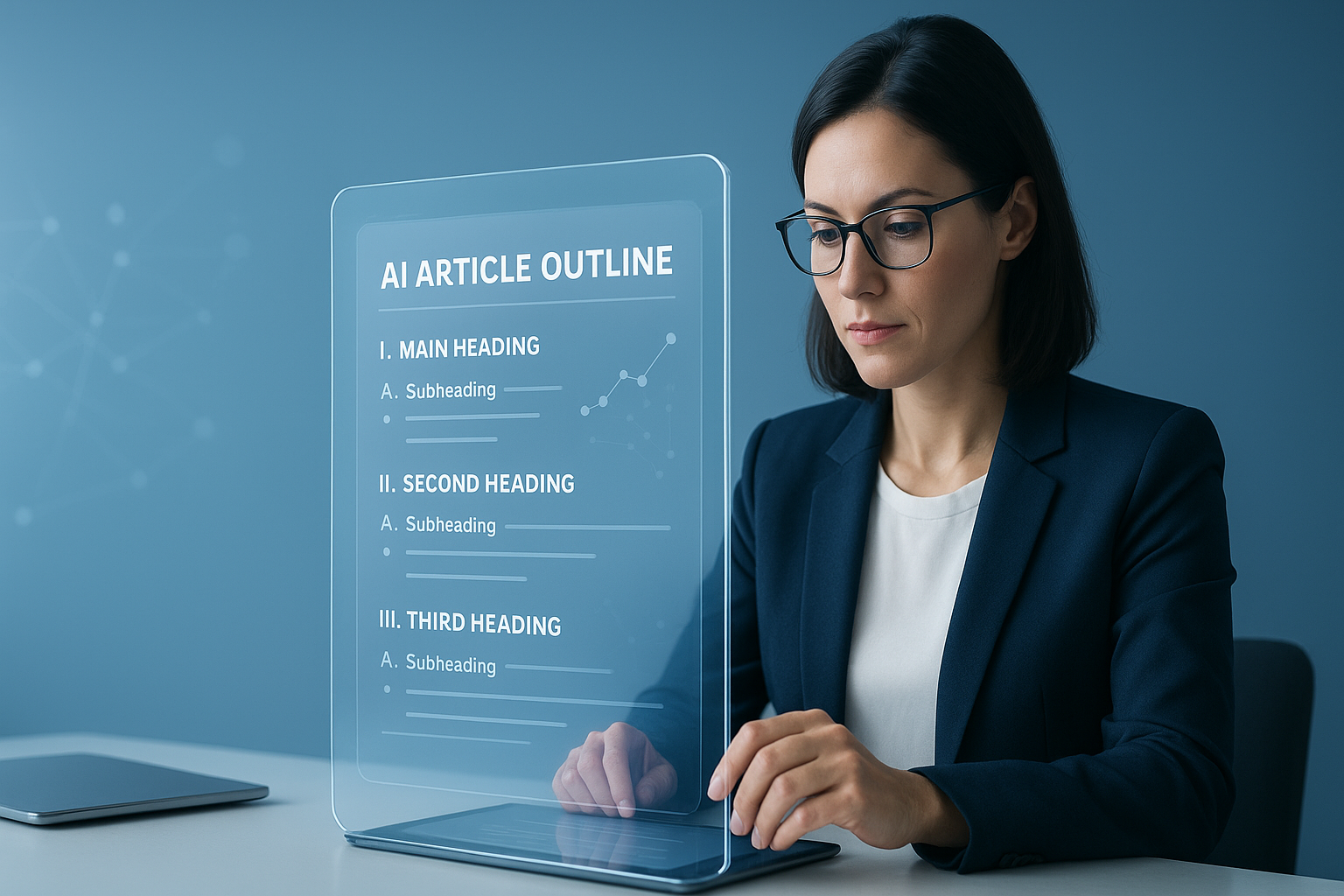
Suggested Image: Technology concept showing AI-assisted content planning workflow on a desktop screen
What are AI article outlines?
AI article outlines are structured content frameworks generated by artificial intelligence to help writers organize a blog post before drafting. They usually include a working title, main sections, subheadings, topic ideas, and sometimes key questions to answer.
Think of them as a fast first draft of your article structure, not a finished plan. Good outlines help you answer the right questions in the right order. That matters for readability, SEO, and user satisfaction.
For marketers managing high publishing volume, AI outlining can remove one of the slowest parts of production. If you’re building a repeatable workflow, a broader SEO and digital marketing tools collection can also help support ideation, optimization, and performance tracking.
- They speed up content planning
- They suggest logical content sections
- They can surface related subtopics
- They help align content with search intent
- They still require human review and editing
Why marketers use AI article outlines
AI article outlines are popular because they save time at the exact point where many teams get stuck: planning. Instead of spending 45 minutes shaping one post, marketers can generate a usable structure in minutes and focus on improving it.
Here’s the problem. Publishing faster only helps if the result is actually useful. Search engines increasingly reward content that demonstrates experience, depth, and clarity. Google’s guidance on people-first content from Google Search Central makes that direction very clear.
The biggest benefits usually show up in these situations:
- Content teams producing multiple articles per week
- Freelancers needing faster first drafts of structure
- SEO writers mapping articles to specific keyword clusters
- In-house marketers covering unfamiliar subtopics
- Editors trying to standardize article quality across writers
| Manual outlining | AI article outlining |
|---|---|
| More control from the start | Much faster first structure |
| Can reflect stronger original thinking | Can surface missed subtopics quickly |
| Slower for large content calendars | Needs careful editing to avoid generic coverage |
| Depends heavily on writer expertise | Depends heavily on prompt quality and review |
How AI article outlines improve content planning
AI article outlines improve content planning by turning a broad topic into an organized path. That helps writers cover key points without rambling, missing search intent, or repeating the same idea in different sections.
Now comes the important part. Structure influences more than readability. It affects how search engines interpret page topics, how users skim a page, and whether the article answers related questions clearly enough for AI-powered search tools to reference it.
They make search intent easier to match
A strong outline forces you to decide what the reader actually wants. Are they looking for a definition, a comparison, a tutorial, or a buying decision? AI can help group those needs quickly, especially when the keyword has multiple interpretations.
To sharpen keyword targeting before outlining, marketers often use a dedicated keyword density checker after drafting to make sure optimization stays natural and relevant.
They reduce weak transitions and topic drift
Many blog posts lose quality halfway through because the structure was never settled. AI-generated outlines can prevent this by creating a visible sequence before writing begins. That makes it easier to spot sections that don’t belong.
They support scalable editorial workflows
When multiple people write for the same brand, consistency becomes a serious challenge. Shared prompting patterns and outline templates can make briefs more uniform, which improves editing speed and final quality.
They help uncover supporting subtopics
This is where many people struggle. They know the target keyword, but they don’t know what else to include. Well-tuned AI prompts can suggest related questions, examples, use cases, and comparisons that strengthen topical coverage.
For teams publishing visuals alongside content, file performance matters too. If your article includes screenshots or diagrams, a tool like Image Compressor can help reduce page weight without sacrificing usability.
What a strong AI-generated outline should include
A useful AI outline is not just a list of H2 headings. It should reflect audience intent, content depth, logical section flow, and a clear answer path from introduction to conclusion.
Here’s what experienced professionals look for before approving an outline:
- A clear primary angle for the topic
- Headings that reflect real search questions
- Sections arranged in a sensible learning order
- Subtopics that support, not dilute, the main keyword
- Space for examples, evidence, and practical guidance
- Distinct points rather than repetitive phrasing
- A conclusion with an obvious next step
| Weak outline signs | Strong outline signs |
|---|---|
| Generic headings like “Benefits” and “Tips” only | Specific headings tied to real user questions |
| Repeats the same idea in different words | Each section has a unique purpose |
| No audience or intent focus | Clearly written for a defined reader |
| No examples or comparisons planned | Built-in spaces for examples, tables, and proof |
How to create better AI article outlines
The quality of AI article outlines depends largely on the input. Better prompts produce better thinking structures. Vague prompts usually produce flat, predictable results.
The answer depends on one thing: context. If you tell the AI only the keyword, it fills in the gaps with average assumptions. If you provide intent, audience, format, tone, and desired outcomes, the structure improves very quickly.
- Start with a clear keyword and angle. Define the main topic and what the article should help the reader accomplish.
- Specify the audience. An outline for marketers should not read like one for students or software engineers.
- State the search intent. Informational, transactional, comparative, or navigational content needs different structure.
- Ask for heading hierarchy. Request H2s and H3s instead of a loose topic list.
- Require practical elements. Ask for examples, common mistakes, FAQs, and conclusion ideas.
- Review for overlap. Remove repetitive sections and merge related points.
- Add human insight. Insert brand perspective, first-hand observations, or process notes the AI would not know.
Marketers often keep supporting research and drafts in shareable document formats. If you need fast file cleanup before review, tools like PDF to Word can make source material easier to edit and repurpose.
A practical prompt template for AI article outlines
If you want better output, ask for more than a simple outline. Give the model a role, audience, content goal, and formatting rules. This small detail changes everything.
Create a detailed blog outline for the keyword “AI article outlines.” Target audience: marketers. Search intent: informational. Goal: explain what AI article outlines are, why they matter, how to use them well, common mistakes, best practices, FAQs, and practical examples. Include SEO-friendly H2 and H3 headings, a logical flow, and suggested tables or lists where helpful. Keep the structure useful for a 2,000 to 3,000-word article.
That prompt won’t guarantee a perfect result, but it pushes the AI toward structure instead of filler. If readability testing is part of your workflow, a quick pass through a word counter can also help you keep sections balanced and easy to scan.
Common problems with AI article outlines
AI article outlines can save time, but they often fail in predictable ways. Knowing those weak spots makes editing much easier.
Let’s look at why. Most AI systems are trained to produce likely patterns, not necessarily the best strategy for your brand, your audience, or your niche. That means average content shapes are common unless you intervene.
Problem 1: The outline is too generic
You’ll see headings that could fit almost any article on almost any topic. This usually happens when the prompt lacks audience context or specificity.
Problem 2: Important sections are missing
Some AI outlines define the topic but skip examples, objections, use cases, or comparisons. That creates thin content even if the article looks organized on the surface.
Problem 3: Headings overlap
Two sections may cover nearly the same idea with slightly different wording. That leads to repetition in the final draft and weakens clarity.
Problem 4: Search intent gets blurred
An informational keyword can end up with a sales-style structure, or a beginner guide can become too advanced. Reviewing intent alignment early saves editing time later.
Problem 5: The result sounds machine-made
Even a solid outline can encourage bland writing if every section follows the same rhythm. Editing the structure before drafting helps prevent monotony.
When compiling research from web pages or screenshots, text extraction tools can speed up prep work. A utility like Image to Text can be useful when notes exist only inside visuals.
Best practices for turning an AI outline into a strong article
The best marketers do not publish AI outlines as-is. They use them as a starting point, then add judgment, expertise, brand voice, and original examples.
Here’s what experienced professionals do differently:
- They rewrite headings to sound clearer and more specific
- They combine weak or repetitive sections
- They add first-hand observations from campaigns or client work
- They insert credible references and examples
- They shape the introduction around a real reader problem
- They answer likely objections before they appear
- They write conclusions that suggest a logical next step
It also helps to validate SEO and technical quality after the draft is complete. For example, meta tag analyzer tools can support title and description reviews before publishing.
AI article outlines and SEO: what actually matters
AI article outlines can support SEO, but they do not improve rankings by themselves. What matters is whether the final article is well-structured, useful, original, and aligned with how people search.
Search engines evaluate far more than headings. Google recommends focusing on helpful, reliable content and clear page experience through resources such as the title link best practices and broader search quality documentation.
For SEO, an outline helps most when it improves these areas:
- Keyword relevance: The article naturally covers the main topic and related terms
- Search intent alignment: The article solves the reader’s actual problem
- Heading clarity: Sections are easy for users and search engines to interpret
- Topical completeness: Major supporting questions are addressed
- Readability: Content is easy to skim and understand
For technical markup and page structure, reviewing official guidance from MDN Web Docs on HTML can be useful, especially for teams publishing custom templates or structured content components.
How AI article outlines fit into AI search optimization
AI-powered search tools favor content that is easy to parse, factually grounded, and clearly structured. That makes well-planned outlines especially valuable in 2026, when more users discover content through summaries, answer engines, and conversational search.
Now comes the bigger shift. It’s no longer enough to rank for a blue link alone. Your content also needs to be understandable to systems that extract definitions, steps, comparisons, and concise answers for AI Overviews and chat-style results.
To support that, build outlines that include:
- Direct definitions near the top of key sections
- Question-based headings where readers need clear answers
- Lists and steps for process-oriented topics
- Comparison tables for decision-making topics
- Examples that add specificity and trust
- Short, clear opening paragraphs under major headings
Google’s evolving guidance around structured, useful content and accessibility is also reinforced by standards from the World Wide Web Consortium, which helps define how web content should remain understandable and usable.
Example workflow for marketers using AI article outlines
A simple workflow usually beats a complicated one. The goal is not to automate every step. It’s to remove friction while keeping strategic control.
- Choose the keyword and intent. Example: “AI article outlines,” informational intent, audience = marketers.
- Review search results manually. Note common article angles, missing gaps, and content formats.
- Generate the first outline with AI. Use a detailed prompt.
- Edit the structure. Remove overlap, add proof points, reorder sections.
- Add internal goals. Include brand perspective, CTA path, related resources, and desired snippets.
- Draft the article. Write naturally from the improved outline, not from the raw AI version.
- Optimize lightly. Check headings, metadata, links, and readability.
- Publish and review performance. Update based on search behavior and engagement data.
Suggested Infographic: AI outline workflow from keyword research to publication and update cycle
Common mistakes marketers should avoid
Most problems with AI article outlines come from overtrusting the output. The tool is fast, but speed can hide weak reasoning.
- Using the first generated outline without editing
- Forcing the primary keyword into every heading
- Ignoring user intent in favor of word count
- Letting sections repeat the same point
- Skipping original examples and evidence
- Publishing generic intros and conclusions
- Treating AI output as expert insight
If you repurpose research into downloadable assets or lead magnets, file organization matters. A tool like Merge PDF can help combine supporting documents for internal review or client handoff.
Frequently asked questions about AI article outlines
Are AI article outlines good for SEO?
Yes, they can be helpful for SEO when used as a planning tool. They improve structure, help cover related subtopics, and reduce the chance of missing important questions. But they do not improve SEO automatically. Rankings depend on the quality of the finished article, how well it matches search intent, and whether it offers original value.
Can beginners use AI article outlines effectively?
Yes, especially if they struggle with organizing ideas. AI can give beginners a starting structure that feels less intimidating than a blank page. The main risk is accepting generic output too quickly. Beginners should compare the outline against live search results and ask whether each section truly helps the reader.
Do AI article outlines replace content strategists?
No. They accelerate part of the planning process, but they do not replace strategic judgment. Content strategists still decide audience priorities, business goals, brand messaging, topical gaps, and quality standards. AI helps generate options. Humans decide which structure deserves to become a real article.
How detailed should an AI-generated outline be?
Detailed enough to guide drafting, but not so rigid that it limits better ideas. A strong outline usually includes the title direction, H2 and H3 sections, key questions to answer, and notes for examples or comparisons. If an outline reads like a complete article, it may be overbuilt and harder to improve creatively.
What is the biggest weakness of AI article outlines?
The biggest weakness is sameness. Many AI-generated structures feel familiar because they rely on common patterns. That can lead to articles that are technically organized but forgettable. The fix is to add audience-specific insight, stronger examples, different framing, and a sharper editorial angle before writing the draft.
Should I use AI article outlines for every blog post?
Not always. They’re most useful when you need speed, when the topic is broad, or when you want to standardize workflow across writers. For highly specialized topics or thought leadership pieces, manual outlining may still produce better results because the point of view matters more than speed.
Are AI article outlines safe to use for client work?
Generally yes, but use them carefully. Avoid pasting confidential client information into tools unless you understand the platform’s privacy and data policies. Review what vendors say about data handling, and remove anything sensitive before prompting. For enterprise teams, internal policy should guide what is acceptable.
How can I make AI article outlines sound less generic?
Start by giving better instructions: define the audience, intent, tone, and content goal. Then edit heavily. Rewrite vague headings, add examples from real campaigns, include objections or edge cases, and reorganize sections to fit the reader journey. The outline becomes more original when you shape it with actual experience.
Final thoughts on using AI article outlines well
AI article outlines are most useful when you treat them as a smart assistant, not an autopilot. They can speed up content planning, improve structure, and help marketers cover a topic more completely. But the real quality still comes from human editing, real examples, and clear strategic thinking.
If you want better results, start with one article. Build an outline with AI, refine it manually, and compare the final draft against your usual process. That small test will show you where AI saves time and where your expertise matters most.
As a next step, you might also review related tools like the keyword density checker, meta tag analyzer, word counter, and Image Compressor to tighten both content quality and on-page performance.