Have you ever checked two websites that seem equally strong, only to find one has a much higher authority score? That’s where a domain authority checker becomes useful. It gives marketers a quick way to estimate how competitive a site looks from a link and trust perspective.
But here’s the problem. Many people treat domain authority like a Google ranking factor, then make bad SEO decisions based on a single number. The score can be helpful, but only if you understand what it measures, what it doesn’t, and how to use it in context.
This guide explains how a domain authority checker works, how to interpret the score, what counts as a good number, and how to use the metric to compare websites more intelligently in 2026. You’ll also see practical ways to improve your site’s authority without chasing vanity metrics.
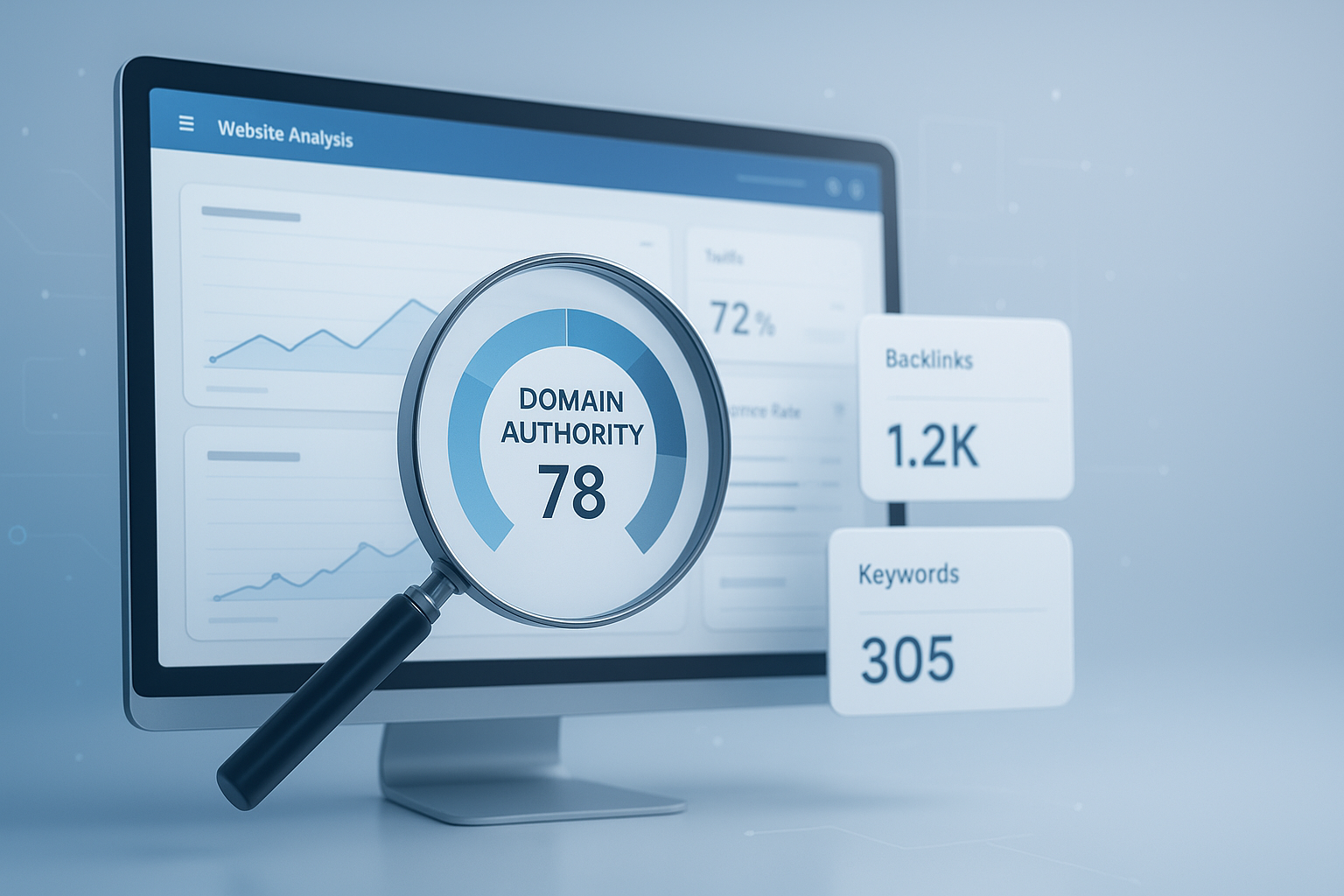
Suggested Image: Technology concept dashboard showing website authority score, backlinks, and ranking trend charts
What is a domain authority checker?
A domain authority checker is a tool that estimates how strong a website is likely to be in search results compared with other sites. It usually produces a score on a scale, often from 1 to 100, based largely on backlink-related signals and overall domain-level strength.
Different SEO platforms use different names and methods for this metric. The idea, however, is similar: measure comparative authority, not guarantee rankings. If you want to review a website quickly, a domain authority checker helps you benchmark your site against competitors, publishers, and potential link partners.
Think of it as a directional SEO metric. It helps answer questions like:
- Is this domain generally stronger than mine?
- Would a backlink from this site likely be valuable?
- Am I improving over time compared with competitors?
- Should I prioritize this market or target easier keywords first?
What does domain authority actually measure?
Domain authority measures relative ranking potential, not actual rankings. It is usually based on link data such as the number of referring domains, link quality, link patterns, and the overall trust profile of a website.
This is where many people get confused. Domain authority is not the same as traffic, content quality, revenue, or brand strength. A site can have a high score and poor conversions. Another can have a moderate score and still dominate a niche because its content matches search intent better.
Most authority-scoring systems look at signals like:
- Quality and relevance of incoming backlinks
- Number of linking root domains
- Strength of sites linking to the domain
- Link profile diversity
- Spam indicators or unnatural link patterns
- Comparative competitiveness across the web index
For a broader understanding of how search systems evaluate pages, review Google Search Central documentation. Google does not use “Domain Authority” as an official ranking metric, but links and reputation signals still matter.
How is domain authority different from Google rankings?
Domain authority is a third-party estimate. Google rankings are the real search results produced by Google’s own systems. One predicts comparative strength. The other reflects what actually ranks for a specific query at a specific time.
Here’s the practical difference:
| Metric | What It Tells You | Main Limitation |
|---|---|---|
| Domain Authority | Relative likelihood a domain can compete in search | Not a direct Google metric |
| Keyword Rankings | Where pages appear for specific searches | Changes by query, location, device, and time |
| Organic Traffic | Visits coming from search engines | Doesn’t explain why traffic rises or falls |
| Conversions | Business impact from SEO traffic | May be influenced by many non-SEO factors |
Here’s what experienced marketers do differently. They use domain authority as one input, then combine it with rankings, content relevance, technical SEO, and conversion data. If you also audit content assets during research, a tool like the PDF Word Counter can help you quickly assess downloadable guides, lead magnets, or competitor PDFs.
Is domain authority a Google ranking factor?
No. Domain authority is not an official Google ranking factor. It is a third-party score created by SEO tool providers to summarize domain-level strength.
That said, the underlying elements that influence authority scores often overlap with things that matter in SEO, especially backlinks and site reputation. Google has repeatedly explained that ranking systems are more complex than a single score. You can review Google’s guidance on creating helpful, reliable, people-first content to see where content quality fits into the bigger picture.
So the smart position is this:
- Don’t ignore authority metrics
- Don’t worship them either
- Use them for comparison, outreach, and prioritization
- Always validate with real search performance data
What is a good domain authority score?
A good domain authority score depends on your niche, competition level, and stage of growth. There is no universal “good” number. A score of 25 may be strong in a narrow local niche, while 25 in enterprise SaaS could be weak.
The answer depends on one thing: who you are competing against. The most useful way to judge a score is relatively, not absolutely.
| Score Range | General Interpretation | Typical Situation |
|---|---|---|
| 1 to 10 | Very new or very weak domain | New site with little link history |
| 11 to 30 | Growing authority | Early-stage blogs, local businesses, niche sites |
| 31 to 50 | Moderately strong | Established content sites and active brands |
| 51 to 70 | Strong | Well-known publishers and trusted brands |
| 71+ | Very strong | Major media, global companies, high-authority platforms |
If you’re evaluating a site’s overall trust profile, pair a domain score review with checks like page speed, content depth, and asset efficiency. For media-heavy sites, the Image Compressor can help reduce oversized images that hurt user experience and search performance.
How to use a domain authority checker the right way
A domain authority checker is most useful when you compare multiple websites in the same market. Used alone, the score can mislead. Used comparatively, it becomes a practical decision-making tool.
Let’s break this down into simple use cases.
1. Compare your site with direct competitors
If your domain authority is 28 and the top-ranking sites for your target keywords average 55, that doesn’t mean success is impossible. It does mean you should be realistic about how difficult those terms may be.
- Check 5 to 10 true competitors
- Compare domain authority ranges, not just one site
- Look for weaker competitors ranking with better content
- Prioritize topics where authority gaps are smaller
2. Qualify backlink opportunities
Not all backlinks are worth the effort. A higher authority domain can be valuable, but relevance matters just as much. A moderate-score industry site may help you more than a powerful but unrelated site.
- Review the domain score
- Check topic relevance
- Assess traffic quality
- Look for signs of spam or paid-link patterns
3. Track growth over time
A rising score often suggests your link profile is improving. It won’t guarantee ranking growth immediately, but it can indicate positive momentum, especially when paired with better impressions and clicks.
If you manage outreach spreadsheets or campaign reports, the Percentage Increase Calculator is useful for measuring month-over-month improvements in authority, backlinks, or traffic trends.
4. Judge whether a niche is realistic
Authority checks can save time before you invest heavily in content. If the first page is dominated by very strong domains, you may need a narrower angle, stronger internal linking, or a long-tail strategy first.
What a domain authority checker cannot tell you
A domain authority checker cannot tell you whether a page satisfies search intent, converts visitors, or offers a strong user experience. It also cannot tell you if a site is trustworthy in the real-world sense.
This small detail changes everything. SEO success often comes from page-level quality, not just domain-level strength.
A domain authority score does not show:
- How well a specific page is optimized
- Whether content is up to date
- How fast the site loads
- How useful the information is
- How well the site converts traffic
- Whether the backlinks are contextually relevant
To assess page quality and usability, technical references such as Core Web Vitals guidance from web.dev and MDN Web Docs are valuable.
Factors that influence domain authority scores
Most domain authority systems are heavily influenced by backlinks, but the quality of those backlinks matters more than raw quantity. A few strong, relevant links can outperform hundreds of weak ones.
Here are the factors that usually make the biggest difference:
- Referring domains: More unique domains linking to you usually help more than many links from the same domain.
- Link quality: Links from trusted, relevant sites carry more weight than random directory links.
- Site relevance: Contextual links from related industries tend to be more meaningful.
- Link diversity: A natural mix of mentions from blogs, news sites, associations, and resources looks healthier.
- Spam signals: Manipulative link schemes can hurt the credibility of your profile.
- Overall index competition: Authority is comparative, so your score can shift as the wider web changes.
If you publish visual assets for link building, compressing them before upload can improve page speed and sharing performance. That’s one practical reason to keep tools like the JPG to PNG Converter available when preparing media for SEO content campaigns.
How to improve your domain authority without chasing shortcuts
The safest way to improve domain authority is to earn better links by publishing useful content, promoting it properly, and building real relationships. Buying cheap links or using automated schemes may create a temporary bump, but the long-term risk is rarely worth it.
Here’s a practical process marketers can follow.
- Create link-worthy content assets. Publish original research, practical guides, templates, calculators, benchmark studies, or data-backed articles.
- Target topics with clear demand. Focus on content people want to reference naturally.
- Strengthen on-page quality. Better structure, clearer visuals, and up-to-date information improve your chances of earning mentions.
- Run focused outreach. Pitch niche-relevant sites, journalists, partners, and industry communities.
- Refresh aging content. Updated pages often attract new links without starting from scratch.
- Improve technical UX. Faster pages, cleaner layouts, and mobile usability support stronger performance overall.
- Build internal links strategically. Spread authority across your important pages.
Google’s guidance on search spam policies is worth reviewing if you want to avoid risky link-building tactics.
Content types that often earn links
- Original surveys and industry reports
- Statistics roundups with citations
- Free tools and calculators
- Case studies with measurable outcomes
- Step-by-step tutorials
- Definitions and glossary pages
- Templates, checklists, and frameworks
This is one reason utility content performs well. A practical resource like a Word Counter can attract organic mentions because it solves an immediate problem and is easy for other sites to recommend.
Common mistakes marketers make with domain authority
The biggest mistake is treating domain authority as the goal instead of a supporting metric. That usually leads to poor link choices, unrealistic expectations, and wasted budget.
Here are the errors that show up most often:
- Comparing unrelated industries: A legal publisher and a local florist should not be judged by the same benchmark.
- Ignoring page-level competition: A weaker domain can outrank stronger domains with better page relevance.
- Buying links based only on score: High-score websites can still be low quality or part of link networks.
- Expecting immediate ranking gains: Authority improvements often take time to affect performance.
- Overlooking content quality: Great link metrics cannot save weak pages.
- Using one tool only: Different providers calculate authority differently, so use scores directionally.
If you’re cleaning up content operations, especially while repurposing files or reports, simple utility tools such as the PDF to Text Converter can help turn offline documents into usable content sources for SEO teams.
Domain authority vs page authority vs backlinks
These terms are related, but they are not interchangeable. Domain authority measures the overall strength of a website, page authority focuses on one page, and backlinks are the links that influence both.
| Term | Meaning | Best Use |
|---|---|---|
| Domain Authority | Estimated strength of the whole domain | Competitor benchmarking and outreach evaluation |
| Page Authority | Estimated strength of a specific page | Assessing ranking potential of individual URLs |
| Backlinks | Links from other websites pointing to yours | Link audits, outreach, and authority growth analysis |
When planning campaigns, use domain metrics to shortlist opportunities, then review page relevance and link context before you act.
How often should you check domain authority?
Most marketers do not need to check domain authority daily. Monthly is enough for routine tracking. Weekly can make sense during active outreach campaigns, migrations, or competitive pushes.
Authority scores are slower-moving than rankings. Checking too often encourages overreaction. A better rhythm looks like this:
- Monthly: Benchmark your domain and key competitors
- After major campaigns: Monitor shifts following PR or outreach efforts
- Before link outreach: Qualify target sites efficiently
- During site acquisitions or partnerships: Assess domain strength as part of due diligence
Suggested Screenshot: Domain authority comparison sheet with competitor columns and monthly trend notes
What should marketers look at besides domain authority?
Domain authority is useful, but it becomes much stronger when paired with supporting SEO metrics. Relying on one score hides too much important context.
Now comes the important part. If you want better decisions, review these metrics together:
- Organic traffic estimates
- Ranking keywords
- Top pages by traffic
- Referring domain growth
- Link relevance and placement
- Branded search demand
- Index coverage and crawl health
- Page speed and Core Web Vitals
- Conversion rate by landing page
For analytics teams that share exports and reports, cleanup tools can save time during handoffs. For example, the Excel to PDF Converter is handy when turning SEO comparison sheets into shareable stakeholder reports.
Practical example: using a domain authority checker for competitor research
Let’s say you run SEO for a mid-sized software company. You want to target a set of commercial keywords, but the first page looks crowded. A domain authority checker helps you quickly estimate whether you should compete directly or narrow your strategy.
- List the top 10 domains ranking for your target query.
- Check each domain’s authority score.
- Calculate the average range, not just the top score.
- Identify weaker domains already ranking.
- Review whether those weaker sites have more focused content or better page intent.
- Choose a long-tail or comparison angle if the authority gap is too large.
Example outcome:
| Scenario | What It Suggests |
|---|---|
| All ranking domains are 70+ | Broad term is highly competitive; target narrower intent first |
| Several ranking domains are 25 to 35 | You may compete with stronger content and better page targeting |
| Low-score domains rank with strong guides | Intent match may matter more than raw authority |
Frequently asked questions
1. Can a low domain authority website still rank on Google?
Yes. A low domain authority site can still rank well if it targets less competitive keywords, satisfies search intent better than competitors, and has strong page-level optimization. Many niche sites win traffic by publishing highly specific content that larger sites ignore. Domain authority helps estimate competition, but it does not decide rankings by itself.
2. Why do domain authority scores vary between tools?
Each SEO platform uses its own link index, scoring model, and weighting system. One tool may discover links another has not indexed yet. Some tools also emphasize different signals, such as link quality, spam indicators, or comparative competitiveness. That’s why the exact number can differ. Focus more on trends and relative comparisons than on one absolute score.
3. How long does it take to improve domain authority?
It depends on how quickly you earn strong, relevant backlinks and how competitive your market is. For newer sites, improvements may appear within a few months if outreach and content promotion are active. In tougher industries, meaningful gains can take longer. Authority usually grows gradually, especially when built through legitimate editorial links rather than shortcuts.
4. Is a backlink from a high-authority site always valuable?
No. Authority matters, but relevance, placement, and editorial context matter too. A link from a highly authoritative but unrelated site may be less useful than a contextual link from a respected niche publication. Marketers should examine whether the linking page is topically aligned, receives traffic, and appears trustworthy rather than judging value by score alone.
5. Should local businesses care about domain authority?
Yes, but within reason. Local SEO often depends more on relevance, reviews, proximity, local citations, and well-optimized service pages. Still, domain authority can help local businesses compare themselves with nearby competitors and evaluate local partnership or backlink opportunities. It should support strategy, not replace local SEO fundamentals.
6. How often should I use a domain authority checker?
For most marketers, checking once a month is enough. If you are running active link-building campaigns, reviewing competitors weekly may be helpful. Daily checks rarely provide extra value because authority scores do not shift as quickly as rankings or traffic. A scheduled review process keeps the metric useful without turning it into a distraction.
7. Is it safe to buy backlinks to improve domain authority?
Buying backlinks is risky, especially when done at scale or through low