Have you ever read a medical document that seemed written for specialists instead of humans? A lab summary says one thing, a provider note says another, and the patient leaves with more questions than answers. That gap is exactly where an AI medical terminology explainer can help.
Used well, it turns dense clinical language into clear, plain-English health content without stripping away accuracy. That matters for patient education, healthcare marketing, medical writing, internal training, and digital health products.
In this guide, you’ll learn what an AI medical terminology explainer does, where it fits into professional workflows, what to watch out for, and how to use it responsibly in 2026. If you create, review, or publish health content, this will help you make complex information easier to understand.
Suggested Image: Modern illustration of a clinician, writer, and patient reviewing simplified medical terms on a screen
What is an AI medical terminology explainer?
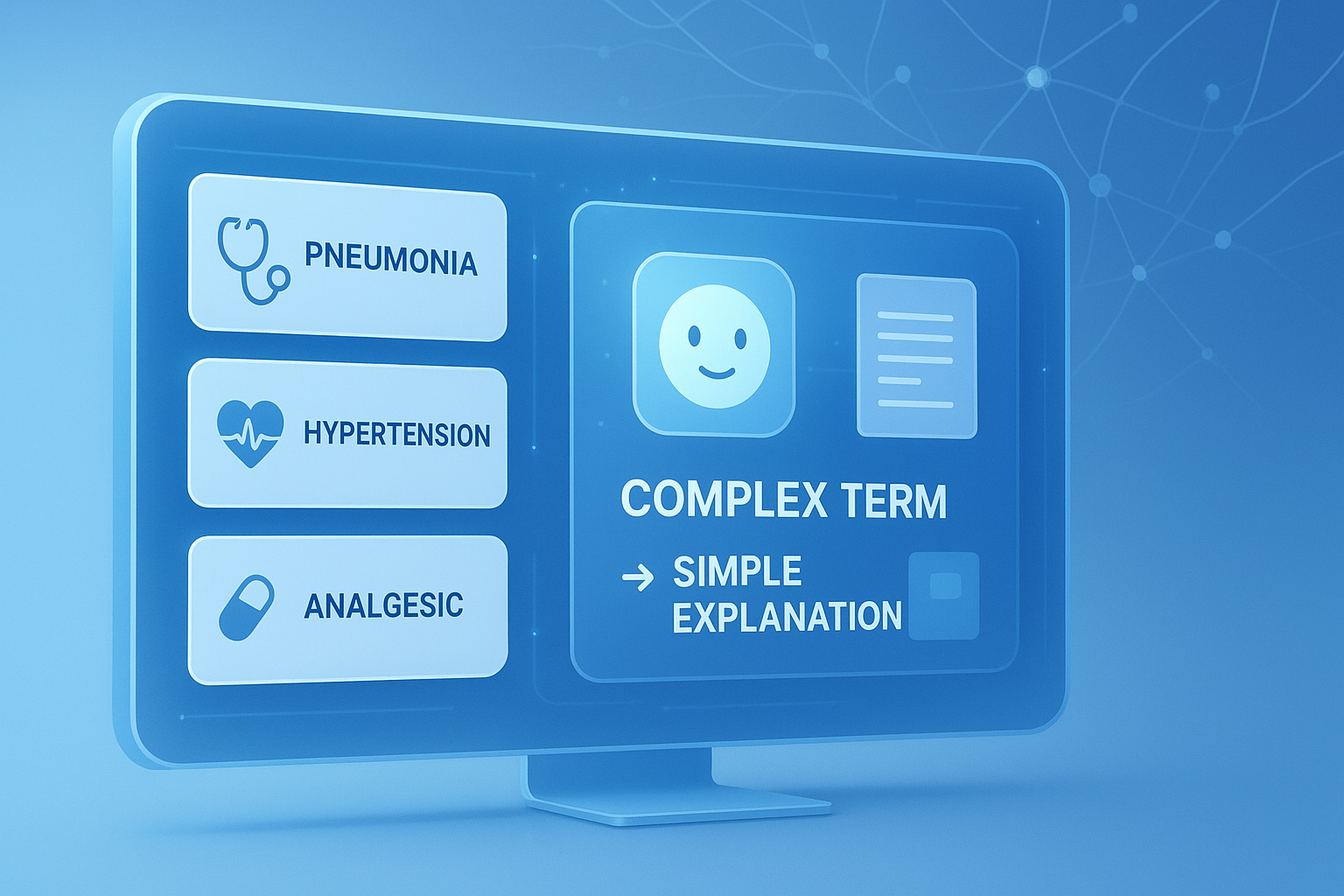
An AI medical terminology explainer is a tool that interprets complex healthcare language and rewrites it into simpler, clearer wording for a specific audience. It can define terms, expand abbreviations, explain diagnoses and procedures, and adjust the reading level of health content.
Think of it as a translation layer between clinical language and everyday understanding. It does not replace medical judgment. Instead, it helps professionals communicate more clearly.
- For patients, it can turn hard-to-read terms into understandable explanations
- For content teams, it can speed up plain-language drafting
- For educators, it can support training materials and glossaries
- For product teams, it can improve healthcare UX copy and onboarding
If you’re also publishing digital content at scale, pairing medical clarity with technical readability matters. Teams often use tools like an Word Counter to keep explanations concise and easier to scan.
Why medical terminology is so hard for readers to understand
Medical language is difficult because it compresses meaning into specialized terms, abbreviations, and context-dependent phrases. Even educated readers can misunderstand content when words are technically correct but poorly explained.
Here’s the problem. Healthcare language is built for precision among professionals, not for public readability. A phrase like “benign neoplasm” may be routine for a clinician, but many readers will pause at both words.
Several factors make this worse:
- Latin and Greek roots: Many terms are unfamiliar outside medicine
- Acronyms and abbreviations: One abbreviation can mean different things in different settings
- Dense sentence construction: Clinical writing often packs too much into one line
- Emotional context: Readers may be anxious, which reduces comprehension
- Low health literacy: Many adults struggle with complex health information
The CDC health literacy resources and the NIH clear communication guidance both stress the same point: people make better health decisions when information is easier to understand.
Who benefits most from an AI medical terminology explainer?
The biggest benefit goes to professionals who must convert medical accuracy into audience-friendly language. This includes healthcare writers, content strategists, patient education teams, product designers, and compliance-aware marketers.
Let’s break this down by role.
Healthcare content teams
Blog editors, copywriters, and SEO teams can use an AI medical terminology explainer to simplify definitions while preserving essential meaning. This is especially useful when writing condition pages, treatment summaries, FAQs, and appointment prep guides.
Clinics and hospitals
Provider organizations often need clearer patient instructions, consent explanations, and after-visit content. AI can help produce first drafts faster, though every output should be reviewed by a qualified professional.
Health app and SaaS product teams
UX writers and designers in health tech can use explainers to improve interface language, symptom descriptions, onboarding copy, and support content. If readability across devices matters, a quick check with a Text Case Converter can also help standardize terminology for buttons, headings, and UI labels.
Medical educators and trainers
These teams often need multiple versions of the same content: practitioner-facing, patient-facing, and beginner-friendly. An explainer can reduce manual rewriting time.
Regulated marketing teams
Healthcare brands must balance clarity, claims risk, and accuracy. AI can support drafting, but not final approval. That distinction matters.
How an AI medical terminology explainer typically works
Most tools use language models trained to recognize medical terms, infer context, and generate simpler explanations. The better systems combine terminology handling, plain-language rewriting, and audience control.
Now comes the important part. Not every output is equally reliable. Quality depends on prompt clarity, source text quality, and review process.
- Input: You paste a sentence, paragraph, report excerpt, or webpage section
- Term recognition: The system identifies medical words, abbreviations, and concepts
- Context analysis: It judges whether the content refers to diagnosis, treatment, anatomy, symptoms, or procedures
- Simplification: It rewrites the content in clearer language
- Output options: Some tools produce definitions, examples, or plain-English summaries
- Human review: A specialist checks for accuracy, nuance, and compliance
For teams handling long source material, utility tools like a Character Counter can help manage field limits for CMS entries, app screens, and search snippets.
What a good explanation should include
A useful explanation does more than define a term. It gives meaning in context, uses plain language, and avoids oversimplifying clinical facts.
Here’s what experienced professionals do differently. They don’t ask AI to “make this easier.” They ask for a precise transformation.
- Define the term in plain English
- Explain why it matters in the current situation
- Expand any abbreviation on first mention
- Use examples when the term is abstract
- Keep the reading level appropriate for the audience
- Flag uncertainty instead of guessing
| Weak explanation | Stronger explanation |
|---|---|
| “Hypertension means high blood pressure.” | “Hypertension means blood pressure stays higher than it should over time, which can raise the risk of heart disease, stroke, and kidney problems if it is not managed.” |
| “Biopsy is a test.” | “A biopsy is a procedure where a small sample of tissue is taken so it can be examined for signs of disease, such as infection, inflammation, or cancer.” |
Suggested Infographic: Clinical term to plain-language explanation workflow
Common use cases in health content
An AI medical terminology explainer is most useful when the goal is clarity, speed, and consistency across health information. It works best as a drafting and editing support tool, not as a final authority.
Patient education pages
Condition overviews, symptom guides, treatment options, and recovery instructions often contain unavoidable clinical language. AI can create the first plain-language version a reviewer then refines.
Medical blogs and SEO articles
Health publishers need content that is accurate and readable. This is where terminology explainers help reduce bounce caused by confusing terms. For teams refining article structure, an Readability Checker can support easier scanning and better reading flow.
After-visit summaries
Many summaries are technically correct but not useful to patients. AI can help expand shorthand and clarify next steps.
FAQs and support centers
Healthcare websites often answer the same questions repeatedly. Explainers can turn specialist language into clearer answers while maintaining consistency across pages.
Clinical training materials
Training often requires layered explanations for new staff, cross-functional teams, or non-clinical employees.
Examples: from clinical language to plain English
The easiest way to judge an AI medical terminology explainer is to compare before-and-after phrasing. Good output stays accurate while becoming easier to grasp on the first read.
| Clinical wording | Clearer patient-friendly version |
|---|---|
| The patient presents with dyspnea on exertion. | The person becomes short of breath during physical activity. |
| Administer medication BID. | Take the medicine twice a day. |
| The lesion was determined to be benign. | The growth was not cancerous. |
| Monitor for adverse events postoperatively. | Watch for problems or side effects after surgery. |
When preparing these side-by-side rewrites for publication, teams often clean formatting with a Remove Line Breaks tool to speed up content entry into CMS fields, emails, and patient portal templates.
Benefits of using AI for medical term explanations
The main advantage is speed, but speed is only useful when paired with reliable review. The best outcomes come from using AI to reduce drafting time while keeping humans responsible for clinical correctness.
- Faster first drafts: Writers can move from technical source text to usable plain-language copy more quickly
- Consistency: Repeated terms can be explained the same way across pages and teams
- Better patient understanding: Clearer wording supports comprehension and trust
- Scalable content operations: Helpful for large websites, knowledge bases, and multi-page condition libraries
- Improved UX: Plain language reduces confusion in forms, portals, and app screens
The World Health Organization health literacy guidance reinforces a core principle here: understanding is not a nice extra. It affects outcomes.
Limitations and risks you should not ignore
An AI medical terminology explainer can help with clarity, but it can also introduce errors, omit nuance, or sound more certain than the source supports. That makes human review essential.
This is where many people struggle. They assume simplified language is automatically safe language. It isn’t.
- Hallucinated definitions: AI may invent details not present in the source
- Loss of nuance: A medically important distinction may disappear during simplification
- Unsafe generalization: One patient’s context may not apply to another
- Abbreviation confusion: The same acronym can have multiple meanings
- Compliance issues: Consumer-facing health content may require legal, regulatory, or clinical approval
- Privacy concerns: Sensitive data should never be pasted into unapproved tools
For privacy and handling protected health information, consult your internal policies and standards such as the HHS HIPAA guidance. If a tool isn’t approved for sensitive data, don’t use real patient details.
Best practices for using an AI medical terminology explainer responsibly
The safest approach is to treat AI as a drafting assistant, not a medical source of truth. Strong teams create a repeatable workflow that checks clarity, accuracy, tone, and audience fit before anything goes live.
- Start with trusted source material. Use clinical references, approved internal copy, or clinician-reviewed documents.
- Specify the audience. Ask for patient-facing, caregiver-facing, or professional-level output.
- Set the reading goal. Request plain English, short sentences, and direct explanations.
- Expand abbreviations. Make sure acronyms are written out clearly on first use.
- Verify every key claim. Cross-check drugs, procedures, risks, timeframes, and numeric values.
- Remove patient identifiers. Never include sensitive personal data in unapproved systems.
- Use expert review. Final copy should be checked by a qualified clinician, editor, or compliance reviewer.
If your workflow also includes web publishing, you may find an HTML to Text tool useful when stripping formatting from copied source text before sending it for review or revision.
How to write better prompts for clearer medical explanations
The quality of the result usually depends on the prompt. A vague instruction creates vague output. A structured request creates explanations that are easier to trust and faster to review.
Here’s a practical prompt formula:
Explain the following medical text for a non-expert adult reader. Use plain English, short sentences, and no jargon unless you define it. Keep the meaning accurate. Expand abbreviations. If a term could have more than one meaning, say so. End with a brief summary of why this matters to the patient.
You can also add constraints such as:
- Target reading level
- Maximum word count
- Bullet list format
- Do not diagnose or make treatment recommendations
- Cite uncertain terms for human review
For editors comparing multiple AI outputs, a Diff Checker can help spot wording changes, lost qualifiers, and inconsistencies between drafts.
How does it compare with a medical dictionary or human editor?
An AI medical terminology explainer is faster and more flexible than a static dictionary, but less dependable than a qualified human reviewer. Each option solves a different problem.
| Option | Best for | Main limitation |
|---|---|---|
| Medical dictionary | Term lookup and formal definitions | Little context and limited readability support |
| AI medical terminology explainer | Fast rewriting, summarizing, and audience adaptation | May introduce errors or overconfident wording |
| Human medical editor | Accuracy, nuance, and final approval | Slower and more expensive |
A strong workflow uses all three. For standardized U.S. clinical coding language, teams may also refer to official references such as the CMS ICD-10 information when relevant.
What to look for in a quality tool
A useful tool should simplify language without hiding uncertainty. It should support audience targeting, preserve context, and make review easier rather than harder.
- Context-aware explanations instead of simple dictionary-style outputs
- Plain-language rewriting with adjustable complexity
- Abbreviation expansion
- Support for paragraphs, not just single terms
- Safe handling expectations and transparent limitations
- Clear output formatting for websites, portals, or documentation
If you also repurpose health content into PDFs, docs, or landing pages, a clean text-processing workflow matters. Teams often rely on tools like a Slug Generator when publishing patient-friendly articles and resource pages with readable URLs.
How AI medical terminology explainers support SEO and AI search visibility
Clear medical writing helps both readers and search engines understand your content. That makes an AI medical terminology explainer valuable not only for readability, but also for discoverability in classic search and AI-generated answers.
The answer depends on one thing: whether simplification improves content quality without reducing accuracy. Search systems reward pages that solve the reader’s problem well.
- Plain language often improves time on page and reduces confusion
- Defined terms help search engines connect related entities and concepts
- Clear headings and concise answers increase Featured Snippet potential
- Structured FAQs support visibility in AI Overviews and answer engines
- Readable content is easier for voice search and assistant-style summaries
Google’s own guidance on creating helpful, reliable, people-first content aligns closely with this approach. In health content, that means clear explanations, trustworthy review, and no exaggerated claims.
Common mistakes to avoid
Most problems come from overtrusting the tool or underdefining the task. Small mistakes in health content can become serious when readers rely on them for decisions.
- Publishing AI output without clinical review
- Simplifying away medically important qualifiers
- Ignoring audience reading level
- Leaving unexplained abbreviations in place
- Using the same wording for patients, clinicians, and marketers
- Pasting sensitive information into non-approved tools
- Confusing content support with medical advice
Suggested Screenshot: Example prompt with audience, reading level, and review notes
Frequently asked questions
Can an AI medical terminology explainer replace a doctor or medical editor?
No. It can help explain medical language, but it should not replace clinical judgment or final editorial review. Doctors and qualified medical editors understand nuance, patient context, claims risk, and safety issues that AI may miss. The best use case is draft support: AI speeds up simplification, while professionals verify the final wording before publication or patient use.
Is it safe to use AI with patient information?
Only if the tool and workflow are approved for sensitive data under your organization’s privacy and security rules. In many cases, the safe choice is to remove names, dates, identifiers, and any protected health information before using AI. If you are unsure, follow internal legal and compliance guidance and assume that unapproved public tools are not suitable for private patient data.
What kinds of medical terms can AI explain well?
AI usually handles common diagnoses, anatomy terms, procedures, symptoms, and standard healthcare phrases reasonably well, especially when context is provided. It may do less well with rare diseases, ambiguous abbreviations, emerging terminology, or highly specialized clinical language. The more technical the source, the more important expert review becomes.
How accurate are AI-generated medical explanations?
Accuracy varies. Some outputs are clear and correct, while others may omit context, misread abbreviations, or state uncertain ideas too confidently. That is why professionals should verify definitions, risks, dosage language, timelines, and any clinical implication. Accuracy improves when prompts are specific and the source text is trustworthy, but review is still required.
Does simplifying medical language hurt SEO?
No, not when done properly. In fact, clearer explanations often help SEO because they match how people actually search and improve user experience. The best pages include both the standard medical term and a plain-language explanation. That allows search engines to understand the topic while helping readers quickly find what the term means.
Should I explain every medical term on a page?
Not always. Explain the terms that are essential for understanding the topic or taking action. Overexplaining every minor term can make content longer and harder to scan. A practical approach is to define key terms on first mention, keep wording consistent, and use brief glossaries or FAQs for additional support when needed.
What teams should review AI-simplified health content before it goes live?
That depends on the organization, but common reviewers include medical editors, clinicians, legal teams, compliance reviewers, and UX content specialists. Consumer-facing pages often need both accuracy review and readability review. If the content includes claims about treatment outcomes, product benefits, or safety, regulatory oversight may also be necessary.
Are paid tools better than free AI explainers?
Sometimes, but not automatically. Paid tools may offer stronger privacy controls, workflow features, and better customization. Free options can still be useful for non-sensitive drafting or concept testing. The real question is whether the tool fits your standards for safety, accuracy, reviewability, and audience clarity. Cost matters, but governance matters more in healthcare content.
Final takeaway
An AI medical terminology explainer is most valuable when it helps professionals turn complex health language into clear, usable content without losing accuracy. It can save time, improve readability, and support stronger patient communication. But it works best inside a careful workflow, not as a shortcut around expertise.
If you’re creating health content, the next practical step is simple: test one page, one report excerpt, or one FAQ with a structured prompt, then review the output line by line. Focus on plain language, contextual accuracy, and audience fit.
To make that workflow smoother, related FreeToolr resources like the Readability Checker, Word Counter, Diff Checker, and HTML to Text tool can help you review, refine, compare, and publish clearer health content more efficiently.