
Used well, AI for students can save hours. Used badly, it can quietly make your work weaker.
That’s the real issue. Many students try AI for quick answers, then end up with vague notes, inaccurate citations, or writing that doesn’t sound like them. The tool isn’t the problem. The workflow is.
This guide shows how to use AI for students in a practical, responsible way. You’ll learn which tools help with studying, note-taking, writing, revision, and research, plus prompts you can copy and adapt. You’ll also see where AI should stop and your own judgment should take over.
If you want better grades, less wasted time, and fewer mistakes, let’s break this down.
What is AI for students, really?
AI for students means using artificial intelligence tools to support learning tasks such as summarizing notes, brainstorming ideas, creating study plans, explaining difficult concepts, checking writing, and organizing research. It works best as a learning assistant, not as a replacement for thinking.
That distinction matters. Good student use of AI improves understanding. Poor use usually leads to shallow learning, academic integrity issues, or inaccurate work handed in with too much confidence.
- Use AI to explain, quiz, organize, and simplify
- Use AI to speed up routine tasks
- Do not use AI to submit unverified answers as your own
- Do not assume AI output is always correct or current
For example, if you’re turning lecture notes into a cleaner study sheet, AI can help. If you need to convert those notes into a shareable file, a tool like JPG to PDF can also be useful when your notes start as phone photos or screenshots.
How students are using AI in 2026
Students now use AI across the full study process, from planning and note capture to revision and editing. The strongest results usually come from combining AI with clear instructions and active review.
Here are the most common use cases:
- Summarizing long readings into shorter revision notes
- Turning class notes into flashcards or quiz questions
- Explaining hard topics in simpler language
- Creating essay outlines before writing
- Checking grammar, clarity, and structure
- Building weekly study schedules
- Generating practice questions for exams
- Translating or simplifying academic language
Many schools now publish guidance on acceptable AI use. Before using any tool for assignments, check your institution’s policy. Guidance from the UNESCO guidance on generative AI in education and research and your own university’s academic integrity rules can help you stay on the safe side.
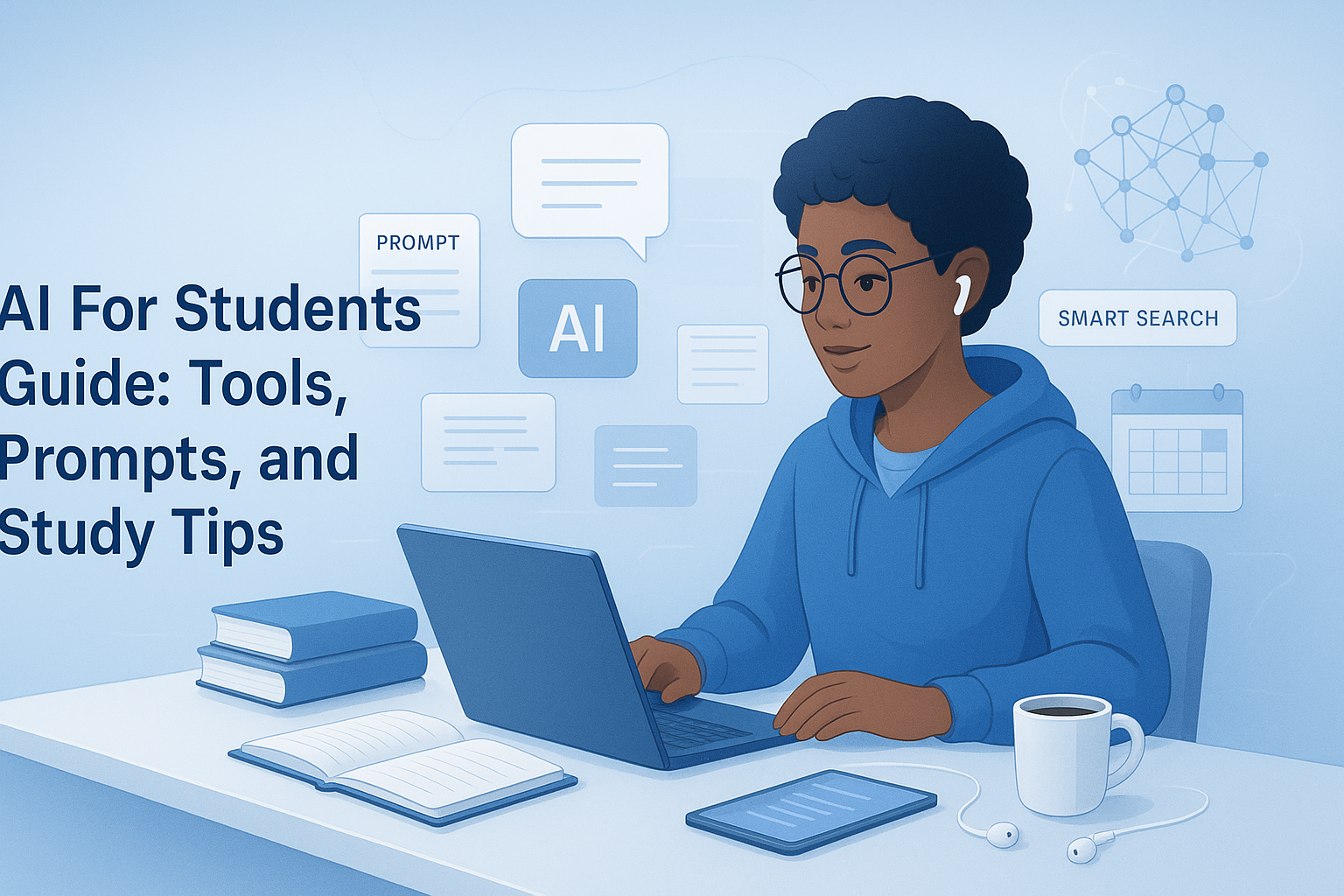
Suggested Image: Modern illustration of a student using AI for notes, planning, and revision
Best AI tools for students by task
The best AI tool depends on the job. There isn’t one perfect option for every student or every subject. Choose tools based on what you need help with and how much verification the task requires.
| Task | Best AI Use | What to Watch For |
|---|---|---|
| Understanding concepts | Ask for simpler explanations and examples | Oversimplified or incorrect explanations |
| Essay planning | Generate outlines and counterarguments | Generic structure and weak thesis ideas |
| Note-taking | Summarize, organize, and tag notes | Important detail may be removed |
| Revision | Create flashcards, quizzes, and spaced review prompts | Wrong answers in self-test material |
| Writing support | Improve clarity, grammar, and transitions | Writing may stop sounding like you |
| Research assistance | Refine questions and identify themes | Fake citations or weak sources |
General-purpose AI assistants
These tools are useful for brainstorming, explaining, summarizing, and drafting prompts. They’re flexible, but they still need supervision. If you ask vague questions, you’ll usually get vague answers.
- Chat-based AI assistants for explanations and planning
- Writing assistants for rewriting and clarity
- Search-integrated AI tools for quick research overviews
Note and document tools
Students often work with screenshots, lecture slides, and scanned pages. Cleaning and converting files makes AI workflows easier. If you’re compressing large visual notes before uploading or organizing them, Image Compressor can make file handling easier without changing your study routine.
Math and calculation support
AI can help explain formulas and show worked examples, but always verify calculations independently. For quick number checks while studying percentages, budgeting, or data tasks, Percentage Calculator can help you confirm results instead of trusting generated math blindly.
Where AI helps most in studying
AI is most useful when it reduces friction around learning. It struggles when students expect it to replace reading, reasoning, or source checking. The sweet spot is structured support.
1. Turning messy notes into useful notes
After class, students often have partial sentences, screenshots, and fragmented ideas. AI can reorganize that material into sections, summaries, definitions, and review questions.
Try a prompt like this:
Organize these lecture notes into clear headings, key definitions, main arguments, and 10 review questions. Keep all subject-specific terms.
If your notes are spread across image files and scanned handouts, cleaning the format first helps. For handwritten or visual study materials, Image to Text Converter can make notes easier to edit and summarize.
2. Explaining difficult concepts
This is where many students see immediate value. AI can restate a concept in simpler language, compare it with something familiar, or explain it step by step.
Better prompt:
Explain photosynthesis as if I am a 15-year-old student. Then give me a more exam-level explanation with key terms I should memorize.
That second instruction matters. It stops the answer from becoming too simplistic.
3. Active revision instead of passive rereading
Rereading notes feels productive, but it’s often weak revision. AI can generate flashcards, mini-tests, and recall questions that force you to retrieve information from memory.
- Ask for multiple-choice questions with explanations
- Request short-answer questions by topic
- Generate “explain this in your own words” prompts
- Ask for mixed-difficulty quizzes
Research-backed study methods such as retrieval practice and spacing are widely supported. The Institute of Education Sciences overview of retrieval practice is worth bookmarking if you want evidence behind your revision approach.
4. Building study schedules
AI is useful for planning when your workload feels messy. It can help map deadlines, split projects into steps, and estimate weekly study blocks. But give it constraints, or the plan won’t be realistic.
Create a two-week study plan for biology, history, and math. I have classes from 9 to 3, sports on Tuesday and Thursday, and exams in 14 days. Include breaks and one review day.
If you need structured time management support, a simple utility like Time Calculator can help you check study blocks, durations, and realistic workloads.
How to use AI for writing without sounding fake
AI should improve your writing process, not replace your voice. The safest and smartest use is for planning, clarity, structure, and editing after you’ve done the thinking.
Here’s what experienced students do differently: they ask AI to support the draft, not invent the argument.
Good ways to use AI for academic writing
- Brainstorm possible angles for an essay topic
- Test whether your thesis is clear
- Generate an outline with counterpoints
- Improve transitions between paragraphs
- Check grammar and sentence clarity
- Suggest stronger topic sentences
Bad ways to use AI for academic writing
- Submitting AI-written paragraphs without review
- Using invented references or quotations
- Copying a generic essay structure that ignores the prompt
- Letting AI flatten your natural writing style
Use a prompt like this instead:
Here is my introduction and thesis. Suggest three ways to improve clarity and argument strength without changing my viewpoint or tone.
If you also write for class blogs, portfolios, or student projects, improving readability matters. For headline testing or cleaner wording, a related resource like AI Content Writing Guide can help you think more critically about how AI shapes written output.
AI for research: useful, but risky
AI can help you start research faster by narrowing topics, identifying themes, and suggesting questions. It should not be trusted as a final source checker. This is where many students make avoidable mistakes.
The biggest risk is false confidence. A polished answer can still contain made-up citations, outdated claims, or misread evidence.
Best uses in the research process
- Refine a broad topic into a focused research question
- List possible subtopics to explore
- Generate keywords for database searches
- Summarize your own collected sources
- Compare viewpoints after you verify them
What not to trust automatically
- References you haven’t checked yourself
- Direct quotations without a source link
- Claims about laws, medicine, or fast-changing events
- Statistics with no visible source
For research quality, use your library database, Google Scholar, and official publications. Citation style guidance from the APA Style official website or other official style manuals helps keep your references accurate.
Suggested Screenshot: Example workflow showing AI topic refinement followed by library database research
Prompt templates students can copy and adapt
Strong prompts produce better results because they reduce ambiguity. Tell the AI the task, level, format, subject, and limits. That one change often improves output more than switching tools.
For summarizing notes
Summarize these notes into 5 key points, then list important terms with short definitions. Keep technical vocabulary and do not remove examples.
For understanding a topic
Explain this concept in plain English, then give me a more advanced explanation suitable for an exam answer. Include one analogy and one common mistake students make.
For revision questions
Create 15 mixed-difficulty quiz questions from these notes. Include 5 multiple-choice, 5 short-answer, and 5 application questions. Put answers at the end.
For essay planning
Help me create an essay outline on this topic. Include a thesis, 3 main arguments, 1 counterargument, and the kind of evidence I should look for. Do not write the full essay.
For editing your own draft
Review this paragraph for clarity, grammar, and logic. Keep my tone. Highlight unclear phrases and suggest improvements without rewriting everything.
For study planning
Build a weekly study plan based on these deadlines, available hours, and weak subjects. Prioritize urgent tasks and include review sessions.
Students working across different formats may also need quick conversion tools while building study packs. For instance, Word Counter is useful when you want tighter answers, essay drafts within limits, or more concise revision notes.
AI study tips that actually improve learning
The best results come from pairing AI with proven study habits. AI can make weak habits faster, or strong habits easier. The difference is how you use it.
- Start with your own attempt. Try the question first, then use AI to check gaps.
- Ask for questions, not just answers. Testing yourself builds memory better than rereading.
- Use it after class, not instead of class. AI organizes learning better than it creates it.
- Verify facts before memorizing them. Wrong summaries create bigger problems later.
- Keep prompts specific. Subject, level, format, and deadline all matter.
- Review in stages. Ask for a summary, then a quiz, then an application task.
For writing-heavy coursework, readability also matters. If you’re condensing texts or reducing clutter in notes, Text Case Converter can help clean formatting when you’re reorganizing copied titles, headings, or study material.
Common mistakes students make with AI
Most AI-related problems come from overtrust, vague prompting, or skipping verification. These mistakes are easy to fix once you know what to watch for.
| Mistake | Why It Hurts | Smarter Fix |
|---|---|---|
| Copying answers directly | Weak learning and possible policy violations | Use AI for explanation and outline support |
| Trusting citations blindly | Fake or incorrect sources | Verify every source in a database or official site |
| Using vague prompts | Generic, low-value output | Specify audience, format, level, and purpose |
| Skipping fact checks | Memorizing errors | Cross-check with class materials and trusted sources |
| Letting AI rewrite everything | Loss of personal voice | Ask for targeted edits only |
How to use AI ethically and safely at school or university
Ethical use means being honest about what the tool did, following your school’s rules, and making sure the final work reflects your own understanding. Safety means protecting personal data and not uploading sensitive information carelessly.
Now comes the important part. Even if your school allows AI, the acceptable level of use may differ by assignment.
- Check course or institution AI policies before submitting work
- Don’t upload private personal information, grades, or confidential material
- Be careful with unpublished research or identifiable data
- Disclose AI use if your teacher or university requires it
- Treat every generated answer as a draft, not a fact
Privacy guidance from the Federal Trade Commission consumer advice and product-specific policies from providers such as OpenAI’s privacy policy can help you make better decisions about what you upload.
Simple workflow: the smartest way to use AI for students
A practical workflow keeps AI useful without letting it take over. Think of it as a four-step loop: learn, prompt, verify, apply. That one system works across most subjects.
- Start with the original material. Read the chapter, lecture notes, prompt, or question first.
- Ask AI for support. Use it to explain, organize, test, or plan.
- Verify the output. Compare answers with class materials and trusted sources.
- Produce your own final work. Write, solve, or revise in your own words.
Here’s a practical example:
- Read your history notes
- Ask AI to identify 5 major themes
- Check those themes against your textbook
- Use AI to create a self-test
- Answer without looking
- Review mistakes and write a short summary yourself
Frequently asked questions about AI for students
Is AI good for students?
Yes, if it supports learning rather than replacing it. AI is especially useful for explaining concepts, organizing notes, generating practice questions, and improving study plans. It becomes a problem when students rely on it for final answers without checking accuracy. Used well, it can save time and improve understanding. Used poorly, it can weaken both skills and trust.
Can students use AI for homework?
The answer depends on your school’s rules and the type of homework. Many teachers allow AI for brainstorming, explanation, or grammar help, but not for generating full answers to submit as your own. Always check the assignment instructions first. A safe rule is this: if AI helps you learn and you still do the real thinking yourself, you’re usually on much safer ground.
What is the best AI tool for studying?
There isn’t one best option for every student. General AI assistants are good for explanations, summaries, and planning. Specialized note and writing tools can help with organization and editing. The best choice depends on your subject, budget, and how much verification the task needs. Start with one tool, learn its limits, and build a simple workflow around it instead of constantly switching between platforms.
Can AI help students write essays?
Yes, but the strongest use is before and after drafting, not instead of drafting. AI can help brainstorm topics, test thesis statements, build outlines, and improve clarity. It should not be trusted to write the final essay for you, especially in academic settings. Overuse often creates generic writing, weak arguments, and possible academic integrity issues. Keep your ideas central and use AI as an editor or planning assistant.
Is AI safe for student research?
It can be safe for early-stage research support, such as narrowing a topic, generating keywords, or summarizing your own verified sources. It is not safe to trust automatically for citations, quotations, or factual claims. Some tools still produce false references or incomplete context. Always verify sources in your library database, Google Scholar, or official institutional materials before using them in assignments.
Do teachers know when students use AI?
Sometimes yes, sometimes no. Teachers often notice when writing suddenly changes tone, becomes overly generic, or includes strange factual errors. AI detectors are not perfectly reliable, so the larger issue is not detection alone. It’s whether the work sounds authentic, follows assignment rules, and reflects real understanding. If you use AI responsibly for planning or editing, your final work should still clearly sound like you.
Are free AI tools enough for students?
For many students, yes. Free tools are often enough for note summaries, study prompts, concept explanations, and basic writing support. Paid versions may offer better speed, file handling, memory, or advanced features, but they aren’t necessary for everyone. Before paying, ask whether the upgrade solves a real study problem. A better workflow often matters more than a more expensive tool.
What should students never put into AI tools?
Avoid uploading private personal data, login details, confidential school records, unpublished research, or sensitive information about other people. If you’re working with protected data, check your institution’s rules first. Even when a tool feels convenient, it may not be the right place for personal or confidential content. When in doubt, remove names, identifying details, and anything you would not want shared outside your own device.
Final thoughts
AI for students works best when it helps you think better, not when it does the thinking for you. The most effective uses are usually the simplest: clearer notes, smarter revision, sharper prompts, and faster planning.
Start small. Pick one task this week, such as turning class notes into quiz questions or improving an essay outline. Then verify the output and keep what actually helps.
If you want to make that workflow smoother, useful next steps include Image to Text Converter for extracting notes, Time Calculator for study planning, Word Counter for writing limits, and JPG to PDF for organizing visual study materials. Use the tool. Keep the judgment. That’s the difference between faster work and better learning.