Most eBay listings don’t fail because the product is bad. They fail because the title is weak.
If your item title is vague, too short, stuffed with random words, or missing key buying terms, your listing can disappear into the crowd. That’s why an AI eBay product title generator has become useful for small business owners who need better titles without spending all day writing them.
The real value isn’t just speed. A good AI tool helps you turn product details into clearer, more searchable titles that match how buyers browse on eBay. When used well, it can improve visibility, clicks, and consistency across your listings.
In this guide, you’ll learn how an AI eBay product title generator works, when to trust it, where it can go wrong, and how to create titles that are optimized for search and written for real shoppers.
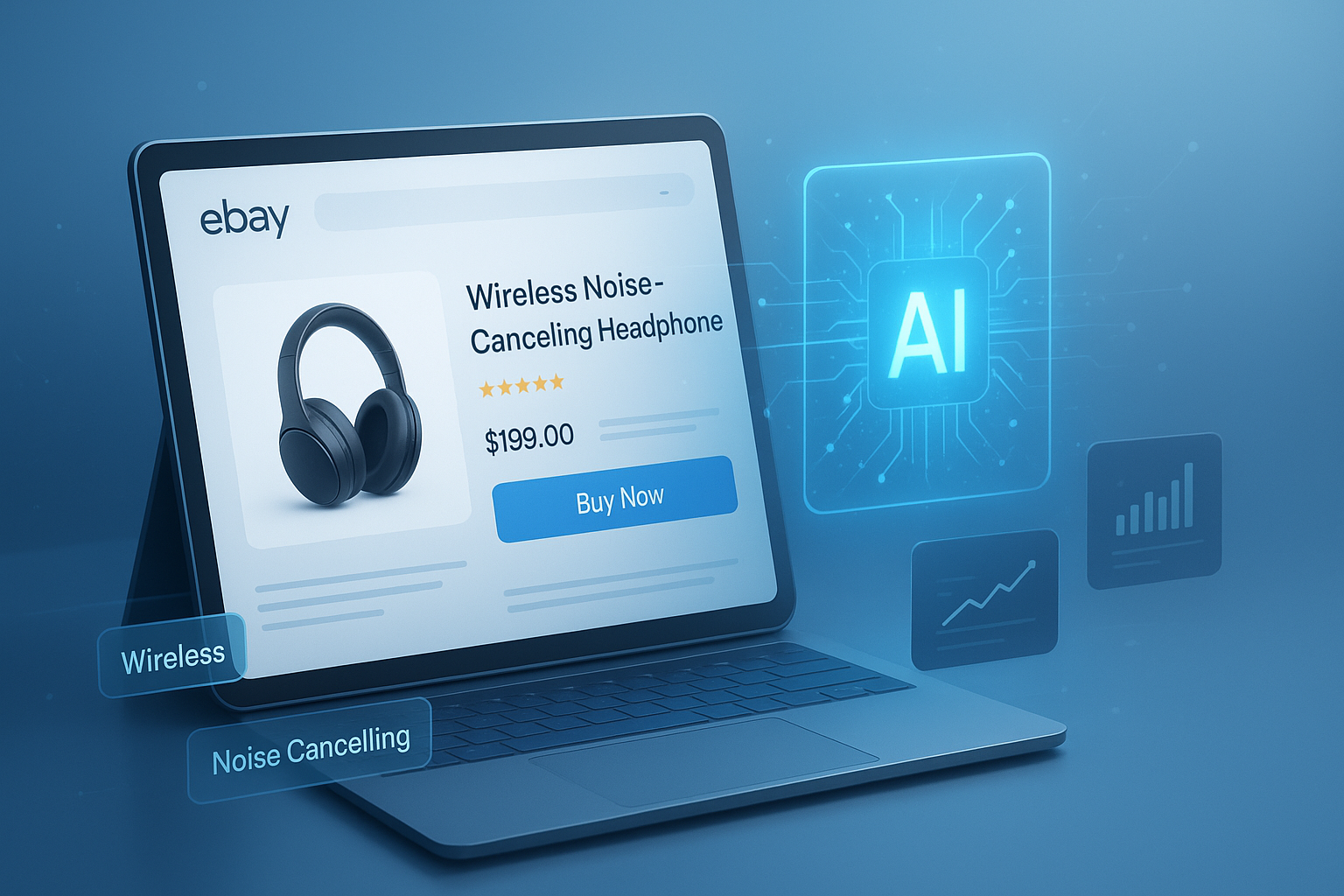
Suggested Image: Technology concept showing AI-assisted eBay listing optimization dashboard
What is an AI eBay product title generator?
An AI eBay product title generator is a tool that creates listing titles based on the details you provide, such as brand, product type, size, color, condition, features, and target keywords. Its goal is to help sellers write titles that are clearer, faster, and better aligned with search behavior on eBay.
Instead of staring at a blank field, you enter basic product information and let the tool suggest title options. Some tools focus on readability. Others focus on keyword placement, title length, or marketplace formatting.
For sellers managing many listings, this can save hours. It also helps create consistency across your catalog, especially when you sell similar products in multiple variations.
If you also work with product photos, a tool like Image Compressor can help reduce file size before uploading pictures for faster page performance and smoother listing management.
Why product titles matter so much on eBay
Your title does two jobs at once. It helps eBay understand what you’re selling, and it helps the buyer decide whether your listing is worth clicking. If either part fails, the listing loses momentum.
eBay’s search ecosystem relies heavily on listing data. According to eBay’s keyword tips for sellers, relevant keywords in titles are critical for helping buyers find items. Clear wording also improves usability, which affects click behavior and buyer trust.
A strong title usually does these things well:
- Names the product clearly
- Includes major identifiers like brand or model
- Adds important attributes such as size, color, compatibility, or condition
- Uses words buyers actually search
- Avoids wasted space and filler
Here’s the problem. Many small sellers either underwrite titles or overstuff them. One leaves out useful search terms. The other creates unreadable clutter. AI can help balance both, but only when the input is good.
How an AI eBay product title generator actually works
Most AI title generators use language models or structured templates to turn raw product details into polished title suggestions. The better tools combine readability with marketplace logic rather than simply rearranging keywords.
In simple terms, the process looks like this:
- You enter product details
- The tool identifies key terms and attributes
- It prioritizes the most important words
- It generates one or more title options
- You review, edit, and choose the strongest version
The quality of output depends on what you feed into the tool. If you input “shirt blue medium,” you’ll get a generic result. If you input “Nike Dri-FIT Men’s Running Shirt Blue Medium Short Sleeve,” the result is far more useful.
For sellers creating product copy beyond titles, an AI paragraph generator can help draft item descriptions, FAQs, or short promotional text while keeping your workflow efficient.
What information should you provide to get better titles?
This small detail changes everything. AI is only as helpful as the product details you enter.
- Brand name
- Product type
- Model or series
- Size or dimensions
- Color
- Material
- Condition
- Key feature or use case
- Compatibility if relevant
- Target search phrase
If dimensions matter, especially for accessories, packaging, or replacement parts, a utility like the Inches to CM converter can help you standardize measurements before writing titles and descriptions.
What makes a good eBay title in 2026?
A good eBay title in 2026 is specific, readable, and built around buyer intent. It uses strong identifying terms first, includes meaningful attributes, and avoids unnecessary words that take up valuable space.
Here’s what experienced sellers do differently. They don’t write titles for themselves. They write them for search visibility and quick buyer recognition.
| Element | Why It Matters |
|---|---|
| Brand | Helps buyers quickly identify the product and improves relevance for brand-specific searches |
| Product type | Tells both the platform and the buyer what the item is |
| Model or variant | Essential for electronics, parts, tools, collectibles, and apparel lines |
| Key attributes | Size, color, material, or compatibility can improve both search matching and click quality |
| Natural wording | Makes the title easier to scan and more trustworthy to human buyers |
You can also review Google’s advice on writing useful, people-first content in the Google Search guidance on helpful content. While Google and eBay are different platforms, the core principle is the same: clarity beats manipulation.
Common traits of strong titles
- Important words appear early
- No filler like “look,” “wow,” or “best”
- No duplicate terms unless necessary
- Readable order instead of random keyword dumping
- Specific attributes that reduce buyer confusion
Benefits of using an AI eBay product title generator
An AI eBay product title generator can save time, improve consistency, and help uncover keyword combinations you might miss when writing manually. For small business owners with many SKUs, that can make listing workflows much easier.
Let’s break this down.
1. Faster listing creation
If you list dozens or hundreds of products, title writing becomes repetitive. AI reduces the blank-page problem and gives you a working draft immediately.
2. Better keyword coverage
Many sellers forget useful words buyers actually use. AI often pulls in terms like material, category, compatibility, and variations that improve search matching.
3. More consistent catalog structure
Consistent titles make your store look more professional. They also make editing, sorting, and updating listings easier later.
4. Easier testing
You can generate several title versions, compare them, and refine based on performance. This is especially useful when similar products compete in crowded categories.
If you’re organizing content for multiple listings, product bundles, or marketing notes, a tool like the Word Counter can help you control copy length and keep titles or descriptions concise.
Where AI title generators fall short
AI is helpful, but it is not a replacement for seller judgment. It can suggest titles that sound polished while still missing what matters most to actual buyers in your niche.
This is where many people struggle. They assume a generated title is automatically optimized. It isn’t.
Common problems include:
- Overused generic adjectives
- Missing category-specific terms
- Awkward phrasing
- Wrong attribute order
- Invented or inaccurate details
- Keyword stuffing that hurts readability
For product data accuracy, especially around spelling, structured naming, and standard terminology, it helps to follow marketplace style rules and documentation. Even broader web standards around clarity and semantics, such as those discussed by the MDN guide to semantic content, reinforce the same lesson: meaning matters.
Never publish AI output without checking these points
- Is the brand correct?
- Is the model number accurate?
- Does the title reflect the actual condition?
- Are important attributes included?
- Does it read naturally from left to right?
- Would a buyer instantly understand the item?
How to use an AI eBay product title generator the right way
The best results come from using AI as a drafting assistant, not a final decision-maker. Give it clear product data, review the output critically, then improve the wording based on search intent and buyer behavior.
Here’s a practical workflow that works well for small business owners.
- Start with accurate product data. Gather brand, category, model, size, color, condition, and features before generating anything.
- Choose one main search phrase. Decide what a buyer would most likely type first.
- Generate multiple title options. Don’t stop at the first output.
- Edit for clarity. Remove weak words and fix awkward order.
- Check title length. Make sure key information appears early.
- Compare similar listings. Look for missing attributes or clearer wording.
- Track performance over time. Watch impressions, clicks, and conversions.
Need to clean up source text before feeding it into AI? The Text Case Converter can help normalize product names, model formats, and attribute capitalization.
Simple title formula you can adapt
A reliable structure looks like this:
Brand + Product Type + Model/Series + Key Feature + Size/Color/Compatibility + Condition
Example:
Samsung Galaxy Buds2 Pro Wireless Earbuds Graphite Noise Cancelling New
That’s much stronger than:
New Earbuds Great Sound Fast Shipping Must See
Manual titles vs AI-generated titles
Manual writing gives you control. AI gives you speed. The best approach for most sellers is a hybrid method: use AI to generate options, then edit manually for accuracy and conversion.
| Approach | Best For | Pros | Limitations |
|---|---|---|---|
| Manual only | Unique or high-value items | Full control, highly tailored wording | Slow and inconsistent at scale |
| AI only | Quick drafts for large catalogs | Fast and efficient | Can be inaccurate or generic |
| AI plus manual editing | Most small businesses | Balanced speed, quality, and control | Still requires review time |
Examples of weak titles and better alternatives
Good examples make this easier to apply. Below are a few side-by-side comparisons that show how specificity improves both search visibility and buyer confidence.
| Weak Title | Better Title | Why It Works Better |
|---|---|---|
| Nice women shoes size 8 | Clarks Women’s Leather Loafers Size 8 Black Slip On | Adds brand, material, color, and style |
| Phone case new | OtterBox iPhone 14 Pro Case Black Shockproof New | Includes compatibility and product type clearly |
| Vintage toy collectible rare | 1989 TMNT Leonardo Action Figure Vintage Playmates Loose | Uses searchable identifiers instead of vague claims |
Suggested Screenshot: Before-and-after eBay title examples generated with AI and manually refined
Best practices for eBay title optimization
The strongest titles are built around relevance, not hype. Use the words buyers need to identify the item quickly, and prioritize facts over promotional language.
- Put the most important terms first
- Use recognizable naming conventions
- Include condition when it matters
- Use abbreviations only if buyers commonly search them
- Avoid all caps unless part of a model name
- Skip symbols and gimmicks unless required for meaning
- Tailor titles by category, not with a one-size-fits-all pattern
For current best practices around structured information and how systems understand content, the Schema.org Product documentation is useful background. Even if you are not adding schema on eBay itself, it shows what data points matter most for product understanding across the web.
If your listing workflow includes images with background cleanup or visual consistency, Image to Base64 may be helpful for development or asset-handling tasks tied to storefront tools and custom systems.
Common mistakes small business owners make
Most title problems are fixable. The challenge is catching them before they damage visibility or attract the wrong clicks.
Using titles that are too generic
A title like “men’s jacket large” doesn’t tell the buyer enough. Add brand, material, style, and color where appropriate.
Stuffing the title with repeated keywords
Repeating the same words doesn’t make the title stronger. It often makes it harder to read and less trustworthy.
Leaving out compatibility
For accessories, replacement parts, and electronics, compatibility can be one of the most important search terms.
Ignoring buyer language
Sellers often describe products using internal terms or supplier language. Buyers search differently. Match real shopping behavior.
Trusting AI without product knowledge
AI doesn’t know your inventory better than you do. If it suggests the wrong variant, you need to catch it.
To improve writing consistency across titles, descriptions, and customer messages, you may also find an online grammar checker useful for reviewing text before publishing.
How to measure whether your new titles are working
Better titles should lead to better visibility and stronger clicks, but don’t judge performance too quickly. Look at patterns over multiple listings and a reasonable testing period.
Focus on these metrics:
- Impressions in search
- Click-through rate
- Watch count
- Conversion rate
- Return rate from mismatched expectations
Now comes the important part. A title that gets more clicks but fewer conversions may be attracting the wrong audience. In that case, the title may be too broad or slightly misleading.
For broader analytics work and percentage changes, a tool like the Percentage Calculator can help you quickly compare listing performance before and after title updates.
For a more disciplined testing mindset, Google’s documentation on search snippets is worth reading. It reinforces how wording affects visibility and user decision-making, even beyond e-commerce platforms.
Should every seller use an AI eBay product title generator?
No. But many should. The answer depends on one thing: how much time you spend listing products compared with how much control you need over each title.
AI title generation is especially useful if you:
- Run a small or medium e-commerce operation
- List many repeatable product types
- Need help writing faster
- Want more title consistency
- Struggle to identify useful keywords
It may be less useful if you mostly sell:
- Rare collectibles requiring expert terminology
- One-of-a-kind handmade items
- Products with legal, technical, or regulated naming requirements
When precision matters and catalog data is messy, it helps to clean your inputs first. Even simple workflow tools like Remove Duplicate Lines can save time when you’re organizing bulk product attributes from spreadsheets or supplier exports.
Frequently asked questions
Is an AI eBay product title generator good for beginners?
Yes, especially for beginners who aren’t sure how to structure titles. It gives you a starting point and helps surface important details such as brand, size, color, or compatibility. That said, beginners should still review every suggestion carefully. AI can improve speed, but it can also introduce errors if your product input is incomplete or unclear. Think of it as a coach, not an autopilot.
Can AI-generated titles improve eBay search rankings?
They can help, but there is no guarantee. Better titles may improve search visibility when they include relevant keywords and clear product details buyers actually use. What matters most is relevance, accuracy, and readability. If AI helps you create stronger titles than you would write manually, your listings may perform better. If the output is generic or inaccurate, it can hurt performance instead.
How long should an eBay product title be?
The ideal length depends on the product, but the real priority is not using every character just because you can. Place the most important words first so buyers and search systems understand the item immediately. A concise, information-rich title usually performs better than a padded one. Focus on brand, product type, model, and major attributes before adding secondary details.
What details should I always include in a title?
Start with the product type and any major identifier, such as brand or model. Then add attributes that truly help the buyer, like size, color, material, condition, or compatibility. The exact mix depends on the category. For clothing, size and brand matter a lot. For electronics, model and compatibility matter more. Include only details that improve identification and search relevance.
Is it safe to rely on AI for bulk listing creation?
It is safe only if you review the output. AI can save a lot of time when creating many titles, but bulk generation increases the risk of duplicate phrasing, wrong attributes, or category mismatch. If you manage a large catalog, build a review step into your process. Check sample outputs first, refine your input format, and watch performance data after publishing changes at scale.
Does AI work better for some eBay categories than others?
Yes. AI tends to work best in categories with structured product details, such as electronics, clothing, accessories, home goods, and common replacement parts. It can be less reliable for highly specialized niches, collectibles, antiques, or products where expert wording matters. In those cases, AI is still useful for drafting, but human editing becomes much more important.
Should I use the same title style for every listing?
You should use a consistent structure, not identical wording. Consistency helps your workflow and store organization, but each title should still reflect the specific product and category. A strong template gives you repeatability without making everything sound robotic. For example, most apparel titles can follow one structure, while electronics or collectibles may need a different order of attributes.
Do I need separate tools for descriptions, images, and text cleanup?
In many cases, yes. Title generation solves only one part of listing optimization. You may also need tools for image compression, text cleanup, grammar review, or product description drafting. Using a few focused tools often works better than expecting one tool to handle every step. The goal is a smoother listing workflow, not just faster titles.
Final thoughts
An AI eBay product title generator can be a smart shortcut for small business owners, but it works best when paired with good product data and human review. The biggest gains usually come from clearer wording, stronger keyword coverage, and more consistent listing structure.
If you want better eBay titles, start with one product category, test a few AI-generated versions, and compare results over time. Keep what improves clicks and conversions. Rewrite what feels vague, stuffed, or inaccurate.
For your next step, it may help to combine title generation with a few supporting tools: Image Compressor for listing photos, AI paragraph generator for richer descriptions, Word Counter for controlling copy length, and Percentage Calculator for measuring listing performance changes.