Rewriting content sounds easy until you’re staring at a draft that feels awkward, repetitive, or too close to the original. That’s where an AI article rewriter becomes useful. It helps marketers reshape existing content faster without starting from a blank page every time.
But speed alone isn’t the real win. A good rewriter can improve clarity, adjust tone, simplify dense copy, and create fresh versions for SEO, email, social, or landing pages. Used well, it saves time while keeping your message intact.
In this guide, you’ll learn how an AI article rewriter works, when to use it, where it falls short, and how to turn machine-assisted rewrites into content people actually want to read.
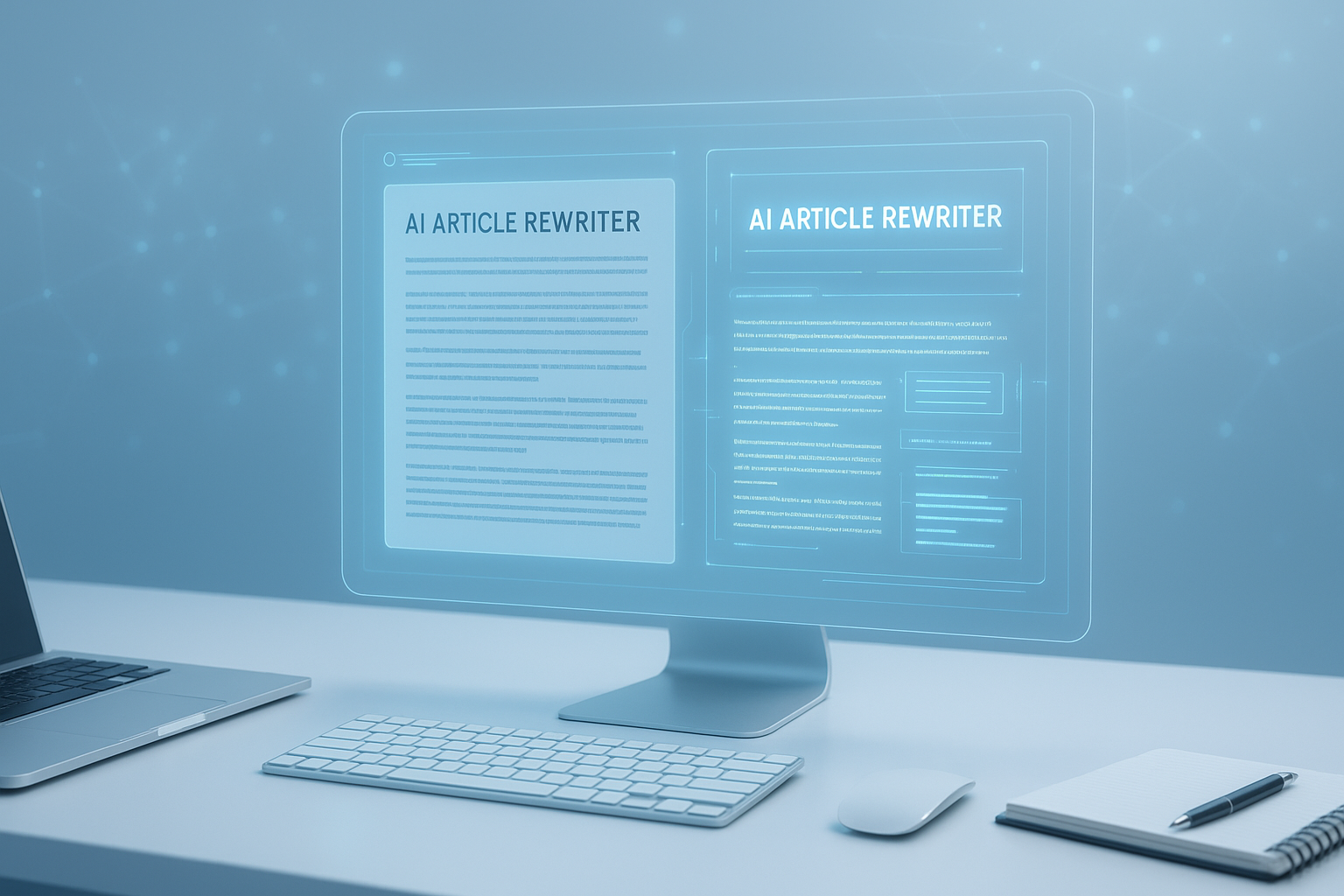
Suggested Image: Technology concept showing AI rewriting text across multiple content formats
What is an AI article rewriter?
An AI article rewriter is a tool that takes existing text and produces a new version with different wording, structure, or tone while preserving the original meaning. Marketers use it to refresh blog posts, repurpose content, improve readability, and create faster first drafts for editing.
Most tools rely on language models that understand context rather than just swapping words with synonyms. That matters because basic spinning tools often create unnatural sentences, while modern AI tools can rewrite by paragraph, audience, format, or goal.
If you’re already testing AI-assisted workflows, tools like the AI article rewriter can fit into content production when you need a clean draft before deeper editing.
What an AI rewriter usually changes
- Sentence structure
- Word choice and tone
- Reading level
- Paragraph flow
- Content format for different channels
- Clarity and conciseness
What it should not do
- Invent facts
- Replace human judgment
- Guarantee originality without review
- Automatically improve rankings
- Understand your brand better than your team
Why marketers use an AI article rewriter
Marketers usually adopt rewriting tools for one reason: output pressure. You need more variations, more updates, and more channel-specific copy than most teams can write manually at scale.
Here’s the problem. The demand isn’t just for “more content.” It’s for content tailored to audience stage, platform, search intent, and campaign goals. Rewriting tools help bridge that gap by turning one draft into multiple usable versions.
- Update aging blog posts without rebuilding them from scratch
- Turn long-form content into email, ad, or social copy
- Simplify technical writing for broader audiences
- Improve weak drafts from freelancers or internal teams
- Test different messaging angles quickly
- Create region-specific or audience-specific versions
When working on campaign assets, many teams also combine rewriting with supporting utilities like an Image Compressor to prepare visuals for faster-loading content pages.
How an AI article rewriter actually works
An AI article rewriter analyzes the meaning, grammar, and context of your text before generating a new version. Instead of changing isolated words, better tools predict more natural ways to express the same ideas.
That process typically includes pattern recognition, semantic understanding, and controlled generation. In simple terms, the tool reads what your text says, identifies how it is structured, and rewrites it based on your prompt or settings.
- Input: You paste a paragraph, article, or draft.
- Intent detection: The model identifies topic, tone, and context.
- Transformation: It rewrites based on your instruction, such as shorter, clearer, formal, persuasive, or SEO-focused.
- Output: You receive a new draft that still needs review.
For marketers concerned about content quality and discoverability, it helps to align rewrites with guidance from Google’s helpful content guidance and the broader Google Search Central documentation.
AI article rewriter vs manual rewriting
The best choice depends on what you need most: speed, nuance, subject knowledge, or editorial control. AI is faster, but human editing is still better at judgment, originality, and brand alignment.
| Factor | AI Article Rewriter | Manual Rewriting |
|---|---|---|
| Speed | Very fast | Slower |
| Brand voice | Needs guidance | Usually stronger |
| Context accuracy | Can drift | Better with expertise |
| Idea expansion | Good with prompts | Often deeper |
| Scalability | Excellent | Limited by time |
| Final polish | Needs review | Can be publication-ready |
Here’s what experienced professionals do differently. They don’t treat AI and manual rewriting as opposites. They use AI for acceleration and editors for quality control.
When an AI article rewriter works best
An AI article rewriter performs best when the source material is solid but needs improvement, adaptation, or reformatting. It is much less effective when the original content is inaccurate, thin, or strategically weak.
Strong use cases
- Refreshing old blog posts with clearer language
- Turning one article into multiple ad or email variants
- Shortening long content for mobile readers
- Rewriting expert interviews into a cleaner narrative
- Localizing copy for different markets without changing the core message
- Adjusting reading level for beginner audiences
Weak use cases
- Highly regulated topics without expert review
- Original research that depends on exact wording
- Brand storytelling that needs emotional nuance
- Legal, medical, or financial claims requiring precision
If your workflow includes downloadable assets or supporting documents, pairing rewritten content with a clean document utility like the PDF to Word tool can make source cleanup much easier before editing begins.
How to use an AI article rewriter without hurting SEO
Using an AI article rewriter does not automatically harm SEO. The risk comes from publishing generic, shallow, or repetitive rewrites with no added value. Search engines reward useful content, not the method used to create it.
According to Google’s guidance on AI-generated content, quality matters more than whether AI was involved. That means your rewrite should still be accurate, original in expression, and clearly helpful to the reader.
- Start with a good source. Don’t try to rescue weak content through automation.
- Rewrite for a clear purpose. Pick one goal such as clarity, tone shift, repurposing, or SEO update.
- Add new value. Include better examples, current context, original analysis, or clearer structure.
- Check intent alignment. Make sure the rewrite still matches what searchers want.
- Edit manually. Remove repetition, flattening, vague claims, and awkward transitions.
- Verify facts. Especially for statistics, product details, and policy references.
This small detail changes everything: AI can rephrase content, but it usually does not know which insight matters most to your audience. That part still belongs to the editor.
Best prompts for better rewriting results
The quality of your rewrite depends heavily on your prompt. If your instruction is vague, the output will usually be too. Clear direction produces sharper, more usable drafts.
Now comes the important part. Most bad AI rewrites are not caused by the model alone. They happen because users ask for “rewrite this” and nothing more.
Useful prompt templates
- Rewrite this article for marketing managers who want simpler language and shorter paragraphs.
- Rewrite this content to improve clarity and remove repetition while keeping the meaning unchanged.
- Turn this blog section into a more SEO-friendly version using a natural tone and clear subheadings.
- Rewrite this paragraph for an email campaign with a conversational style and one strong call to action.
- Create a cleaner version of this text for beginners with plain English and practical examples.
- Rewrite this article with a stronger introduction, better flow, and clearer transitions.
If you’re formatting content for the web after rewriting, a utility like the Word Counter can help tighten long sections and keep page copy easier to scan.
Common mistakes marketers make with AI rewriting
The biggest mistake is assuming a rewritten draft is finished. It rarely is. AI can speed up revision, but publishing without review often leads to bland, inaccurate, or off-brand content.
- Overtrusting the first output: The first version is usually a draft, not a final article.
- Ignoring factual drift: Small wording changes can alter meaning.
- Chasing keyword density: Forced repetition weakens readability and may hurt quality.
- Using poor source text: AI tends to amplify confusion if the original is messy.
- Skipping brand voice edits: Many outputs sound neutral unless directed otherwise.
- Rewriting without audience intent: A B2B landing page and a beginner blog post need different language.
For quality control, some teams even use simple side-by-side review methods in combination with formatting tools such as the Text Diff Checker to compare original and rewritten versions more carefully.
What to check before publishing rewritten content
Before you publish AI-assisted content, review it like an editor, not a tool user. The goal is not just to avoid mistakes. It’s to make sure the rewrite is genuinely better than the original.
Editorial checklist
- Does the opening match the reader’s intent?
- Are the facts current and correctly phrased for 2026?
- Does the article sound like your brand?
- Has repetition been removed?
- Are headings informative and easy to scan?
- Is there new value beyond simple paraphrasing?
- Does the article include examples or practical detail?
- Have you checked grammar, links, and formatting?
For formal publishing standards, it also helps to follow basic web writing and accessibility principles outlined by the W3C Web Accessibility Initiative and clear language guidance from MDN Web Docs when structuring readable web content.
Practical examples of how marketers use an AI article rewriter
The value of an AI article rewriter becomes clearer when you look at real workflows. It is rarely used as a one-click publishing tool. It works best as a production assistant inside a larger process.
Example 1: Updating an old SEO blog post
A content manager has a 1,500-word article from 2022 that still ranks but reads poorly. They use AI to rewrite overly long sections, modernize the intro, and improve readability. Then they add fresh examples, update external references, and tighten the headline structure.
Example 2: Repurposing a webinar transcript
A marketer turns a rough transcript into a blog post draft. The AI cleans filler language, groups related ideas, and creates a usable structure. A human editor then verifies the claims and sharpens the narrative.
Example 3: Creating channel-specific variations
One product article becomes a LinkedIn post, a newsletter section, and a short landing page summary. The AI handles the first rewrite for each format, saving hours of manual adaptation.
Suggested Screenshot: AI rewrite workflow from source draft to edited blog post
How to choose the right AI article rewriter
The best tool is not always the one with the most features. It’s the one that produces clean, controllable output for your type of content and workflow.
| What to Evaluate | Why It Matters |
|---|---|
| Context retention | Prevents meaning from drifting during rewrites |
| Tone control | Helps match brand voice and audience expectations |
| Output readability | Reduces editing time after generation |
| Length flexibility | Useful for both short-form and long-form content |
| Ease of use | Important for repeatable team workflows |
| Privacy and data handling | Critical when rewriting internal or client material |
If you also rework web pages or code-heavy documentation, related utilities such as the HTML Minifier can help clean accompanying assets after content updates are published.
Best practices for human-sounding rewrites
If you want rewritten content to sound natural, the editing stage matters as much as the tool itself. A human voice usually comes from specificity, rhythm, and judgment, not just grammar.
- Replace vague statements with concrete examples
- Vary sentence length to avoid robotic flow
- Cut generic filler and repeated ideas
- Add opinion only where expertise supports it
- Use transitions that sound spoken, not mechanical
- Break oversized paragraphs into scannable sections
- Check whether the introduction creates interest
- Read the final draft aloud before publishing
This is where many people struggle. They expect AI to create personality automatically. In reality, voice often emerges during revision.
Frequently asked questions
Is an AI article rewriter the same as an article spinner?
No. An article spinner mainly swaps words or phrases, which often creates awkward or low-quality text. A modern AI article rewriter is more context-aware and can restructure sentences, improve flow, and adjust tone. That said, not every AI tool is equally good. Some still produce shallow paraphrasing, so output quality depends on the model, the prompt, and the editor reviewing the result.
Can rewritten AI content rank in Google?
Yes, it can rank if the content is useful, original in expression, accurate, and aligned with search intent. Google focuses on content quality rather than whether AI was used. A weak rewrite with no added value is unlikely to perform well. A well-edited rewrite that improves clarity, adds examples, and better meets user needs can absolutely compete in search results.
Do I still need to edit content after using an AI article rewriter?
Yes. Editing is essential. AI can improve speed, but it may flatten tone, repeat points, or slightly change meaning. You should review for accuracy, brand voice, structure, SEO fit, and readability. In most marketing workflows, the AI handles the first pass and the human writer handles final quality. That combination usually produces the best results.
What kind of content is best for AI rewriting?
AI rewriting works best for existing content that already has solid information but needs a better presentation. Good examples include old blog posts, product descriptions, landing page drafts, email campaigns, webinar transcripts, and simplified versions of technical content. It is less reliable for sensitive topics where exact wording and expert review are critical.
How do I avoid plagiarism when using an AI article rewriter?
Start with your own content or properly authorized source material. Then use the tool to create a genuine rewrite rather than a lightly altered copy. Add fresh insights, examples, updated information, and editorial changes. You should also compare the output against the source to make sure the wording is sufficiently distinct and that the final result offers original value to readers.
Are free AI article rewriters good enough for marketers?
They can be useful for quick drafts, testing ideas, or rewriting short sections. For everyday marketing tasks, a free tool may be enough if the output is readable and you plan to edit it carefully. The main question is not whether the tool is free or paid. It’s whether it preserves meaning, saves time, and supports your workflow without producing generic content.
Can AI rewriting help with content repurposing?
Yes, and this is one of its strongest uses. A single article can be rewritten into a social caption, email section, product summary, or ad variation much faster than writing each version manually. The best results come when you specify the audience, platform, tone, and target length instead of asking for a generic rewrite.
Is it safe to paste client content into an AI article rewriter?
That depends on the tool’s privacy practices and the sensitivity of the material. Before using any rewriter for confidential content, review its terms, data handling policy, and whether submitted text may be stored or used for model improvement. For internal, legal, financial, or client-sensitive content, privacy standards should be part of your tool selection process.
Final thoughts
An AI article rewriter is most useful when you treat it as a smart drafting assistant, not a replacement for strategic writing. It can help marketers rewrite content faster, improve readability, and create more variations with less effort. But the real quality still comes from the person guiding, checking, and refining the output.
If you want better results, start with a strong source, give the tool clear instructions, and edit with purpose. That simple workflow is what turns fast rewrites into publishing-ready content.
As your next step, try rewriting one underperforming blog post and compare the result against the original. You may also find it helpful to use the Grammar Checker, Word Counter, Text Diff Checker, and PDF to Word tools to tighten, compare, and prepare your final draft more efficiently.