Have you ever opened an AI article generator, typed a topic, and got a draft that looked usable at first glance but felt flat the moment you read it? That’s the part most marketers run into. Speed is easy. Publishing something worth ranking is harder.
An AI article generator can shorten research time, speed up outlining, and help you produce more content without starting from a blank page. But it only works well when you know what to ask for, what to edit, and where AI still falls short.
This guide breaks down how AI article generators work, when they’re useful, where they can hurt SEO, and how experienced marketers use them in 2025 to create faster, cleaner, search-friendly content. You’ll also see practical workflows, common mistakes, and ways to improve your output with related tools like an AI paragraph generator when you need help expanding weak sections.
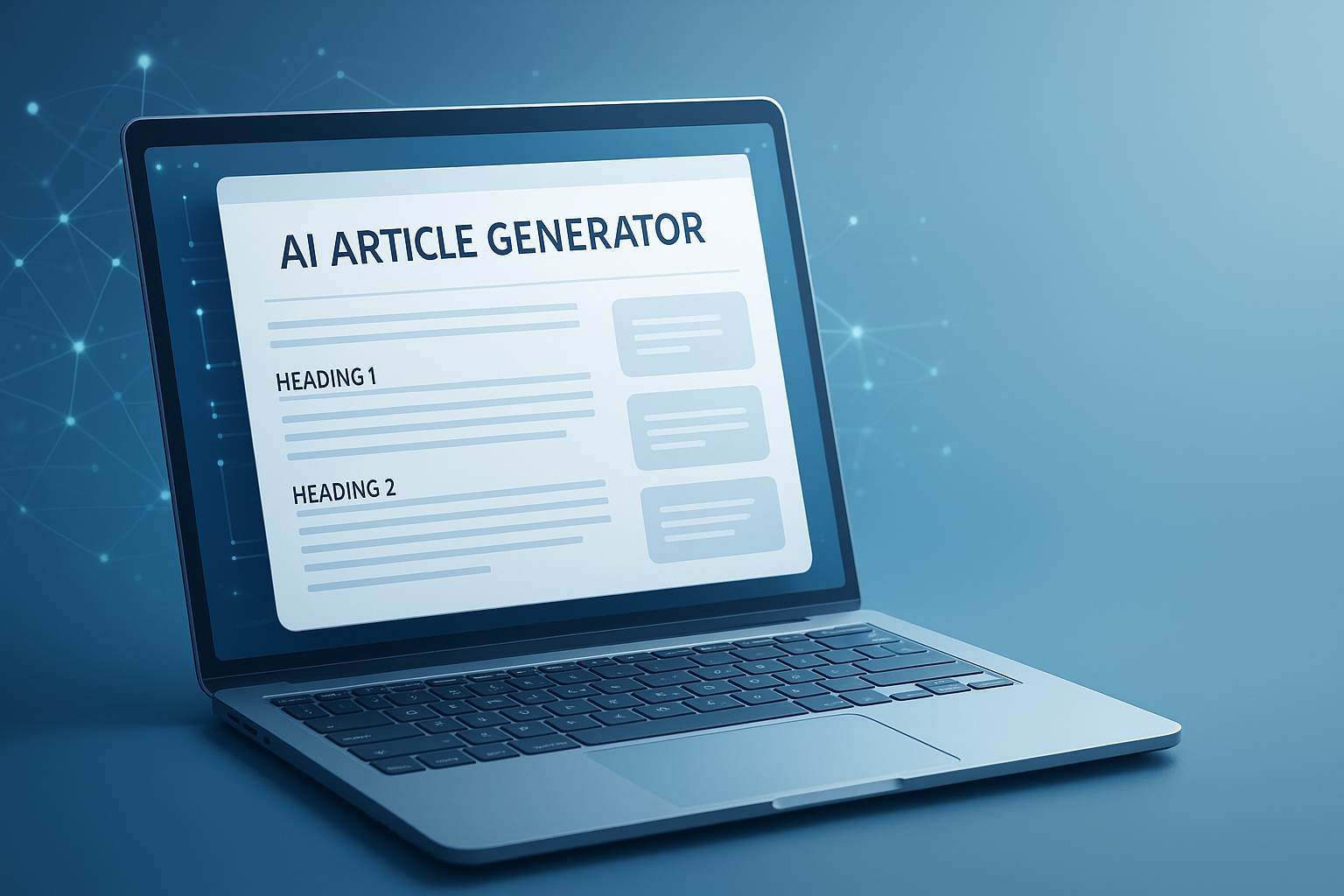
Suggested Image: Technology concept showing AI-assisted content workflow from prompt to published article
What is an AI article generator?
An AI article generator is a writing tool that creates article drafts from a prompt, topic, keyword, outline, or short brief. It uses language models to predict and assemble text that sounds natural, usually in seconds or minutes instead of hours.
For marketers, that usually means the tool can help with:
- Blog post ideas
- SEO outlines
- Headline options
- First drafts
- Section rewrites
- Meta descriptions
- FAQ generation
That said, AI does not “know” facts the way a subject expert does. It generates plausible language based on patterns in its training data. That’s why the output can be useful, but it still needs human review for accuracy, clarity, and brand fit.
If you want to understand how search systems evaluate helpful, original content, Google’s guidance on creating helpful, reliable, people-first content is worth reading before you rely too heavily on automation.
How does an AI article generator work?
At a basic level, an AI article generator turns your input into predicted text. The better your instructions, the better the draft will be. Most tools do not think like a strategist. They respond to structure, context, and constraints.
Here’s the usual process behind the scenes:
- You enter a prompt. This may include the topic, target audience, keyword, tone, format, and goal.
- The model interprets intent. It estimates what kind of article you want based on your wording.
- It builds probable language. The system predicts one token or word-part at a time to form sentences and paragraphs.
- It organizes output. Many tools package the result as a title, intro, headings, body copy, and conclusion.
- You review and refine. This is where real quality happens.
Now comes the important part: the output quality depends less on the tool name and more on the prompt quality. If your brief is vague, the draft will usually be generic.
What affects output quality most?
- Specificity of the prompt
- Clear audience definition
- Search intent alignment
- Topical depth requested
- Whether you ask for examples, FAQs, or comparisons
- How much editing happens after generation
If you need quick support for subtopics, intros, or transitions rather than a full post, a focused tool like an content generator for short-form marketing copy can be useful during drafting.
Why marketers use an AI article generator
The main advantage is not magic writing. It’s time compression. AI helps marketers move faster through repeatable parts of the content process so they can spend more time on strategy, editing, and distribution.
Here’s where it usually helps most:
- Faster ideation: Generate topic clusters, working titles, and angle variations.
- Quicker outlining: Turn a keyword into a usable structure within minutes.
- Draft acceleration: Build a first pass instead of starting from nothing.
- Content scaling: Support multiple campaigns, pages, or client accounts at once.
- Repurposing: Convert webinars, emails, transcripts, and notes into article drafts.
- Consistency: Maintain a format across category pages, how-to content, and support articles.
This is where many people struggle. They expect AI to replace the hard part. It doesn’t. It removes friction from the early stages, but the real business value comes from what you add afterward: better framing, stronger examples, clearer explanations, and fact-checking.
For teams handling repetitive assets, tools that support cleanup and publishing also matter. If your workflow includes downloading briefs or reports, a simple PDF merger can help combine stakeholder notes, outlines, and SERP research into one review document.
Benefits and limitations at a glance
An AI article generator can be a strong assistant, but it is a poor substitute for judgment. The smartest way to use it is to know exactly where automation stops being helpful.
| Area | Where AI Helps | Where Human Input Matters Most |
|---|---|---|
| Speed | Creates drafts quickly | Deciding what deserves publication |
| Research | Suggests common subtopics | Verifying facts, sources, and freshness |
| SEO | Helps structure headings and FAQs | Matching search intent and avoiding thin content |
| Brand voice | Can imitate a broad tone | Keeping the writing distinct and credible |
| Accuracy | May summarize known concepts | Catching errors, hallucinations, and weak logic |
Can AI-generated articles rank in Google?
Yes, AI-assisted content can rank if it is helpful, accurate, original, and aligned with user intent. The issue is not whether AI was used. The real question is whether the finished page deserves to rank better than competing pages.
Google has repeatedly focused on content quality rather than the method used to create it. You can review the broader framework in Google’s SEO Starter Guide and its documentation about search snippets and page presentation.
Here’s what usually helps AI-assisted articles perform better:
- Strong search intent match
- Original examples or firsthand insight
- Clear structure with scannable headings
- Accurate, current information
- Useful comparisons, checklists, or steps
- Real editing for tone, logic, and depth
Here’s what often hurts rankings:
- Mass-produced pages with little differentiation
- Keyword-heavy copy written for bots
- Generic advice that adds nothing new
- Unverified claims and outdated data
- Thin affiliate-style articles with no expertise
If you publish visual-heavy posts, don’t forget page performance. Compressing screenshots and diagrams with an Image Compressor can support load speed without hurting readability.
How to use an AI article generator the right way
The best workflow is simple: use AI for momentum, not authority. You want the tool to help with the first 60 to 70 percent, while you handle positioning, quality control, and the final polish.
- Start with one clear keyword and intent. Know whether the reader wants a definition, comparison, tutorial, or buying guidance.
- Write a real brief. Include audience, pain points, desired outcome, tone, and content format.
- Ask for an outline first. This prevents the tool from wandering into filler.
- Generate section by section. Shorter prompts often produce better results than one huge request.
- Add evidence and examples. Insert firsthand experience, case context, or cited references.
- Edit hard. Remove repetition, vague claims, and empty transitions.
- Optimize on-page SEO. Improve title, subheads, internal links, and snippet-friendly answers.
- Fact-check before publishing. Always.
For teams that create multiple content types, it helps to break writing into components. You might draft section intros with an AI text generator, then shape the final article manually around them.
Suggested Screenshot: Example of a content brief with prompt, target audience, keyword, and article structure
A practical prompt template for marketers
Here’s a simple prompt framework that usually produces stronger drafts than a one-line request:
You are writing for [target audience]. Create a [article type] on [topic] for the keyword [primary keyword]. Search intent is [informational/commercial/etc.]. Use a [tone] tone. Include an intro, clear H2s, practical examples, a comparison table, common mistakes, and FAQs. Keep the article easy to scan and avoid fluff. Explain limitations where relevant.
This small detail changes everything: tell the tool what to avoid. Add constraints such as “no generic intro,” “no buzzwords,” “use short paragraphs,” or “do not repeat the keyword unnaturally.”
What a strong AI content workflow looks like
Most weak AI content comes from weak process, not weak software. If your workflow includes research, structure, editorial review, and optimization, the quality goes up fast.
| Stage | AI Role | Human Role |
|---|---|---|
| Topic planning | Generate content angles and clusters | Choose topics with business value and realistic ranking potential |
| Outline creation | Suggest heading structure | Refine based on SERP intent and expertise |
| Draft writing | Produce first draft quickly | Correct logic, examples, and depth |
| Optimization | Suggest FAQs, metadata, and rewrites | Align with brand voice, UX, and SEO priorities |
| Publishing | Assist with formatting ideas | Final QA, link review, and accuracy checks |
If campaign planning includes timing and publishing schedules, a simple date calculator can help map editorial deadlines, update cycles, and content refresh intervals without manual counting.
Common mistakes that make AI content feel obvious and weak
You can usually spot rushed AI content in the first 30 seconds. It sounds polished on the surface, but nothing inside it feels specific, useful, or lived-in.
- Publishing the first draft: This is the biggest mistake by far.
- Using vague prompts: Generic input creates generic output.
- Ignoring search intent: A definition article won’t satisfy a buyer looking for comparisons.
- Over-optimizing keywords: Repetition hurts readability and trust.
- Skipping fact-checking: AI can state wrong information confidently.
- Forgetting UX: Long blocks of text lower engagement.
- Lacking examples: Readers trust content that shows, not just tells.
Here’s what experienced professionals do differently. They don’t ask, “Can AI write this?” They ask, “Which parts should AI speed up, and which parts need a real editor?” That framing leads to much better articles.
If you repurpose source material from screenshots, PDFs, or visual notes, an image to text converter can help capture raw material before you turn it into a cleaner brief.
How to make AI-generated articles sound more human
The answer depends on one thing: whether you’re willing to edit for meaning, not just grammar. Human-sounding articles are built through choices. They are not produced by simply asking AI to “sound natural.”
Use these editing tactics:
- Replace generic openings. Start with a real problem, not a textbook intro.
- Add specificity. Mention realistic situations, team constraints, or common decisions.
- Vary sentence rhythm. Mix short, direct lines with longer explanatory ones.
- Cut padded transitions. If a sentence says little, remove it.
- Insert opinion carefully. Explain what works, what doesn’t, and why.
- Use plain language. Clarity beats cleverness in SEO content.
It also helps to rewrite section by section instead of editing the full post in one pass. A tool like an AI paragraph rewriter can be helpful for refreshing repetitive sections, but the final judgment still needs to come from you.
Best use cases for an AI article generator
Not every content job should start with AI. It works best when the task is structured, scalable, and still open to editorial improvement afterward.
Where AI usually works well
- How-to blog posts with clear steps
- Glossary and definition pages
- FAQ sections
- Content refreshes for older articles
- Outline generation for new topic clusters
- Email-to-blog repurposing
- Landing page support content
Where you should be more careful
- Medical, legal, or financial advice pages
- Technical tutorials requiring exact instructions
- Strong thought leadership pieces
- Original research and data interpretation
- Case studies where details matter
For higher-risk areas, check official guidance directly rather than trusting generated summaries. For example, if your content touches privacy or ad compliance, the FTC business guidance center is far more reliable than a generic AI draft.
AI article generator vs human writer
This comparison is often framed the wrong way. It’s not AI versus humans. It’s AI plus human expertise versus slow manual production. The highest-performing content teams use both.
| Factor | AI Article Generator | Human Writer |
|---|---|---|
| Speed | Very fast | Slower |
| Original insight | Limited | Strong |
| Accuracy | Needs verification | Also needs review, but better judgment |
| Brand voice | Can approximate | Can create and maintain distinct voice |
| Cost efficiency | High for drafts and scaling | High for premium quality and expertise |
A practical middle ground is to let AI handle ideation, framing, and first-draft support, then have a marketer or editor refine the content for trust, search value, and conversions.
How to optimize AI-assisted content for AI search and featured snippets
AI search engines pull answers quickly, so structure matters more than ever. If you want better visibility in search results, your content must be easy to extract, easy to summarize, and still useful in full-page form.
Best practices include:
- Answer the heading question in the first paragraph
- Use short lists for steps, mistakes, and benefits
- Add comparison tables when users may be evaluating options
- Write concise definitions before deeper explanation
- Use descriptive headings that match real query patterns
- Support claims with reliable sources when possible
Google also provides official documentation on structured data through its introduction to structured data, which can improve how certain page elements are understood.
Suggested Infographic: AI content optimization checklist for Google Search, AI Overviews, and chat-based search engines
What to review before you publish
Before any AI-assisted article goes live, run a final editorial check. This catches the issues that most often lead to low engagement, weak rankings, or trust problems.
- Does the introduction match the reader’s intent?
- Is the primary keyword used naturally, not repeatedly?
- Are there any factual claims without verification?
- Does every section add something useful?
- Have you removed repetitive wording?
- Are headings clear and scannable?
- Did you include examples, comparisons, or practical steps?
- Are internal and external links genuinely helpful?
If accuracy depends on measurements, estimates, or conversions inside your content workflow, using precise utilities matters. For example, a word counter can help when you need cleaner content-length targets for briefs, updates, or SERP comparison reviews.
Frequently asked questions
Is an AI article generator good for SEO?
Yes, it can be helpful for SEO when used as a drafting assistant rather than an autopublish tool. It works best for building outlines, generating first drafts, identifying common subtopics, and creating FAQs. It performs poorly when the output is generic, inaccurate, or stuffed with keywords. Strong SEO still depends on search intent, originality, editing quality, internal linking, and trustworthiness.
Can Google detect AI-written content?
Search engines may identify patterns associated with low-quality automated text, but the bigger issue is quality, not detection alone. If your article is repetitive, shallow, or obviously generated without review, it is more likely to underperform. A well-edited AI-assisted article that is accurate, useful, and original can perform just fine. Focus on value and clarity rather than trying to game detection.
Do I need to fact-check AI-generated articles?
Always. AI systems can produce wrong information, outdated advice, or invented details that sound believable. This is especially important for technical, financial, legal, health, or compliance-related topics. A safe process is to verify claims using primary sources, official documentation, or internal subject experts before publication. Treat the draft as a starting point, not as a final authority.
What should I include in a good prompt?
A strong prompt should include the target audience, topic, primary keyword, search intent, tone, article format, and specific elements you want, such as examples, tables, FAQs, or step-by-step sections. You should also tell the tool what to avoid, like fluff, buzzwords, or generic intros. The more constraints you provide, the more focused and useful the draft usually becomes.
Should I use one long prompt or several short prompts?
Several short prompts are usually better for quality. A single large prompt can produce a draft quickly, but section-by-section prompting often creates clearer, more relevant copy because it gives you more control. Many marketers use AI first for the outline, then prompt each section independently. This leads to stronger flow, fewer repeated ideas, and easier editing later.
Is an AI article generator better for beginners or experienced marketers?
It can help both, but experienced marketers usually get better results because they know how to shape prompts, judge quality, and edit strategically. Beginners may gain speed, but they are also more likely to publish weak content without noticing problems in logic, depth, or search alignment. In practice