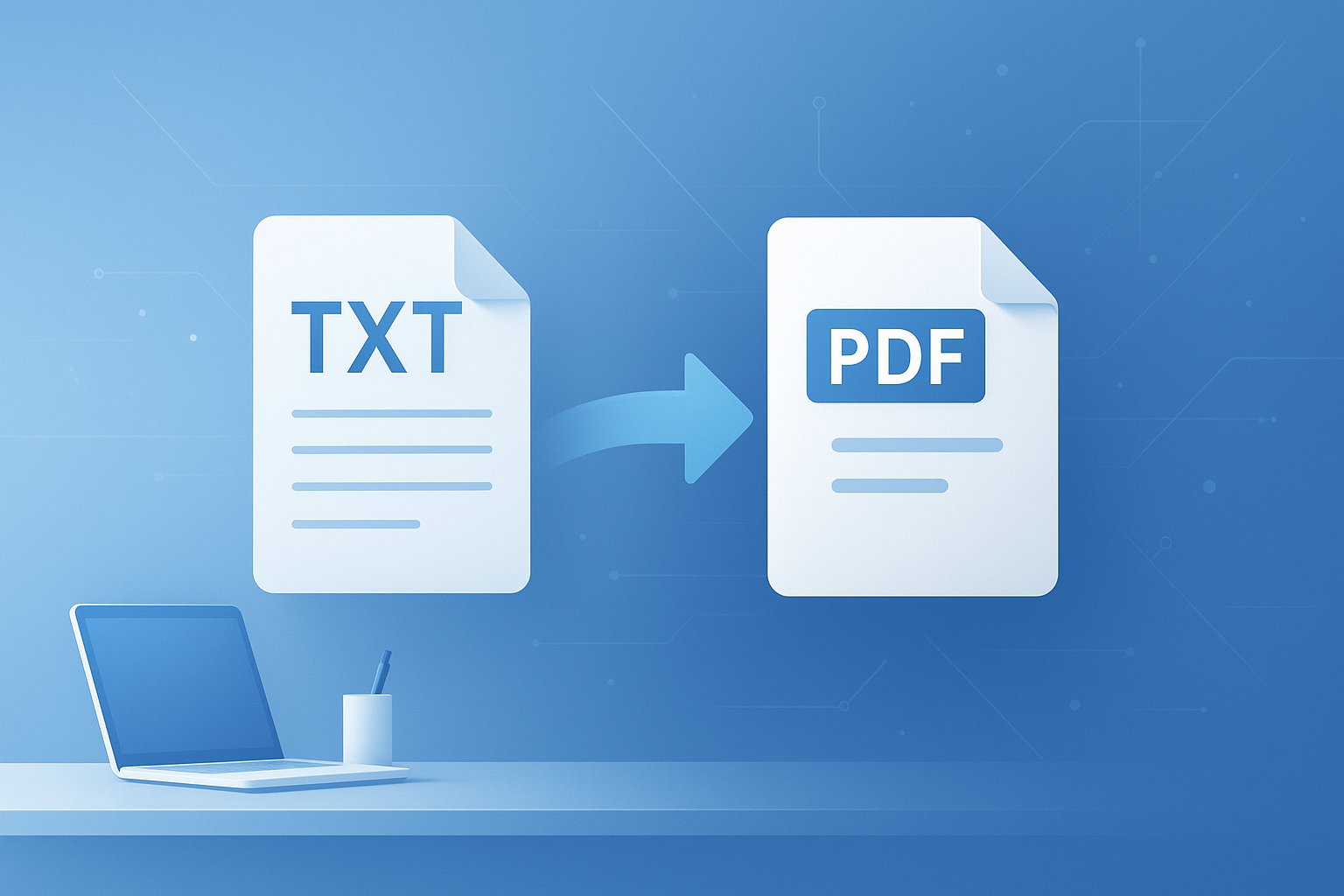
Need to turn a plain text file into a polished document without wrestling with formatting? A good txt to pdf converter solves that in minutes. It takes a simple .txt file and packages the content into a PDF that’s easier to share, print, archive, and open consistently on almost any device.
That matters more than most beginners expect. Text files are lightweight and universal, but they look bare, break layout easily, and don’t always feel presentation-ready. PDFs, on the other hand, are built for stable viewing and distribution. According to Adobe’s PDF overview, the format was designed to preserve document appearance across systems.
In this guide, you’ll learn how a txt to pdf converter works, when to use one, what to watch for, and how to get cleaner results the first time. If you also work with images or scanned documents, tools like the Image Compressor can help reduce file size before you bundle assets into a document workflow.
Suggested Image: Modern illustration of a plain TXT file transforming into a clean PDF document
What is a TXT to PDF converter?
A txt to pdf converter is a tool that changes a plain text file with the .txt extension into a PDF file. The main goal is simple: keep your written content readable, portable, and easier to share without changing the words inside it.
TXT files store unformatted text. They usually don’t include fonts, spacing rules, page design, headers, images, or clickable elements. A PDF wraps that text into a document structure with pages, margins, layout, and predictable display behavior.
- TXT is best for raw content, notes, logs, code snippets, and drafts
- PDF is better for distribution, printing, archiving, and professional sharing
- Conversion bridges the gap between plain content and presentable output
If you often move between document formats, it also helps to understand related file workflows such as PDF to text conversion, especially when you need to extract content back from a PDF later.
Why convert TXT to PDF instead of sharing the text file?
Most people convert TXT to PDF for one reason: control. A plain text file can look different depending on the app, window size, or device. A PDF keeps the content in a fixed document format, which makes it more reliable for readers.
Here’s where that matters in everyday use:
- Sending meeting notes to a client
- Saving logs or transcripts for records
- Submitting school assignments
- Sharing technical instructions with staff
- Printing plain text in a cleaner layout
- Archiving written content in a standard format
PDF also has broader long-term reliability. The Library of Congress format description for PDF explains why PDF is widely used for preservation and document exchange.
| Format | Best Use | Limitations |
|---|---|---|
| TXT | Draft text, logs, code, simple notes | No visual formatting, weak presentation, layout may feel unfinished |
| Sharing, printing, archiving, formal delivery | Less convenient to edit directly after export |
How does a TXT to PDF converter work?
A converter reads the plain text content, places it into a page layout, and exports that layout as a PDF. The text usually stays the same, but the file gains structure such as page dimensions, line wrapping, margins, and document-level compatibility.
Even a basic converter typically performs these steps:
- Uploads or opens the .txt file
- Reads the characters and line breaks
- Applies default formatting such as font, spacing, and margins
- Splits the text into pages if needed
- Creates a PDF file for download or saving
This sounds simple, but one small detail changes everything: how the tool handles line breaks, encoding, and special characters. If a converter mishandles text encoding, quotes, symbols, or non-English characters may display incorrectly. The W3C explanation of character encoding is useful if you’re dealing with multilingual text or imported data.
What the converter usually preserves
- Words and sentences
- Paragraph breaks
- Basic line spacing
- Simple page flow
What it usually does not preserve
- Complex design
- Tables stored only as spacing
- Interactive elements
- Embedded media
- Precise alignment created with random spaces
If your text includes numbers, measurements, or technical figures, verify them before exporting. For example, if a file includes screen dimensions or resolution-related notes, a tool like the screen resolution calculator can help double-check values before the PDF is finalized.
When should you use a TXT to PDF converter?
Use a txt to pdf converter when the text is finished or close to finished and needs to be shared in a stable format. It’s not the best editing format, but it is one of the easiest formats for distribution and record keeping.
Common use cases include:
- School work: Turn a plain draft into a submission-ready document
- Office notes: Share instructions or reports without layout shifting
- Server logs: Save readable copies for review or compliance
- Transcripts: Package plain text conversations into a document
- Legal or administrative records: Archive content more formally
- Writing samples: Send a cleaner version to editors or clients
Here’s what experienced professionals do differently: they convert only after checking structure. They make sure the text file has clean paragraph breaks, sensible headings, and no stray symbols before export.
If you need to prepare supporting visuals alongside text documents, the JPG to PNG Converter can be useful when image quality matters for attached diagrams or screenshots.
Step by step: how to convert TXT to PDF cleanly
The fastest way to get a good result is to prepare the text before conversion. Most bad PDFs come from messy source files, not from the conversion itself. A few small checks can save time and avoid redoing the file.
- Open the TXT file and review the content. Check for broken lines, strange characters, duplicated spacing, and missing paragraph breaks.
- Decide whether the text needs simple structure. Add headings, lists, or separators if the content is currently one long block.
- Make sure the encoding displays correctly. If symbols or accented letters look wrong, fix that before export.
- Upload the file into the converter. Use a trusted tool that outputs clean, readable PDFs.
- Review formatting options if available. Set page size, margins, orientation, or font if the tool allows it.
- Convert and download the PDF. Save a copy with a clear file name.
- Open the finished PDF on at least one other device. This is the quickest way to catch layout problems.
Suggested Screenshot: TXT upload screen with formatting options and convert button
Simple pre-conversion checklist
- Remove extra blank lines
- Fix inconsistent indentation
- Replace tabs used for fake table layouts
- Check quotes, symbols, and accented text
- Use meaningful file names
If your workflow includes web text or generated markup, validating structure can help before you save or publish related content. The HTML Viewer is handy when you need to inspect text that originated from HTML before turning it into a clean document.
What makes a good TXT to PDF converter?
A good converter does more than create a PDF. It preserves readability, handles clean text properly, and avoids introducing formatting issues. For beginners, usability matters just as much as output quality.
Look for these features:
- Accurate text rendering: The text should match the source without broken characters
- Proper line break handling: Paragraphs should remain readable
- Reasonable page margins: The result should not feel cramped
- Fast conversion: Small text files should process quickly
- No unnecessary clutter: The converter should focus on the document, not distractions
- Privacy awareness: Especially important for business, school, or client files
- Cross-device compatibility: The finished PDF should open cleanly in standard readers
For PDF behavior and compatibility, Adobe Acrobat and browser PDF viewers are widely used references, while MDN’s documentation standards are a good model for clear technical content and reliable web practices when documents move between browser-based tools.
Common formatting issues after conversion
Most TXT to PDF problems come from the source file, not the export button. Since TXT is plain text, it doesn’t carry rich layout instructions. That means anything “visually arranged” with spaces or tabs may break once the text is placed into PDF pages.
These are the most common issues beginners run into:
- Broken paragraphs: Lines wrap awkwardly because the original text used manual line breaks
- Misaligned sections: Spacing-based layouts shift in the PDF
- Weird symbols: Encoding mismatch changes characters
- Too many pages: Large font size or wide margins increase page count
- Unreadable logs or code: Monospaced content may need better formatting support
How to fix them
- Use real paragraph spacing instead of random blank lines
- Avoid building columns with spaces
- Check whether UTF-8 or another encoding is needed
- Preview before final download if the tool supports it
- For structured content, consider formatting it in a document editor before PDF export
If you are preparing screenshots for a PDF and they look oversized, the image resizer can help keep supporting images neat and easier to place in a document workflow.
TXT to PDF vs Word to PDF: which should you use?
The answer depends on one thing: whether your content needs formatting control. If you only need to preserve plain written content, TXT to PDF is quick and efficient. If you need headings, styling, tables, page numbers, or branding, Word to PDF is usually the better route.
| Option | Best For | Tradeoff |
|---|---|---|
| TXT to PDF | Simple notes, logs, plain drafts, lightweight text sharing | Minimal formatting control |
| Word to PDF | Formal documents, reports, resumes, styled content | More setup and heavier editing workflow |
A practical rule is this:
- Choose TXT to PDF for speed and simplicity
- Choose Word to PDF for presentation and layout control
Is it safe to use an online TXT to PDF converter?
It can be safe, but only if you use a trustworthy service and avoid uploading sensitive material without checking the tool’s privacy practices. Convenience is great, but file privacy matters even for simple text documents.
Before uploading, check:
- Whether the site uses HTTPS
- Whether it explains file deletion or retention
- Whether the text contains passwords, client data, financial details, or personal identifiers
- Whether the tool requires an account for a simple conversion
For general online safety guidance, the CISA Secure Our World advice offers practical security habits that also apply when handling uploaded documents. If the file contains confidential information, offline conversion or trusted enterprise software is the safer choice.
Best practices for better PDF results in 2026
If you want cleaner output, think like an editor before you convert. A txt file may be simple, but the final PDF will still reflect the quality of the source. Good preparation leads to a better document every time.
- Keep the source text clean. Remove clutter and random spacing.
- Use clear section breaks. Even plain text benefits from structure.
- Check on mobile and desktop. PDFs are stable, but readability still matters across screens.
- Name files clearly. For example: project-notes-march-2026.pdf
- Archive the original TXT file. It remains easier to edit later.
- Compress related images first. This helps if the PDF will include graphics or attachments.
This is also a good point to mention file efficiency. If your work involves media, the MB to KB Converter can help you understand file-size reductions when preparing lighter assets for sharing and storage.
Real-world examples where TXT to PDF makes sense
Beginners often understand the value of conversion faster when they see where it fits in real work. TXT to PDF is not just a technical step. It’s a practical finish line for many simple document tasks.
Example 1: Student assignment notes
A student writes an outline in Notepad and wants to submit reading notes. The text is complete, but the .txt file looks too raw. Converting to PDF makes the submission look cleaner and easier for the instructor to open and print.
Example 2: IT log review
An admin exports a plain text log and needs to send it for review. A PDF version prevents accidental edits and keeps the content in one stable file for meetings or records.
Example 3: Interview transcript
A researcher receives a transcript in plain text. Before sharing it with a team, they convert it to PDF so everyone sees the same version, with page breaks that support easier annotation and archiving.
Example 4: Draft policy memo
A small business owner writes a quick policy note in a text editor. Rather than emailing a raw .txt file, they convert it to PDF for cleaner circulation among staff.
If your workflow eventually includes search-friendly publishing or content cleanup, the word counter can help review document length before finalizing related articles, summaries, or written materials.
Frequently asked questions
1. Will converting TXT to PDF change my text content?
The words themselves usually stay the same, but the way they appear can change. Line breaks, spacing, margins, and page wrapping may look different in the PDF. That’s why it’s smart to review the source text first. If the TXT file uses manual spacing to create layout, the PDF may not preserve that look exactly.
2. Can I edit the PDF after converting from TXT?
Yes, but editing a PDF is usually less convenient than editing the original TXT file. A PDF is better for sharing than for rewriting. The best practice is to keep the text file as your editable source and use the PDF as the final output version for printing, sending, or archiving.
3. Why do strange symbols appear after conversion?
This usually happens because of character encoding problems. If the original text file was saved with one encoding and the converter reads it as another, symbols, accents, or punctuation can break. Check the source file’s encoding and use UTF-8 when possible, especially for multilingual text or copied content from websites or apps.
4. Is a TXT to PDF converter good for code files or logs?
It can be, especially when you need a stable copy for sharing or record keeping. However, code and logs often rely on monospaced formatting, indentation, and long lines. If the converter doesn’t handle these well, readability can suffer. In those cases, preview the output carefully or use a tool that supports better formatting options.
5. Are online TXT to PDF converters free?
Many are free for basic use, especially for small files. Some tools charge for batch conversion, advanced formatting, cloud storage, or premium document features. For beginners doing occasional conversions, a simple free tool is often enough. Just make sure the service is trustworthy and appropriate for the sensitivity of your file.
6. What is the difference between exporting and converting?
In everyday use, people often mean the same thing. “Converting” usually refers to changing one file type into another, like TXT to PDF. “Exporting” often implies creating a final output from within an app, sometimes with more formatting control. The result may be similar, but exporting usually happens inside a document program rather than a standalone converter.
7. Can a TXT to PDF converter add formatting like headings and fonts?
Basic converters usually apply default formatting automatically, such as font type, line spacing, and margins. Some offer a few options, but they generally don’t rebuild a plain text file into a fully designed report. If you need styled headings, logos, tables, or custom page layout, it’s better to move the text into a word processor first.
8. Should I keep the original TXT file after making the PDF?
Absolutely. The TXT file is your easiest version to edit quickly. Once you spot a typo or need to update wording, making changes in the text file is much simpler than editing the PDF. A good workflow is to keep both: the TXT as the working source and the PDF as the shareable, final-looking version.
Conclusion
A reliable txt to pdf converter makes plain text easier to share, print, archive, and present. The conversion itself is simple, but the quality of the result depends heavily on the source file. Clean paragraphs, proper encoding, and a quick review after export make the biggest difference.
If you’re just getting started, your next best step is straightforward: clean up the TXT file first, convert it, then check the PDF on another device. For related tasks, tools like the PDF to text converter, Image Compressor, image resizer, and word counter can help you manage the rest of your document workflow more smoothly.