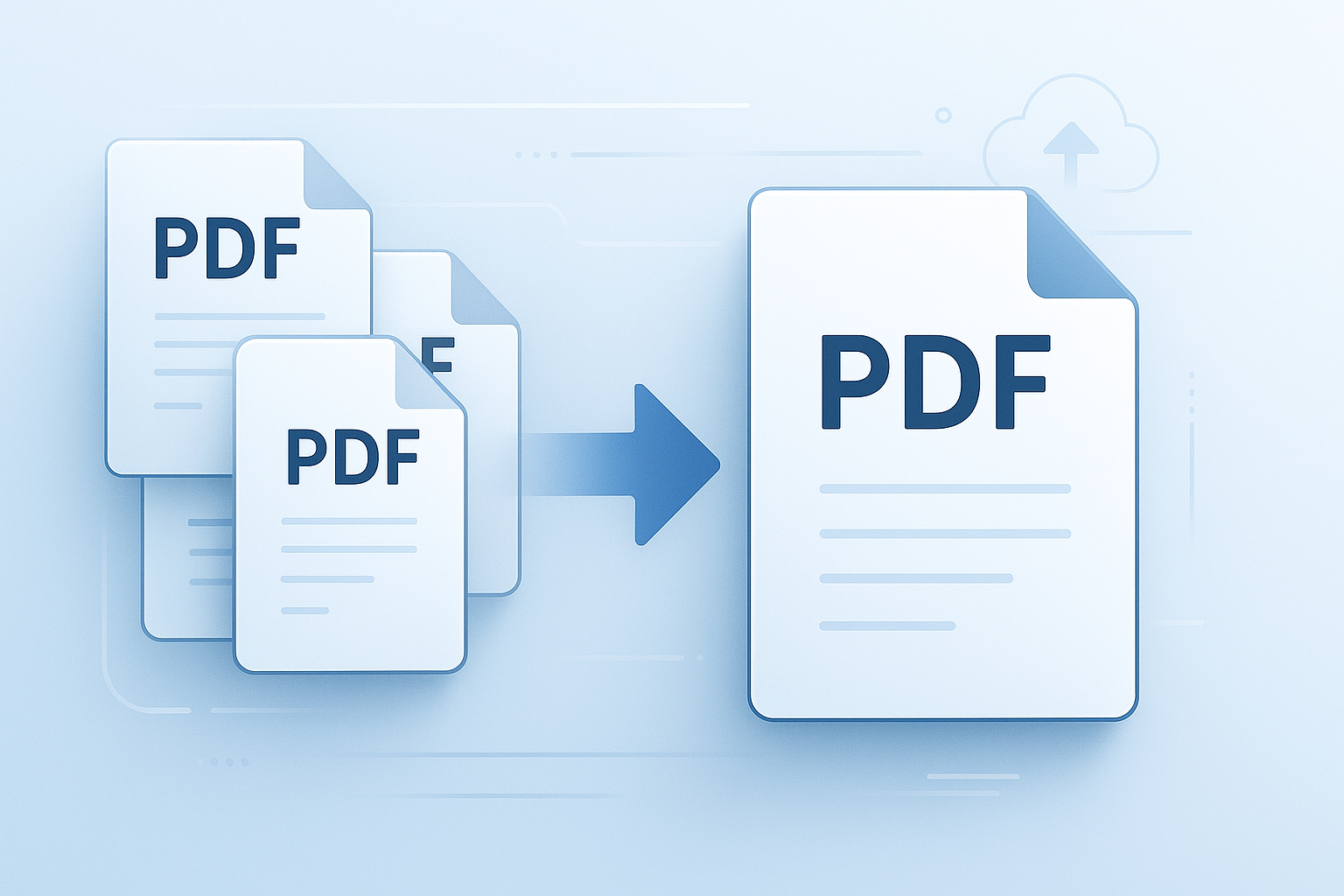
Need to combine several documents into one clean file without ruining the layout? A good merge PDF tool solves exactly that problem. It lets you join pages from invoices, contracts, assignments, forms, or scanned records into a single PDF you can store, share, or print with less hassle.
That sounds simple, but small details matter. The wrong tool can shuffle page order, inflate file size, or create formatting issues that only show up after you send the document. For beginners, that can turn a two-minute task into a frustrating cleanup job.
In this guide, you’ll learn what a merge PDF tool does, when to use one, how to combine files online without losing quality, and what to check before you hit download. If you also work with images before converting them to PDF, tools like an Image Compressor can help you keep final files easier to manage.
Suggested Image: Minimal vector illustration of multiple PDF files merging into one document
What is a merge PDF tool?
A merge PDF tool combines two or more PDF files into one document while keeping pages readable, properly ordered, and ready to share. Most online tools let you upload files, rearrange page order, and download a single merged PDF in just a few steps.
This is useful when you want to organize related documents into one file instead of sending several attachments. Common examples include:
- Combining a resume and cover letter
- Merging receipts into one expense report
- Joining class notes, worksheets, and references
- Putting contract pages and supporting documents together
- Creating one client-ready file from multiple scans
PDF remains one of the most widely used formats for fixed-layout documents because it preserves structure across devices. Adobe’s overview of the PDF file format explains why it is commonly used for sharing documents that need consistent appearance.
Why people use an online merge PDF tool
An online merge PDF tool is popular because it removes the need for desktop software. You can combine files from a browser, whether you’re on a laptop, tablet, or phone, as long as the tool is mobile-friendly.
Here’s why that matters in real life:
- Convenience: No installation required
- Speed: Merge several documents in minutes
- Accessibility: Use it from different devices
- Organization: Keep related files in one place
- Sharing: Send one polished attachment instead of many
If you’re organizing supporting documents for an application, report, or business package, it can also help to check file naming consistency first. For other document workflows, readers often also use a PDF document guides hub to find related tasks and fixes.
How to merge PDF files online without losing quality
To merge PDF files online without losing quality, start with clean source files, keep the correct page order, avoid unnecessary conversions, and use a tool that preserves the original document content during export.
Let’s break this down into a practical process beginners can follow.
- Gather the final versions first. Make sure each PDF is the correct version before uploading.
- Check orientation and readability. Confirm pages are not sideways, cropped, or blurry.
- Upload all PDFs to the merge tool. Add every file you want included.
- Arrange the page or file order. Put them in the exact sequence you want readers to see.
- Merge and preview the result. Quickly inspect the combined file for missing pages or layout issues.
- Download and rename the final file. Use a clear name like
Project-Proposal-Final.pdf.
The most important quality rule is this: merging usually does not improve a poor file. If the source PDF is blurry or badly scanned, the final merged version will still be blurry. That is why preparing files correctly matters more than most beginners expect.
What affects PDF quality during merging?
In most cases, page quality depends on the original documents, not the merge action itself. The merge step simply combines existing PDFs unless the tool reprocesses, compresses, or converts them aggressively.
- Low-resolution scans
- Images embedded at poor quality
- Repeated file conversions
- Over-compression
- Font substitution issues
- Broken page dimensions
If you’re starting from image files rather than PDFs, resize with care. A helpful related option is an Image Resizer when you need to standardize document images before creating or merging PDFs.
Best use cases for a merge PDF tool
A merge PDF tool is most useful when separate files belong together and should be viewed in a specific order. It helps create a cleaner reading experience for the person receiving the document.
Here are common situations where merging makes sense:
Job applications
Many applicants combine a resume, cover letter, and portfolio summary into one file. This can make submission easier when employers prefer a single upload.
School and university work
Students often merge assignments, research notes, signed forms, and scanned appendices. If an instructor asks for one document, merging saves time and avoids missing attachments.
Business records
Invoices, contracts, purchase orders, and approval sheets are easier to archive when stored as one file per case or project.
Legal and administrative paperwork
Applications often require supporting identification, declarations, and signed pages together. One combined PDF helps reviewers follow the full packet in order.
Scanned paper documents
If you scan multiple pages separately, merging turns them into a proper digital document. Before scanning and uploading, it may also help to prepare page dimensions with tools like a mm to inches converter if you work with print sizes or document standards.
Suggested Screenshot: Minimal vector mockup showing drag-and-drop file order before merging
Merge PDF tool vs other PDF actions
People often confuse merging with compressing, converting, or splitting PDFs. These tasks sound related, but each one solves a different problem.
| PDF Action | What It Does | Best For |
|---|---|---|
| Merge | Combines multiple PDFs into one file | Creating one organized document |
| Split | Separates one PDF into smaller files | Extracting sections or pages |
| Compress | Reduces file size | Email uploads and storage limits |
| Convert | Changes file type, such as JPG to PDF | Turning images or documents into PDFs |
| Edit | Changes text, markup, or form content | Revising the document itself |
If your final file becomes too large after combining documents, you may need a separate compression step. If the content starts as images, a JPG to PNG tool may also help in image preparation workflows where format choice affects clarity before PDF creation.
What to look for in a good merge PDF tool
The best merge PDF tool should be simple, secure, and reliable. Beginners usually care about one thing first: can I combine my files quickly without breaking the document? That should absolutely be the baseline.
Now comes the important part. A decent tool should also give you enough control to avoid common mistakes.
- Drag-and-drop upload: Faster and easier than manual browsing
- Page reordering: Lets you fix sequence before merging
- No obvious quality loss: Keeps pages readable and properly formatted
- Clear file handling: Explains upload and deletion practices
- Works in browser: Useful for beginners and casual users
- Reasonable speed: Important for larger files
- Mobile support: Helpful when working from a phone
Security and privacy also matter. If your PDFs contain personal or business information, review data handling practices before uploading. The FTC privacy and data security guidance is a useful reminder that document handling should never be treated casually.
Common mistakes that cause problems when merging PDFs
Most PDF merge issues are preventable. The trouble usually comes from poor file preparation, rushed page ordering, or misunderstanding what the merge process actually changes.
Here are the mistakes beginners make most often:
- Merging draft versions: Double-check that every file is final.
- Ignoring page order: One misplaced page can confuse the entire document.
- Uploading scans that are too blurry: Merging will not fix bad scans.
- Assuming all pages have the same size: Mixed page sizes can make the final file look inconsistent.
- Skipping a final review: Always open the merged PDF before sharing it.
- Using unclear file names: Generic names like
document1.pdfcreate confusion later.
Here’s what experienced professionals do differently: they prepare files before merging. For example, if supporting pages include screenshots or charts, they may optimize visuals first with an PNG to JPG tool or simplify image-heavy content before packaging everything into one PDF.
How to keep merged PDFs organized and easy to share
A merged document is only useful if someone can understand it quickly. Good organization makes the PDF easier to read, easier to store, and less likely to be returned for corrections.
Use these simple habits:
- Name the file clearly. Include subject, version, and date if needed.
- Put documents in reading order. Start with the most important or requested page.
- Keep orientation consistent. Rotate sideways pages before sending.
- Use logical sections. Group related pages together.
- Check file size. Large PDFs can fail email or portal uploads.
- Open the final PDF on another device. This catches layout issues early.
If your document includes measurements, plans, or print materials, keeping dimensions consistent is especially important. For layout-related checks, some users pair PDF work with a cm to inches converter when dealing with regional size differences.
Is it safe to use an online merge PDF tool?
Yes, an online merge PDF tool can be safe for routine files, but the answer depends on the sensitivity of the content and the service’s privacy practices. You should always treat financial, legal, medical, and identity documents with extra caution.
This is where many people struggle. They focus on convenience and forget that PDFs often contain more than visible text. Some files may include signatures, account details, addresses, or embedded metadata.
- Read the tool’s privacy policy
- Check whether uploaded files are deleted automatically
- Avoid public or shared devices for sensitive files
- Use secure internet access, not open public Wi-Fi
- Inspect the final document before distribution
For general file safety awareness, the CISA security best practices and Google account security recommendations are useful reminders for protecting documents and accounts connected to online tools.
Online merge PDF tool vs desktop software
Online tools are usually best for quick, occasional tasks. Desktop software may be better for heavy workflows, advanced editing, or highly sensitive documents that should stay offline.
| Option | Advantages | Limitations |
|---|---|---|
| Online merge tool | Fast, easy, no install, works across devices | May have upload limits or privacy concerns for sensitive files |
| Desktop PDF software | More control, offline use, advanced editing options | Often costs more and takes longer to learn |
For many beginners in 2026, the online route is enough for schoolwork, applications, records, and admin tasks. But if you regularly handle large document batches, signed agreements, or archived files, a more advanced setup may be worth it.
Practical example: when merging PDFs makes life easier
Imagine you’re applying for a rental property. The landlord asks for ID, proof of income, bank statements, and a signed application form. Sending six separate attachments increases the chance that one gets missed.
A better approach is to combine them into one clearly ordered document:
- Application form
- ID copy
- Recent payslips
- Employment letter
- Bank statement summary
Now the reviewer opens one file, sees everything in context, and can process the application faster. The same principle works for freelance proposals, tax records, school submissions, and client onboarding packets.
If you handle numbers alongside documents, related tools such as a percentage calculator can also help when preparing financial summaries before exporting them into PDF format.
Frequently asked questions
1. Does a merge PDF tool reduce document quality?
Usually, no. A merge PDF tool mainly combines existing files into one document. Quality problems are more often caused by poor source scans, low-resolution images, or extra compression during processing. If the original PDFs are clear, the merged result should stay clear as well. Always preview the final file before sending it, especially when text is small or pages contain charts, signatures, or screenshots.
2. Can I change the page order before merging PDF files?
Yes, most modern tools let you rearrange files or pages before creating the final PDF. This matters more than people think. A merged file is only useful if the order makes sense to the reader. For applications, reports, and records, place the most important document first, then supporting pages in logical sequence. Always check the preview if page order affects review or approval.
3. Is there a file size limit when using an online merge PDF tool?
Many online tools have upload or processing limits, especially for large scans, image-heavy PDFs, or long reports. The exact limit depends on the service. If files are too large, reduce size before uploading by compressing images, rescanning at a sensible resolution, or removing unnecessary duplicate pages. This can speed up both upload and download while keeping the final document easier to share.
4. What’s the difference between merging and compressing a PDF?
Merging combines multiple PDFs into one file. Compressing reduces the file size of a PDF. They solve different problems. If you have several separate documents, merge them first to create one organized file. If that new file is too large for email or a submission portal, then use a compression step. Think of merging as organizing content and compressing as optimizing delivery.
5. Should I use an online tool for sensitive legal or financial PDFs?
You can, but you should be cautious. Review the service’s privacy practices, deletion policy, and security approach before uploading anything sensitive. For identity documents, contracts, medical records, or confidential business files, many people prefer tools with clear data handling policies or offline options. If the document could create real harm if exposed, convenience should never be your only decision factor.
6. Can I merge scanned images and digital PDFs together?
Yes, as long as they are all available as PDFs before merging, or the tool supports converting image files as part of the workflow. The quality of scanned pages is the main issue here. If the image scans are blurry, too dark, or crooked, the final merged file will still look that way. Clean scans, correct orientation, and readable text make a much bigger difference than the merge itself.
7. Do I need special software to use a merge PDF tool?
No, not always. Many tools work directly in your browser, which is why beginners often prefer them. You upload your files, arrange them, merge them, and download the final PDF. Desktop software is still useful if you need advanced editing, stronger offline privacy, or batch processing for large volumes of files. For occasional use, browser-based tools are usually enough.
8. What should I check before sharing a merged PDF?
Review page order, readability, file name, orientation, and whether all pages are included. Also confirm that no draft pages, duplicates, or unrelated attachments slipped into the final document. If you’re sending the PDF professionally, open it once on another device to make sure it displays correctly. That quick review can prevent mistakes that are easy to miss immediately after downloading.
Final thoughts
A reliable merge PDF tool makes document sharing simpler, faster, and more organized. The key is not just combining files, but combining the right files in the right order while keeping quality intact.
If you remember only a few things, make it these: start with clear source files, arrange pages carefully, review the result before sharing, and be cautious with sensitive documents. That small workflow change prevents most of the problems beginners run into.
Your next practical step is simple: gather the PDFs you want to combine, check the page order, and create one final version you can actually trust. If you need help with related tasks afterward, tools like the Word Counter, BMI Calculator, or Age Calculator may support other document, form, or reporting workflows depending on what you’re preparing.