
Put $100 away today, leave it alone, and years later it can turn into far more than you expect. That’s the quiet power of compound interest. It doesn’t just pay you interest on your original money. It pays interest on your interest too.
Most beginners hear that phrase and assume it’s complicated. It isn’t. Once you understand the basic idea, you can make better decisions about savings accounts, investments, debt, and long-term financial planning.
This guide explains how compound interest works, why time matters so much, where people get confused, and how to use it to your advantage in 2026 and beyond. If you want to run your own numbers as you read, a Compound Interest Calculator makes the math much easier.
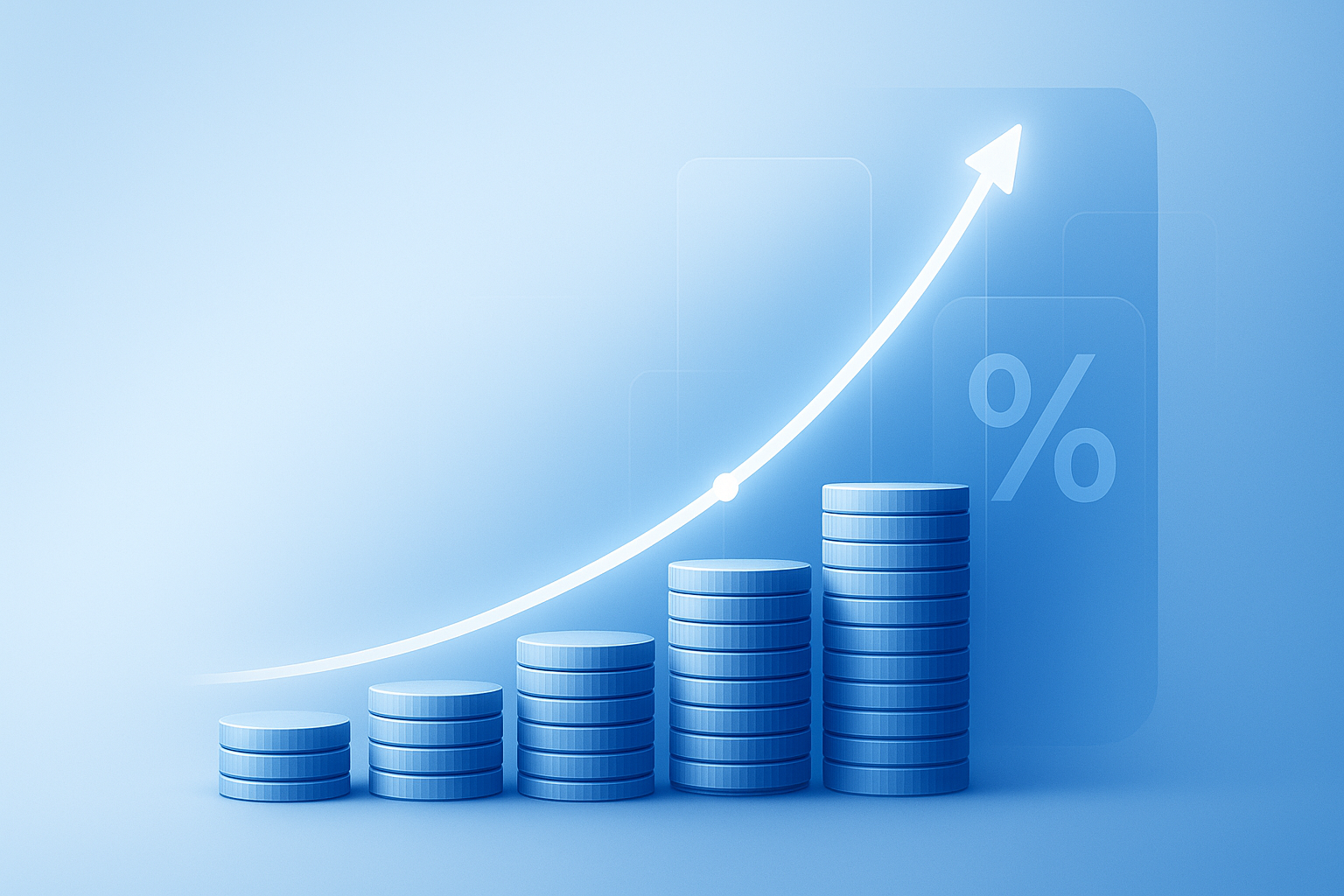
Suggested Image: Finance Illustration of money growing over time with interest-on-interest layers
What is compound interest?
Compound interest is interest earned on both the money you start with and the interest that has already been added. In simple terms, your money begins earning money, and then those earnings start earning money too.
That’s what makes it different from simple interest. With simple interest, growth is based only on the original amount. With compound interest, growth accelerates over time because the base keeps getting larger.
- Principal: the amount you start with
- Interest rate: the percentage earned or charged
- Compounding: how often interest is added
- Time: how long the money stays invested or owed
For a formal overview of how interest works in consumer financial products, the Consumer Financial Protection Bureau explanation of compound interest is a reliable starting point.
How does compound interest work?
Compound interest works by repeatedly adding earned interest to your balance. Each new period, the account calculates interest on a bigger amount than before. That small detail changes everything.
Here’s a simple example. Suppose you invest $1,000 at 10% annual interest, compounded once per year.
- Year 1: You earn $100, so your balance becomes $1,100
- Year 2: You earn 10% of $1,100, which is $110, so your balance becomes $1,210
- Year 3: You earn 10% of $1,210, which is $121, so your balance becomes $1,331
If this were simple interest, you’d earn the same $100 each year. But with compound interest, the amount earned grows because the balance grows.
The standard formula is:
A = P(1 + r/n)nt
- A = final amount
- P = starting principal
- r = annual interest rate
- n = times interest compounds per year
- t = number of years
If formulas aren’t your thing, use a Percentage Calculator to understand the rate impact, then compare it with a compounding tool for the full picture.
Suggested Infographic: Step-by-step breakdown of principal, interest earned, and new balance over 5 years
Why compounding frequency matters
The more often interest is added, the faster the balance can grow. Daily compounding usually produces slightly more growth than monthly compounding, and monthly usually beats annual, assuming the rate stays the same.
| Compounding Frequency | What It Means | Growth Impact |
|---|---|---|
| Annually | Interest added once a year | Lowest compounding effect |
| Quarterly | Interest added four times a year | Moderate growth boost |
| Monthly | Interest added 12 times a year | Common for savings and loans |
| Daily | Interest added every day | Highest growth from the same quoted rate |
Why compound interest matters so much
Compound interest matters because it rewards patience. The biggest gains often happen later, not early. That’s why people who start small but start early can sometimes outperform people who invest larger amounts much later.
Here’s the problem. Many beginners focus only on how much they can save this month. Experienced savers also focus on when they start. Time is often more powerful than contribution size in the early stages.
- It helps savings grow faster over long periods
- It can turn regular investing into substantial wealth
- It makes retirement planning more realistic
- It also makes debt more expensive when interest compounds against you
For retirement savers, the SEC’s investor compound interest calculator and education materials show just how dramatic long-term growth can be.
Simple interest vs compound interest
Simple interest is straightforward. Compound interest is more powerful over time. The difference may look small at first, but over years or decades it becomes significant.
| Feature | Simple Interest | Compound Interest |
|---|---|---|
| Interest calculated on | Original principal only | Principal plus accumulated interest |
| Growth pattern | Linear | Accelerating |
| Best for | Short-term, predictable calculations | Long-term saving and investing |
| Impact on debt | More limited cost increase | Debt can grow quickly |
If you’re comparing borrowing options, a Loan Calculator can help you see how interest changes the total amount repaid over time.
What determines how fast compound interest grows?
Four inputs shape compound growth: starting balance, rate, time, and contribution amount. Of those four, time is usually the most underestimated by beginners.
1. Your starting amount
A larger initial deposit gives compounding more to work with right away. But don’t let that discourage you. Starting small today is usually better than waiting for the “perfect” amount later.
2. Your interest rate or return
Higher rates can increase growth, but they often come with more risk when you’re investing. Savings accounts, bonds, and stock index funds all behave differently. The right choice depends on your goals and timeline.
3. The length of time
This is where many people struggle. They expect fast results in the first few years. In reality, compound growth tends to look slow early and much stronger later. That’s normal.
To estimate long-term horizons, a Year Calculator can help you map contribution periods, retirement targets, or savings goals more clearly.
4. Ongoing contributions
Adding money regularly can matter just as much as the initial amount. Even modest monthly deposits can significantly increase the end result because every contribution gets its own time to compound.
A practical compound interest example
Let’s break this down with a realistic beginner example. Imagine you invest $200 per month and earn an average 7% annual return, compounded monthly, for 30 years.
You contribute a total of $72,000 over those 30 years. But thanks to compound growth, the ending value may be far higher than the amount you personally contributed.
| Scenario | Monthly Contribution | Time | Approximate Effect |
|---|---|---|---|
| Start at age 25 | $200 | 30 years | Strong long-term compounding |
| Start at age 35 | $200 | 20 years | Much lower final balance |
The monthly amount is identical. The difference is time. If you want to estimate recurring contributions or break them into monthly targets, a Monthly Payment Calculator can help you plan a realistic savings schedule.
Suggested Image: Compound growth line chart comparing someone who starts 10 years earlier
Where compound interest helps you
Compound interest is not limited to investing. It shows up across personal finance. Knowing where it works for you and where it works against you is what separates smart planning from expensive mistakes.
Savings accounts
High-yield savings accounts can compound daily or monthly. They won’t usually deliver stock-market-level returns, but they are useful for emergency funds and short-term goals. You can check account safety in the U.S. through the FDIC deposit insurance resource.
Retirement accounts
401(k)s, IRAs, and similar accounts are where compound interest or compound returns often become most powerful. Reinvested earnings over decades can have a major effect on retirement readiness. The IRS retirement plans guidance is useful for understanding annual contribution rules and plan basics.
Investments
Stocks, mutual funds, ETFs, and dividends can all contribute to compounding when gains remain invested. Returns are not guaranteed, but long holding periods can allow growth to build on itself.
Education and savings goals
If you’re saving for college, a house deposit, or a future business fund, compound growth can make regular saving more effective than many people expect.
If you’re working backward from a big target, a Savings Calculator can help you estimate how much to set aside consistently.
Where compound interest hurts you
Now comes the important part. Compound interest is great when you earn it, but brutal when you owe it. Credit cards and some loans can grow far more expensive if balances are left unpaid.
- Credit card balances can rise quickly when interest compounds daily
- Carrying debt for long periods raises total repayment cost
- Minimum payments often keep borrowers stuck longer than expected
- Late fees plus compounding can make small debt much worse
The CFPB credit card resources explain how interest, payments, and fees affect borrowers in practice.
How to use compound interest to build wealth
Using compound interest well is less about finding a magic investment and more about good habits repeated for a long time. The basics are simple, but consistency does the heavy lifting.
- Start early. Even small amounts benefit from extra years.
- Contribute regularly. Monthly investing builds momentum.
- Reinvest earnings. Don’t interrupt compounding unless you need the cash.
- Choose costs carefully. High fees reduce growth over time.
- Stay patient. The best results often appear later.
- Avoid high-interest debt. It cancels out progress.
Here’s what experienced professionals do differently: they automate. Automatic transfers reduce missed contributions and remove emotion from the process.
If you need help checking whether a quoted annual rate really fits your goal, an APR Calculator can help you compare borrowing and return figures more accurately.
Common compound interest mistakes beginners make
Most mistakes aren’t mathematical. They’re behavioral. People often understand the concept but still make choices that weaken its benefits.
- Waiting too long to begin: lost time is hard to recover
- Focusing only on rate: fees, taxes, and risk matter too
- Withdrawing too early: this interrupts the compounding cycle
- Ignoring inflation: real purchasing power matters, not just account balance
- Carrying expensive debt while investing modestly: the math may work against you
- Assuming returns are guaranteed: investing involves uncertainty
This is also why tracking your inputs carefully matters. A Budget Calculator can help you find steady contribution room without guessing.
Compound interest and inflation: what beginners should know
Compound growth looks impressive on paper, but inflation reduces what your money can actually buy. A 7% return is not the same as a 7% real gain if prices are rising too.
The answer depends on one thing: your real return after inflation and fees. If inflation averages 3% and your investments return 7%, your rough real growth is closer to 4% before taxes. That still matters a lot over time, but it gives a more honest picture.
For official inflation data in the U.S., the Bureau of Labor Statistics CPI data is the most useful reference.
How long does it take for money to double?
A quick estimate comes from the Rule of 72. Divide 72 by your annual interest rate, and the result tells you about how many years it takes for money to double.
- At 6%, money doubles in about 12 years
- At 8%, money doubles in about 9 years
- At 12%, money doubles in about 6 years
It’s an estimate, not a perfect forecast, but it’s handy for quick planning. If you’re comparing different time horizons or age-based goals, a Age Calculator can help connect the math to real life milestones.
Frequently asked questions
Is compound interest always a good thing?
No. Compound interest is good when you earn it on savings or investments, but harmful when it applies to debt. A savings account that compounds helps your balance grow. A credit card that compounds can make repayment much more expensive. The key is to put compound growth on your side and avoid paying high compounding interest whenever possible.
What is the difference between APR and APY?
APR usually refers to the annual cost of borrowing without fully emphasizing compounding in the same way APY does. APY reflects the effect of compounding on money you earn in deposit accounts. If two accounts have the same stated rate but different compounding schedules, the APY will help you see which one actually pays more over a year.
Can I benefit from compound interest with small amounts of money?
Yes. You do not need a large starting balance. Small, regular contributions can grow meaningfully if you give them enough time. Starting with $25, $50, or $100 per month may not look impressive at first, but the long time horizon is what creates the real advantage. Consistency matters more than trying to begin with a perfect amount.
How often should interest compound for the best result?
More frequent compounding generally helps, such as daily instead of monthly or annually, assuming the quoted rate stays the same. That said, compounding frequency usually matters less than the interest rate, fees, contribution level, and time invested. Beginners often overfocus on frequency when the larger factors would make a bigger difference to the final result.
Does compound interest apply to stock market investing?
Yes, although with investments it is often better described as compound returns rather than guaranteed interest. When dividends are reinvested and gains remain invested, returns can build on prior returns over time. Unlike a savings account, market returns are not fixed, so growth is uneven. Still, long-term compounding is one of the main reasons people invest for retirement and future goals.
What is the biggest mistake people make with compound interest?
The biggest mistake is waiting too long to start. Many people believe they need more income, more confidence, or better timing before beginning. In reality, a modest start today often beats a larger start years later. Another common mistake is carrying high-interest debt while trying to invest aggressively, which can erase the benefit of compounding.
Are compound interest calculators accurate?
They are accurate when the inputs are accurate, but the result is still just an estimate. For fixed-rate savings products, calculators can be very precise. For investments, they are projections because future returns, inflation, taxes, and fees can change. They are best used for planning scenarios, not as promises of what your account will definitely become.
Should I pay off debt first or invest first?
It depends on the interest rate and your overall financial position. High-interest debt, especially credit card debt, often deserves priority because the compounding cost is so steep. Lower-interest debt may be less urgent, especially if you have employer retirement matching or long-term investment goals. In many cases, people do both: pay down expensive debt while still making basic retirement contributions.
Final thoughts
Compound interest is one of the most important ideas in personal finance because it affects both wealth building and debt. The core lesson is simple: start early, add consistently, reinvest when possible, and give your money time to grow.
If you want a practical next step, run your numbers before making a decision. A Compound Interest Calculator, Savings Calculator, Budget Calculator, and Loan Calculator can help you compare saving, investing, and borrowing choices with more confidence.
The math is powerful, but the habit is what matters most. Small actions, repeated for years, are where compound interest really proves its value.