Long text isn’t always better. In many professional settings, it slows decisions, hides the main point, and makes useful information harder to act on. That’s why an AI content shortener has become a practical tool for teams that need faster, clearer writing without losing meaning.
Think about the messages you write every week: emails, summaries, reports, meeting notes, product updates, or web copy. Most of them can be shorter. The challenge is cutting words without cutting context. That’s where the right approach matters.
This guide explains how an AI content shortener works, when to use it, where it can go wrong, and how professionals can get better results from it in 2026. You’ll also see examples, best practices, and a simple workflow you can apply right away.
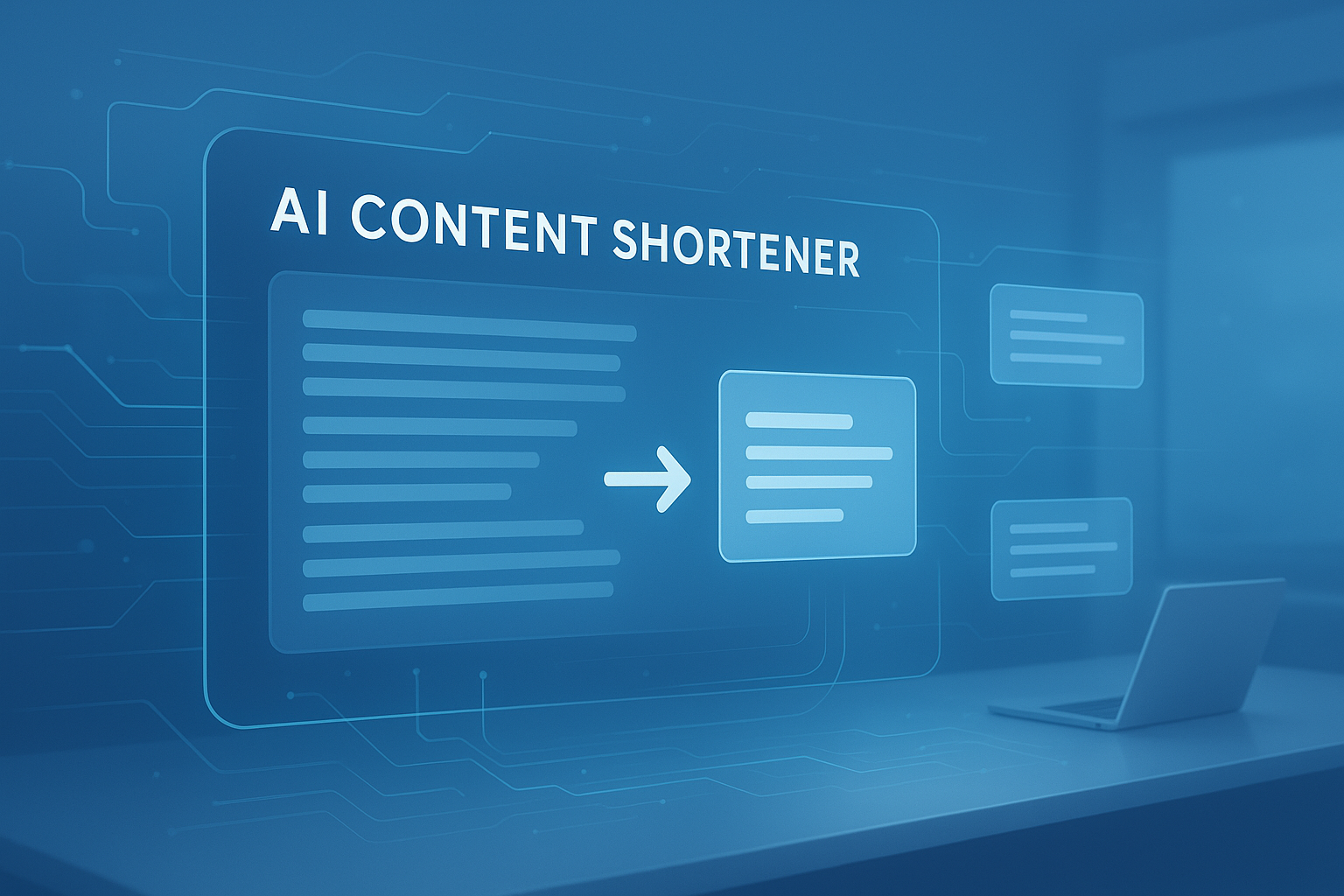
Suggested Image: Technology concept showing long text being condensed into a shorter, clearer summary with AI assistance
What is an AI content shortener?
An AI content shortener is a tool that reduces the length of written content while trying to preserve its intent, key facts, and readability. It can trim paragraphs, summarize articles, simplify explanations, and remove repetition much faster than manual editing alone.
At a basic level, these tools analyze the meaning of a passage and generate a shorter version. Some are designed for simple compression. Others let you choose tone, word count, reading level, or output format.
Professionals usually use an AI content shortener for tasks like:
- Condensing long emails into clear action points
- Turning reports into executive summaries
- Shortening blog drafts before editing
- Rewriting dense copy for better readability
- Creating social captions from longer content
- Reducing word count without losing the main message
If you’re also refining machine-generated drafts, a dedicated AI content shortener tool can help you cut excess wording before final review.
Why professionals use AI to shorten content
Professionals don’t use AI just to save keystrokes. They use it because attention is limited. Clearer writing gets read, understood, and acted on faster.
Here’s the problem. Many business documents are too long because they’re written in stages. People add context, explanations, stakeholder comments, and compliance notes. Over time, the message gets buried.
An AI content shortener helps by:
- Removing repetition and filler
- Surfacing the main point earlier
- Making content easier to scan
- Reducing editing time
- Improving consistency across teams
- Creating versions for different channels
This matters for search visibility too. Google’s guidance continues to reward helpful, people-first content rather than text written mainly to manipulate rankings. You can review that directly in Google’s helpful content guidance.
Shorter content isn’t automatically better, of course. The real goal is efficient communication. If cutting words weakens the message, the content has failed.
How an AI content shortener actually works
Most AI shortening tools use language models to identify important ideas, rank relevance, and generate a condensed version. They don’t simply delete random sentences. The better tools try to retain meaning while reducing unnecessary text.
In practice, the process usually looks like this:
- The tool reads the input and identifies topics, facts, and relationships.
- It detects low-value material such as filler phrases, redundancies, and off-topic details.
- It rewrites the content into a shorter form based on instructions like target length or tone.
- The user reviews the result for accuracy, nuance, and context.
Some tools are extractive, meaning they pull the most important existing lines. Others are abstractive, meaning they generate a new shorter version in fresh wording. Modern AI tools often blend both methods.
If your workflow includes cleaning text copied from different sources or inconsistent formatting, a supporting utility like an text case converter can help standardize the final output before publishing or sharing.
What should be shortened, and what should not?
Not every piece of writing should be compressed. An AI content shortener is best used when the value of the content comes from clarity and speed, not from detailed nuance or legal precision.
Good candidates for AI shortening
- Blog introductions that feel too long
- Internal updates and team announcements
- Meeting notes and recap emails
- Draft landing page copy
- Research summaries
- Product descriptions with repeated phrases
- Long-form content adapted for social media
Use extra caution with these
- Legal contracts
- Medical information
- Compliance-heavy documents
- Financial disclosures
- Technical instructions where precision matters
- Customer communications involving liability or policy
When content includes regulated or sensitive information, always verify the final version against the original. For topics involving accuracy and disclosure standards, trusted references such as the FTC business guidance can help teams stay disciplined about clarity and claims.
AI content shortener vs manual editing
AI is faster. Manual editing is usually more precise. The best results come from using both together rather than choosing one over the other.
| Method | Best For | Main Advantage | Main Limitation |
|---|---|---|---|
| AI content shortener | First-pass reduction, summaries, multi-channel reuse | Speed | May miss nuance or context |
| Manual editing | Final approval, brand voice, sensitive material | Judgment | Takes longer |
| Hybrid workflow | Most professional content teams | Balance of speed and quality | Still needs review process |
Here’s what experienced professionals do differently. They let AI remove bulk, then they manually restore what matters: precision, tone, and credibility.
Benefits of using an AI content shortener
The biggest benefit is time savings, but that’s only part of the story. Used properly, these tools can improve communication quality across channels.
- Faster editing: Long drafts become manageable in minutes.
- Better readability: Dense writing becomes easier to scan.
- More consistent messaging: Teams can create shorter versions for email, web, and internal use.
- Stronger executive communication: Decision-makers often want summaries, not full documents.
- Easier repurposing: A single long article can become multiple shorter assets.
- Lower cognitive load: Readers can focus on what matters most.
If you’re publishing online, shorter and cleaner wording can also improve user experience. That matters for accessibility and readability. The W3C introduction to accessibility is a useful reminder that clearer content often serves more readers, not fewer.
For teams working on web pages, a related word counter tool can help check whether shortened content fits specific publishing requirements.
Common limitations and risks
An AI content shortener can make writing cleaner, but it can also create subtle errors. This is where many people struggle. They assume shorter automatically means better, then publish content that sounds polished but leaves out crucial details.
Watch for these risks:
- Lost nuance: The shortened version may remove context that changes interpretation.
- Factual drift: The wording may become simpler but slightly less accurate.
- Tone mismatch: The output may sound too generic for brand or audience.
- Over-compression: Important supporting evidence may disappear.
- False confidence: Smooth language can hide weak logic.
- Privacy concerns: Sensitive internal text should not be pasted into the wrong system.
When working with AI tools, privacy and data handling matter. Review internal policies and relevant vendor documentation before uploading confidential material. For broader security best practices, many teams refer to guidance from resources like Microsoft Learn security documentation.
How to use an AI content shortener well
The quality of the result depends heavily on the instruction you give the tool. A vague request creates vague output. A clear prompt creates a much stronger draft.
A practical 6-step workflow
- Start with a clean draft. Remove obvious duplicates and unrelated notes first.
- Set the goal. Decide whether you want a summary, simplified version, shorter copy, or channel-specific rewrite.
- Specify constraints. Give a target length, audience, and tone.
- Ask it to preserve key details. Mention figures, policy language, dates, or product names that must remain.
- Review line by line. Check meaning, missing context, and factual accuracy.
- Finalize manually. Polish the opening, transitions, and calls to action yourself.
For example, instead of typing “shorten this,” try something more specific:
Shorten this 700-word project update to 220 words for senior managers. Keep deadlines, blockers, owner names, and next steps. Use direct language and short paragraphs.
This small detail changes everything. The better your instructions, the less cleanup you’ll need later.
If you also need to adapt the result for metadata or search snippets, an meta description length checker can help ensure the final copy fits standard search display limits.
Best use cases by profession
An AI content shortener becomes more useful when you apply it to a repeatable workflow. Different roles use it for different reasons, but the same principle holds: shorten for clarity, not just for length.
Marketing teams
- Condense long blog drafts into email teasers
- Shorten landing page copy
- Create ad variations from core messaging
- Turn webinars into article summaries
Managers and executives
- Reduce project updates to decision-ready summaries
- Extract action items from long meeting notes
- Prepare board-friendly overviews from detailed reports
HR and internal communications
- Simplify policy updates for employees
- Create quick-read versions of announcements
- Rewrite dense process instructions into plain English
Writers and editors
- Trim repetitive sections in early drafts
- Build article summaries and excerpts
- Create multiple versions for newsletter, social, and web use
Developers and product teams
- Shorten release notes for customer-facing updates
- Turn technical notes into simpler user-facing explanations
- Condense documentation intros for better onboarding
If you’re preparing content for search performance, reviewing titles and structure alongside a broader SEO tools collection can help align brevity with discoverability.
Examples: before and after shortening
Examples make the difference clear. A good AI content shortener doesn’t just remove words. It improves focus.
Example 1: Internal update
Before: Our team has been making continued progress on the onboarding workflow redesign initiative, and at this stage we are currently in the process of reviewing stakeholder feedback that came in after last Thursday’s cross-functional session. Based on early review, there are a few requested changes related to field labels, instructional text, and the signup confirmation flow, though none appear to be major blockers at this moment.
After: The onboarding redesign is progressing as planned. We’re reviewing stakeholder feedback from last Thursday’s cross-functional session. Requested changes focus on field labels, helper text, and the signup confirmation flow. No major blockers have emerged so far.
Example 2: Blog paragraph
Before: For many businesses, the challenge is not necessarily creating content in the first place, but rather making sure that the content they produce is concise enough for busy readers who may not have the time or attention span to work through overly long explanations and repeated points that don’t add much value.
After: Many businesses don’t struggle to create content. They struggle to make it concise enough for busy readers.
Suggested Infographic: Before-and-after content shortening examples for business writing
How AI-shortened content affects SEO and AI search
Shorter content can help SEO when it improves clarity, relevance, and user experience. It can hurt SEO when it removes context, weakens topical depth, or strips out terms readers actually search for.
Let’s break this down. Search engines don’t reward content just because it’s brief. They reward content that satisfies intent. For an informational query, that usually means the page should answer the question directly, provide depth where needed, and stay easy to navigate.
Good AI-shortened content tends to:
- Put the answer earlier on the page
- Reduce filler around key topics
- Improve scanability with lists and headings
- Make summaries stronger for snippets and AI Overviews
Poorly shortened content often:
- Removes important examples
- Cuts supporting facts that build trust
- Overuses generic phrasing
- Makes multiple pages sound nearly identical
For technical SEO fundamentals, Google Search Central documentation remains the best primary reference. If you’re summarizing pages that also need speed improvements, a support tool like an Image Compressor can help reduce page weight without changing your copy.
What to look for in a good AI content shortener
Not all tools are built the same. The best one for you depends on the type of content you handle and how much review time you can spare.
| Feature | Why It Matters |
|---|---|
| Custom length control | Helps fit emails, summaries, snippets, and platform limits |
| Tone options | Useful for adapting content to professional, casual, or technical audiences |
| Meaning preservation | Reduces the risk of losing important context |
| Simple interface | Speeds up repeat use by non-technical teams |
| Privacy clarity | Important for internal or sensitive content |
| Clean output formatting | Makes the result easier to paste into CMS, email, or documents |
If your team often repurposes structured content, a companion slug generator can also help turn finalized titles into clean URLs during publishing.
Common mistakes to avoid
Most bad results come from process mistakes, not from the idea of AI itself. Once you know what to avoid, quality improves quickly.
- Using vague prompts: “Make it shorter” is rarely enough.
- Skipping human review: AI compression can remove details you still need.
- Cutting too aggressively: Brevity should not destroy trust or usefulness.
- Ignoring audience: A summary for executives differs from one for customers.
- Leaving in generic phrasing: Shorter copy still needs personality and specificity.
- Forgetting structure: Headings, bullets, and spacing often matter as much as word count.
Here’s a practical rule: if shortening makes the reader ask more questions than before, you shortened the wrong parts.
Frequently asked questions
Is an AI content shortener the same as a summarizer?
Not exactly. A summarizer usually creates a condensed overview of the main points. An AI content shortener may do that, but it can also rewrite the original text into a shorter full version while keeping tone, structure, and specific details. In other words, summarizing is one use case. Shortening is broader and often more useful for editing workflows.
Can an AI content shortener improve writing quality?
Yes, but only when the original draft already has a clear message. AI can remove repetition, tighten weak sentences, and improve readability. It cannot reliably fix unclear thinking, bad logic, or missing evidence on its own. If the source text is messy, the shortened version may be cleaner but still weak. Review and judgment still matter.
Will shortening content hurt SEO?
It depends on what gets removed. If the tool trims filler and brings important answers closer to the top, SEO can improve. If it cuts useful examples, context, or search-relevant terms, performance can drop. The safest approach is to shorten for clarity while preserving intent, topic depth, and key supporting details.
How much should I shorten a piece of content?
There is no universal percentage. The target should match the format and audience. An executive summary may cut 70 percent of a report. A blog post may only need a 15 to 25 percent reduction. Start by asking what the reader actually needs to know. Then cut anything that doesn’t serve that purpose.
Is it safe to paste work documents into AI tools?
Sometimes, but not always. Safety depends on the tool, its privacy practices, your company policy, and the sensitivity of the content. Avoid uploading confidential, regulated, or client-protected information unless the system is approved for that use. Always check internal rules and the provider’s data-handling terms before sharing private material.
What types of prompts get the best results?
The best prompts are specific. Include the target audience, desired length, tone, and any details that must stay. For example, ask the tool to shorten a client update to 150 words, keep all dates and action items, and use direct language. Specific instructions reduce guesswork and usually produce cleaner, more useful output.
Can I use AI-shortened content for emails, blogs, and social posts?
Yes. That’s one of the most practical uses. A long article can become an email summary, a short LinkedIn post, a web excerpt, or a meeting recap. Just remember that each channel has different expectations. A strong result for email may still need edits before it works well on a landing page or social platform.
What’s the best workflow for professionals?
Use AI for the first pass, then edit manually. Start with a clear draft, tell the tool exactly what to reduce, review for accuracy, and then refine tone and structure yourself. This hybrid method is usually the fastest way to produce content that is both efficient and trustworthy.
Final thoughts on using an AI content shortener
An AI content shortener is most valuable when you treat it as an editing assistant, not a final authority. It can save time, improve readability, and make professional communication easier to act on. But the final standard should still be human: Is the message accurate, clear, and useful?
If you want better results, start small. Take one long email, report, or blog section and test a structured prompt. Compare the shortened version against the original. You’ll quickly see where AI helps and where your own judgment matters more.
As a next step, you might pair an AI content shortener with a word counter tool, a meta description length checker, an SEO tools collection, or an Image Compressor to make your content cleaner, sharper, and easier to publish across channels.