
Ask any team to make a quick decision, and the same problem shows up fast: people can list ideas, but they struggle to organize the trade-offs. That is exactly why interest in AI generate pros and cons tools keeps growing.
These tools can save time, surface blind spots, and help professionals move from a vague idea to a structured decision in minutes. But they can also produce shallow, generic, or even misleading points if you use them carelessly.
This guide explains how AI generate pros and cons tools actually work, when they help most, where they fall short, and how to get more reliable output. If you want faster decisions, clearer comparisons, and better planning in 2026, this is the practical version worth reading.
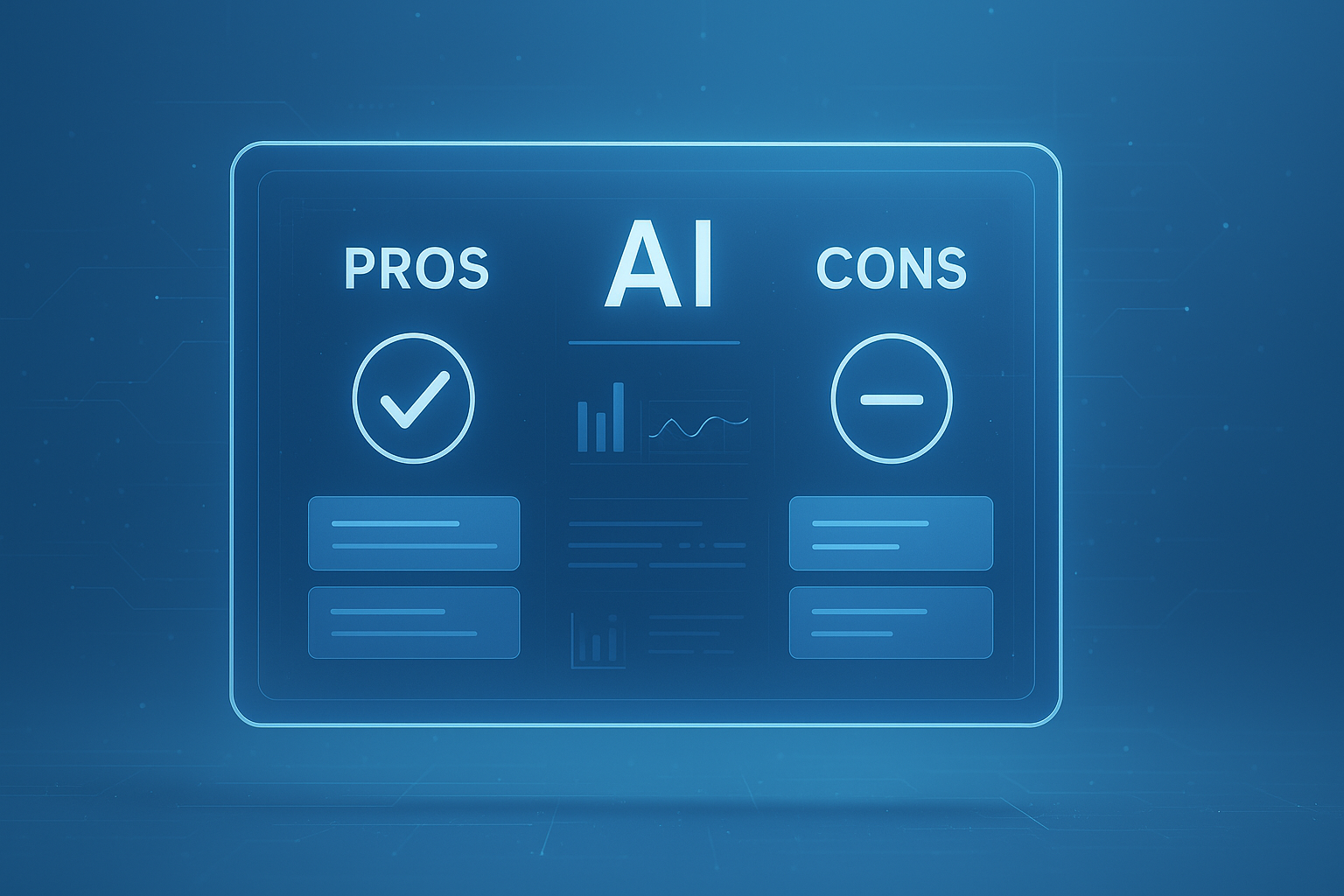
Suggested Image: Technology concept showing AI comparing two options with pros and cons panels
What does AI generate pros and cons mean?
AI generate pros and cons refers to using an AI tool to produce a balanced list of advantages and disadvantages for a topic, decision, product, strategy, or idea. The goal is simple: reduce thinking friction and give you a starting structure for evaluation.
In practice, you enter a prompt such as “pros and cons of remote work for a sales team” or “advantages and disadvantages of switching from PDFs to web forms.” The AI then predicts useful points based on patterns learned from large amounts of text.
That makes it helpful for:
- decision support
- content outlines
- meeting prep
- product comparisons
- risk identification
- brainstorming counterarguments
If you are already using AI for content workflows, a related next step is reviewing prompt quality. FreeToolr readers exploring writing workflows may also find the AI Email Writer useful for turning rough analysis into polished internal communication.
How these tools work behind the scenes
Most AI pros and cons generators do not “reason” like a human expert in the strict sense. They generate likely, relevant statements based on your input, context, and language patterns. That is why the quality of the prompt changes the quality of the result.
Here is the short version of the process:
- The user provides a topic, option, or question.
- The model identifies likely themes related to that topic.
- It predicts arguments that usually appear for and against it.
- It formats those ideas into a readable list.
- If prompted well, it can rank, explain, or tailor the points.
This is useful, but it introduces risk. AI may sound convincing even when it lacks current evidence or business context. That is why decisions with legal, medical, financial, or compliance consequences should be verified against authoritative sources such as the Federal Trade Commission, the U.S. Securities and Exchange Commission, or your own internal documentation.
When your work depends on web visibility, it also helps to understand how search systems evaluate helpful content. The Google Search Central documentation remains one of the best references for this.
AI generate pros and cons: the main benefits
The biggest advantage is speed. A good tool can turn a blank page into a usable list in seconds. For professionals juggling research, meetings, and content production, that alone can remove a lot of friction.
1. Faster first drafts
Instead of staring at a topic and trying to think of both sides, you get an instant framework. That helps when you need to evaluate:
- software purchases
- hiring models
- marketing channels
- process changes
- content topics
- product ideas
2. Better brainstorming range
Many people naturally focus on the side they already prefer. AI can force a wider view by producing objections, concerns, and trade-offs you may have missed.
3. Cleaner communication
Pros and cons lists are easy to share in meetings, briefs, and presentations. They help teams discuss decisions without getting lost in long, unstructured discussion.
4. Useful starting point for content planning
Writers, SEOs, and editors often use pros and cons generation to shape comparison posts, FAQ sections, buyer guides, and landing page messaging. If you are refining page structure and readability, the Word Counter can help tighten long drafts and improve scanability.
5. Helpful for non-experts entering a topic
If you are exploring a new field, AI can quickly surface standard arguments. That does not replace expertise, but it does reduce the time needed to understand the basic landscape.
Where AI pros and cons tools often fail
Now comes the important part. The output can look polished while still being weak, repetitive, or wrong. That is where many people overtrust the tool and make avoidable mistakes.
| Common limitation | What it means in practice |
|---|---|
| Generic output | Lists sound accurate but offer obvious, surface-level points |
| Lack of context | The pros and cons may not match your industry, team size, or goals |
| False balance | It may present both sides equally even when evidence strongly favors one |
| Hallucinated claims | Some points may be fabricated, outdated, or unverifiable |
| Weak prioritization | The biggest risks and benefits may not appear first |
Here is the practical takeaway: AI is strong at generating options, but weak at owning consequences. The moment accuracy, compliance, budgets, or stakeholder impact matters, a human reviewer has to step in.
For technical topics, checking definitions against documentation matters. When prompts involve web technologies or implementation details, trusted references like MDN Web Docs and W3C standards are far more reliable than raw model output.
When should you use AI to generate pros and cons?
Use it when the cost of being partially wrong is low and the value of speed is high. In other words, it works best as a thinking assistant, not a final authority.
Good use cases include:
- brainstorming article angles
- preparing discussion points before a meeting
- comparing tool categories at a high level
- drafting balanced product descriptions
- identifying likely objections from customers or stakeholders
- creating teaching materials or study prompts
For example, a content strategist comparing “gated vs ungated lead magnets” can use AI to create a draft list of trade-offs, then refine the points using analytics, industry context, and actual conversion data.
If you are evaluating on-page assets and user experience, related formatting tools can help after the analysis stage. For example, the PDF to Word tool can be useful when you need to extract decision notes from PDF reports into editable working documents.
When should you not rely on it?
The answer depends on one thing: how much harm a bad answer could cause. If the output could alter legal exposure, health outcomes, financial decisions, or public trust, AI-generated pros and cons should never stand alone.
Avoid using it as the primary source for:
- medical advice
- legal interpretation
- regulated financial recommendations
- security assessments
- compliance decisions
- high-stakes procurement without expert review
For safety-sensitive topics, always validate with primary sources. Depending on the subject, that may mean checking CDC guidance, vendor documentation, internal policy, or a qualified specialist.
How to get better results from an AI pros and cons generator
This small detail changes everything: vague prompts produce vague trade-offs. If you want useful output, give the model context, audience, constraints, and purpose.
Use a prompt that includes these four elements
- the exact topic
- the audience or decision-maker
- the decision context
- the output format you want
Weak prompt:
Give pros and cons of remote work.
Better prompt:
Generate 8 pros and 8 cons of remote work for a 50-person software company. Focus on productivity, hiring, culture, security, and management complexity. Rank the points by business impact and keep each point under 20 words.
Ask for tailored output
Instead of stopping at a simple list, ask the tool to:
- group items by theme
- rank them by importance
- separate short-term vs long-term impact
- identify assumptions behind each point
- flag which points need evidence
- rewrite for executives, marketers, or technical readers
Force specificity
If the result feels generic, push further. Ask:
- Which of these points are most relevant for B2B SaaS?
- Which disadvantages are most likely in a regulated industry?
- What trade-offs matter most for a small team with limited budget?
Teams working on search content can also pair this process with structured keyword planning. The Keyword Density Checker helps review whether a comparison article stays focused without overusing the target phrase.
A practical workflow professionals can use
The most effective process is not “ask once and publish.” Experienced professionals treat AI output as raw material, then validate, rank, and refine it before using it in decisions or content.
- Define the decision clearly.
- Prompt the AI with business context.
- Ask for pros, cons, assumptions, and unknowns.
- Remove generic or duplicated points.
- Verify factual claims with reliable sources.
- Reorder the list by impact, not by AI sequence.
- Add real-world constraints like cost, time, and team skills.
- Turn the final version into a decision memo, article, or presentation.
This is also where simple formatting tools save time. If you are moving results into polished assets, the Text to HTML Converter can help convert raw notes into publish-ready structure without extra cleanup.
Suggested Screenshot: Example workflow showing prompt, AI output, human edits, and final ranked pros and cons list
AI-generated pros and cons vs manual analysis
Both methods have value. AI is faster at generating a broad starting list, while manual analysis is stronger for depth, context, and accountability.
| Method | Best for | Main weakness |
|---|---|---|
| AI-generated list | speed, brainstorming, first drafts | can be generic or inaccurate |
| Manual analysis | high-stakes decisions, nuanced evaluation | slower and more resource-intensive |
| Hybrid approach | most professional workflows | still requires human review discipline |
For most teams, the hybrid model wins. Use AI for ideation, then apply human judgment for prioritization and verification.
Real-world examples of effective use
Let’s break this down with examples. The tool becomes much more useful when the topic is specific and the goal is clear.
Example 1: Software selection
A project manager compares self-hosted software with SaaS tools. AI can quickly produce common trade-offs around control, cost, scalability, implementation, and security. The manager then validates those points with vendor docs and internal IT policies.
Example 2: Content strategy
An SEO lead wants article angles for “pros and cons of AI writing in customer support.” AI can produce balanced subtopics such as speed, tone consistency, privacy, hallucinations, and escalation risk. The lead then expands the useful points into a full outline.
Example 3: Internal process change
An operations team is considering a four-day workweek pilot. AI helps create an early list of benefits and risks, but HR and finance still have to assess scheduling, labor rules, staffing coverage, and department-specific realities.
When supporting long-form articles with visuals and assets, content teams often need lighter files and cleaner media handling. In that case, the Image Compressor can help prepare web-friendly images without adding unnecessary page weight.
Common mistakes people make
Most poor results come from process errors, not from the idea of using AI itself. The tool is often blamed for output that was never properly guided or reviewed.
- Using a one-line prompt with no context
- Accepting the first answer without refinement
- Treating every point as equally important
- Failing to verify factual claims
- Forgetting audience-specific concerns
- Ignoring legal, financial, or operational constraints
- Copying raw output directly into published content
Here’s what experienced professionals do differently. They assume the first draft is incomplete. Then they improve it with better prompts, evidence checks, and editorial judgment.
Best practices for content creators and marketers
If you are using AI generate pros and cons for blog posts, landing pages, or comparison content, your goal is not just speed. Your goal is useful structure that reflects real user questions and real trade-offs.
For SEO articles
- Start with the user’s actual decision
- Cover both benefits and limitations honestly
- Add examples, context, and use cases
- Support claims with trusted external sources when needed
- Write in plain language, not generic AI phrasing
For sales and product teams
- Use the tool to surface objections before sales calls
- Turn repeated cons into FAQ content
- Adapt the list by persona, industry, and company size
- Never hide genuine disadvantages if trust matters
If you are repurposing analysis across channels, file conversion can remove a lot of friction. The JPG to PDF tool can help compile screenshots, annotated comparisons, or workshop outputs into shareable documents.
How to evaluate whether the output is actually good
A polished list is not always a useful list. Quality depends on relevance, specificity, accuracy, and decision value. If the output cannot help someone choose, prioritize, or understand risk, it still needs work.
Use this simple checklist:
- Are the points specific to the exact scenario?
- Do they include both obvious and less obvious trade-offs?
- Are important risks clearly explained?
- Would a domain expert agree with the framing?
- Are any items unsupported or too vague?
- Is the list ranked in a practical order?
| Quality signal | Strong output looks like |
|---|---|
| Specificity | Points mention audience, industry, or operating context |
| Balance | The list is fair without forcing artificial symmetry |
| Decision utility | It helps the reader compare options or assess trade-offs |
| Verifiability | Claims can be checked with data, documentation, or expert input |
Frequently asked questions
Is an AI pros and cons generator accurate?
It can be directionally useful, but accuracy depends on the topic, the prompt, and your review process. For broad, low-risk subjects, the output is often good enough to start with. For expert topics, regulated industries, or high-stakes decisions, always verify the claims. Treat the tool as a fast drafting assistant, not as a final source of truth.
Can I use AI-generated pros and cons in professional reports?
Yes, but not without editing. AI can help create a first-pass structure for reports, presentations, and briefing notes. Before using it in anything formal, remove generic points, add company-specific context, and verify all factual statements. If the report could influence budgets, policy, compliance, or purchases, a subject matter expert should review the final version.
What is the best prompt for AI generate pros and cons?
The best prompt includes the topic, audience, context, scope, and desired format. For example: “Generate 10 pros and 10 cons of adopting AI chatbots for a mid-sized e-commerce business. Focus on support costs, customer satisfaction, integration, data privacy, and escalation challenges. Rank by business impact.” Specific prompts almost always outperform broad prompts.
Are AI-generated pros and cons good for SEO content?
They are useful for planning, but they should not be published raw. Content that performs well in search usually adds examples, explanation, audience context, and verified claims. AI can help identify likely subtopics and objections, but human editing is what makes the article credible, readable, and distinct from generic pages already online.
Do these tools work better for simple or complex topics?
They usually work better for simple or moderately complex topics where common trade-offs are well known. With highly technical, legal, or emerging subjects, the tool may miss important nuance or invent details. As complexity increases, the value shifts from “final answer” to “brainstorming assistant.” The more specialized the topic, the more human review matters.
Can AI generate pros and cons for product comparisons?
Yes, and that is one of the most practical use cases. It can quickly outline likely strengths and weaknesses between two tools, services, or approaches. Still, product comparisons need evidence. Features, pricing, limitations, and compatibility change often, so you should confirm those details through official vendor documentation before sharing or publishing the comparison.
Are there privacy risks when using these tools?
There can be. If you enter private company data, customer information, or confidential strategy details into a third-party AI system, you may create security or compliance problems. Review the provider’s privacy terms, data handling policy, and retention rules before use. For sensitive work, use approved internal tools or remove identifying details from prompts.
How do I make the output less generic?
Give the model more context and push for specificity. Mention the industry, audience, team size, budget level, and decision criteria. Then ask the tool to rank points, explain assumptions, or separate immediate effects from long-term risks. Generic prompts invite generic answers. Detailed prompts usually produce more useful and less repetitive results.
Final thoughts on AI generate pros and cons
AI generate pros and cons tools are best used as accelerators, not substitutes for judgment. They are excellent for brainstorming, outlining trade-offs, and speeding up early-stage thinking. They are much less reliable when accuracy, nuance, or accountability matters.
The practical approach is simple: use AI to create a starting list, then review, verify, rank, and rewrite it for the real decision in front of you. That hybrid process is faster than doing everything manually and safer than trusting automation blindly.
If you want to keep improving your workflow, useful next steps include testing the AI Email Writer for turning analysis into messages, the Keyword Density Checker for refining SEO drafts, the Text to HTML Converter for clean publishing, and the Image Compressor for lighter supporting visuals. The tool matters, but the workflow matters more.