Writing a mission statement sounds simple until you actually try to do it. Most teams either write something too vague to be useful or spend hours debating every word. That’s exactly why an AI company mission generator has become so useful for startups, service businesses, and growing teams.
The real value is not just speed. A good AI company mission generator helps you turn scattered ideas into a clear statement about what your company does, who it serves, and why it exists. Used well, it can save time, reduce blank-page frustration, and give your brand direction.
In this guide, you’ll learn how these tools work, what makes a strong mission statement, where AI helps most, where human judgment still matters, and how to create something that sounds real instead of generic.
Suggested Image: Modern illustration of a team using AI to draft a company mission statement
What is an AI company mission generator?
An AI company mission generator is a writing tool that creates mission statement drafts based on details such as your industry, audience, values, products, and goals. It uses language models to turn short business inputs into concise statements that explain purpose and direction.
In practical terms, it helps answer one core question: what does your company stand for?
- It speeds up brainstorming
- It gives you multiple wording options
- It helps small teams find clarity faster
- It reduces the pressure of starting from scratch
- It can improve consistency across branding documents
If you’re refining your messaging across channels, tools that support writing and structure can also help. For example, if you later need polished text for presentations or downloadable brand documents, a tool like Word Counter can help you keep your final mission statement concise and readable.
Why mission statements still matter in 2026
A mission statement is still one of the clearest ways to define your company’s purpose. It guides internal decisions, shapes brand messaging, and helps customers quickly understand what your business is trying to achieve.
Many businesses skip this step because they assume people won’t read it. That’s the wrong way to think about it. A mission statement is not just a website paragraph. It influences hiring, branding, leadership decisions, pitch decks, onboarding, and strategy.
According to the U.S. Small Business Administration, clear business planning and positioning are central to building a sustainable company. Your mission is part of that foundation.
Here’s where it matters most:
- For founders: it helps define the business beyond products
- For teams: it creates alignment around purpose
- For customers: it explains why your company exists
- For investors and partners: it adds clarity to your direction
- For marketing: it improves consistency across messaging
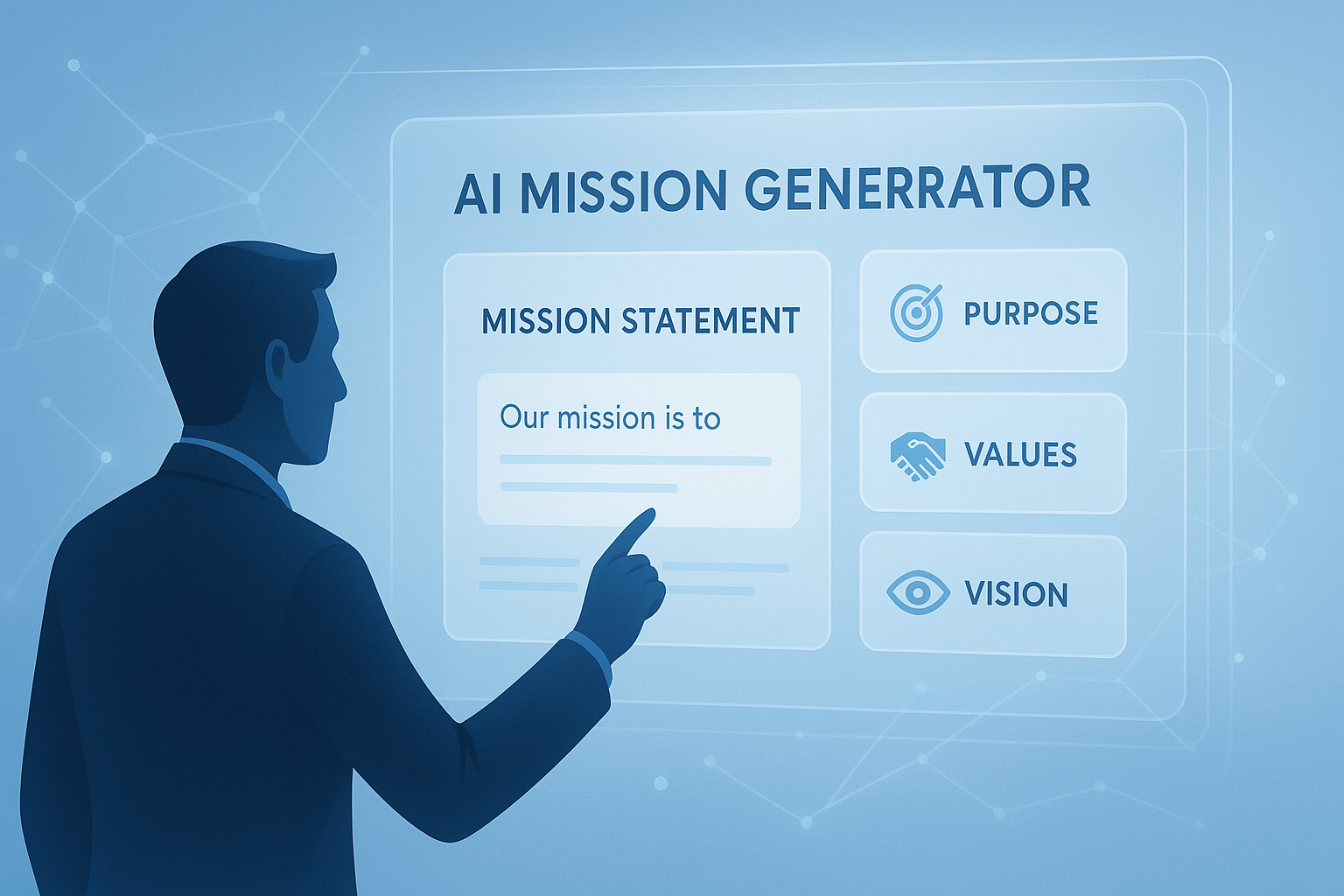
This is also where businesses often confuse mission with vision or values. That small detail changes everything.
| Term | What it means |
|---|---|
| Mission statement | What your company does, for whom, and why |
| Vision statement | What future your company wants to help create |
| Core values | The principles that guide behavior and decisions |
How an AI company mission generator works
Most mission generators follow a simple process. You provide business details, the model identifies patterns in your inputs, and it produces one or more mission statement options in a professional tone.
Here’s the basic workflow:
- Enter your company name or type of business
- Describe your product, service, or solution
- Identify your target audience
- Add key values such as innovation, trust, simplicity, sustainability, or service
- Select a tone, if the tool offers one
- Review the AI-generated mission statement drafts
- Edit for authenticity, specificity, and brand voice
Some businesses like to prepare their inputs before using a generator. That usually leads to much better output. If your brand notes live in PDFs or planning files, a utility such as PDF to Text can make it easier to pull rough content into an editable format before drafting your mission statement.
For broader guidance on how AI systems generate responses, Google’s overview of large language models is a useful technical reference.
What makes a strong mission statement?
A strong mission statement is clear, specific, believable, and easy to remember. It should quickly tell readers what your company does and why it matters without sounding inflated or empty.
Here’s what experienced professionals look for:
- Clarity: plain language beats abstract language
- Relevance: it should reflect what the business actually does
- Audience focus: it should show who benefits from your work
- Purpose: it should explain the value behind the business
- Brevity: usually one or two sentences is enough
- Distinctiveness: it should not sound interchangeable with competitors
Here’s a simple formula that often works well:
We help [target audience] achieve [desired outcome] through [product, service, or approach].
That structure is not mandatory, but it’s a useful starting point. If you want to keep your line short enough for homepages, about pages, and team documents, the Character Counter can help you tighten wording without losing meaning.
Examples of weak vs strong mission statements
| Weak example | Why it fails |
|---|---|
| We strive to be the best in innovation and excellence. | Too vague, no audience, no clear purpose |
| We empower businesses with transformative solutions for a changing world. | Sounds polished but says almost nothing |
| Strong example | Why it works |
|---|---|
| We help small retailers simplify inventory management so they can save time, reduce waste, and serve customers better. | Clear audience, clear problem, clear benefit |
| We create affordable online learning tools that help students build practical skills with confidence. | Specific offering, direct language, believable promise |
When AI helps most and when it doesn’t
An AI company mission generator works best when you already understand your business but need help shaping the wording. It is less useful when your business model, audience, or positioning is still unclear.
Let’s look at where AI adds the most value:
- Turning rough notes into a clean first draft
- Creating multiple options quickly
- Reducing repetitive brainstorming sessions
- Helping solo founders clarify language
- Reframing a mission statement for a different tone
Now the limitations:
- It may produce generic phrases
- It can overuse clichés like “empower” and “innovate”
- It may miss nuance in your brand voice
- It cannot decide your actual business priorities for you
- It can sound credible even when the wording is not distinctive
This is why final editing matters. The Federal Trade Commission business guidance is a useful reminder that business claims should be truthful and not misleading. Your mission statement should be inspiring, but it should also reflect reality.
How to use an AI company mission generator effectively
The best results come from better inputs, not just better tools. If you give AI vague prompts, you’ll usually get vague mission statements back.
Here’s a practical method that works well for most businesses:
1. Define your company in plain English
Before generating anything, write one simple sentence about what you do. No buzzwords. No polished brand language. Just the truth.
- What do you sell or provide?
- Who is it for?
- What problem does it solve?
- Why does that matter?
2. List your non-negotiable values
You do not need a long list. Three to five values are enough.
- Affordability
- Speed
- Trust
- Sustainability
- Accessibility
- Craftsmanship
3. Give the generator real context
Include business details the AI can use. For example:
We are a B2B software company that helps small construction firms manage project timelines and job costs. Our customers need simpler tools, not enterprise complexity. Our values are clarity, reliability, and time savings.
4. Generate several options, not one
One draft rarely solves the whole problem. Generate multiple versions, then compare them. If you’re collecting team feedback in a slide deck or visual mockup, a utility like Image to PDF can help package screenshots and revisions into one shareable file.
5. Edit out generic language
Words like “world-class,” “leading,” “innovative,” and “best-in-class” usually weaken a mission statement unless they are backed by something specific.
6. Test it with real people
Ask three simple questions:
- Do you understand what we do?
- Does this sound like us?
- Would this still make sense a year from now?
Suggested Infographic: Step-by-step workflow for generating and refining a mission statement with AI
Prompt examples that produce better mission statements
Prompt quality has a direct effect on output quality. A short, generic prompt often creates a generic result. A specific prompt gives the AI much more to work with.
Weak prompt
Create a mission statement for my business.
Better prompt
Write three mission statement options for a startup that provides bookkeeping software for freelancers. The tone should be clear, practical, and trustworthy. Focus on helping independent professionals save time, reduce stress, and stay in control of finances.
Even better prompt
Create five mission statement options for an eco-friendly cleaning company serving small offices. Keep each under 25 words. Avoid clichés. Highlight health, reliability, and environmental responsibility. Make the tone warm but professional.
If you’re fine-tuning prompt length for consistency across AI tools, the Text Case Converter can also help clean raw notes and standardize formatting before you paste them into a generator.
For businesses using AI content systems more broadly, Microsoft Learn’s prompt engineering guidance offers practical recommendations on how to structure better prompts.
Mission statement examples by business type
Different business models need different wording. A local service company should not sound like a venture-backed software startup. The structure may be similar, but the tone and level of ambition should fit the business.
Startup example
We help small teams automate repetitive admin work so they can focus on growth, customer service, and better decisions.
Ecommerce example
We make sustainable everyday products easier to buy by offering practical design, fair pricing, and low-waste packaging.
Consulting firm example
We help growing businesses solve operational challenges with clear strategy, actionable advice, and measurable improvements.
Local service business example
We provide dependable home repair services that make it easier for families to keep their homes safe, functional, and stress-free.
Education business example
We create accessible learning tools that help students build real skills and gain confidence at every stage of their education.
If you’re comparing several wording styles internally, it may help to track readability and length in a simple side-by-side review sheet. For content teams working across websites, metadata, and technical pages, the HTML to Markdown tool can also simplify moving approved mission text between systems.
Common mistakes businesses make with AI-generated mission statements
The biggest mistake is treating the first AI output as finished work. AI is excellent at generating drafts. It is not automatically excellent at sounding like your company.
Here are the most common problems:
- Too broad: “We help businesses succeed” could describe almost anyone
- Too ambitious: claims are bigger than the company’s actual role
- Too long: the message gets buried in explanation
- Too generic: common startup language replaces clear meaning
- Too internal: the statement reflects management language, not customer value
- Too trendy: wording depends on buzzwords that will age badly
Here’s what experienced professionals do differently. They use AI for range, then use judgment for precision.
For plain-language guidance, the Plain Language Guidelines are especially useful. A mission statement should be easy to understand on the first read.
How to tell if your mission statement is actually good
A good mission statement passes a simple test: someone outside your company can read it once and understand what you do, why you do it, and who it helps.
Use this review checklist:
- Can a new customer understand it in under 10 seconds?
- Does it describe a real audience?
- Does it connect to an actual product or service?
- Does it avoid empty claims?
- Could a competitor use the exact same sentence?
- Would your team feel comfortable repeating it publicly?
- Will it still fit if the company grows moderately?
You can also score mission statement drafts side by side.
| Criteria | Questions to ask |
|---|---|
| Clarity | Is the meaning obvious on first read? |
| Specificity | Does it name the audience, benefit, or category clearly? |
| Differentiation | Does it sound uniquely tied to your business? |
| Brevity | Can it be said in one sentence without losing meaning? |
| Authenticity | Would employees and customers recognize this as true? |
AI-generated mission statement vs human-written mission statement
The answer depends on one thing: whether you need a draft or a final brand-defining sentence. AI is faster. Humans are better at nuance, context, and brand truth.
| Approach | Best for | Main limitation |
|---|---|---|
| AI-generated | Speed, ideation, first drafts, option generation | May sound generic or over-polished |
| Human-written | Final messaging, emotional nuance, strategic positioning | Takes more time and usually more revision |
| Hybrid approach | Most businesses | Requires editing discipline |
For most companies, the hybrid approach is the practical choice. Draft with AI. Refine with human judgment. Validate with stakeholders.
For more on trustworthy AI use, the NIST AI Risk Management Framework is a solid resource, especially for businesses building repeatable internal workflows around AI-assisted content.
Frequently asked questions
Can an AI company mission generator create a mission statement for any industry?
Yes, most generators can produce mission statement drafts for nearly any industry, including software, consulting, retail, healthcare, education, and local services. The quality depends on the information you provide. If you describe your audience, offer, values, and tone clearly, the output usually improves. Industry-specific wording still needs review to make sure it sounds accurate and credible.
How long should a company mission statement be?
For most businesses, one sentence is enough. In some cases, two short sentences work better if the company has a slightly more complex offer. The goal is clarity, not length. If readers need to reread the statement to understand it, it is probably too long. A strong mission statement is brief enough to remember and clear enough to guide decisions.
Is it safe to use AI for business messaging?
It can be safe if you use it carefully. Avoid entering confidential information, unreleased strategy, customer data, or private financial details into any AI tool unless you fully understand the provider’s privacy terms. Use AI for drafting and brainstorming, then review everything internally. Sensitive or regulated industries should apply extra review standards before publishing any AI-assisted messaging.
What is the difference between a mission statement and a slogan?
A mission statement explains the purpose of the company. A slogan is a short marketing phrase designed to be memorable. Mission statements are usually more informative and internal-facing, even when they appear publicly. Slogans are more promotional and often appear in ads, websites, or packaging. A mission statement should guide your brand. A slogan should support recognition.
Should startups use an AI company mission generator?
Yes, especially if the founders are still working through language and positioning. Startups often know the product well but struggle to explain the bigger purpose clearly. An AI company mission generator can accelerate that process by offering multiple directions quickly. The key is not to accept the first version blindly. Startups should revise the draft as the business model and customer understanding become sharper.
Can I use the same mission statement on my website, pitch deck, and hiring page?
Usually yes, but small adjustments may help depending on context. Your core mission should stay consistent across channels, but the surrounding explanation can change. Investors may want more strategic context. Job candidates may care more about team purpose and culture. Website visitors need clarity fast. Keep the central statement stable, then adapt the supporting copy for the audience.
How many mission statement options should I generate before choosing one?
Three to ten options is a practical range for most businesses. Fewer than three may limit your thinking. Too many can slow decision-making and create unnecessary debate. Generate enough versions to compare tone, clarity, and specificity. Then narrow the list to two or three finalists and test them with teammates or trusted customers. The best mission statement is usually the clearest, not the cleverest.
What should I do after generating a mission statement?
Review it, shorten it, and test it in real use. Add it to your website, internal brand guide, onboarding materials, and marketing notes only after you confirm it reflects the business accurately. It should also align with your vision, values, and product messaging. If it feels generic, revise the inputs and try again. Treat the generated draft as the beginning of the process, not the end.
Final thoughts on using an AI company mission generator
An AI company mission generator can save time and remove the hardest part of the process: starting. But the best mission statements still come from clear thinking, honest positioning, and careful editing. AI helps you produce options. Your job is to make sure the final statement sounds true, useful, and specific to your business.
If you’re creating or refining your company mission in 2026, start with the basics. Define what you do. Name who you help. Explain why it matters. Then use AI to explore better wording, not to invent a purpose you do not actually have.
As your next step, draft three versions and compare them for clarity and specificity. To keep refining the result, tools like Word Counter, Character Counter, PDF to Text,