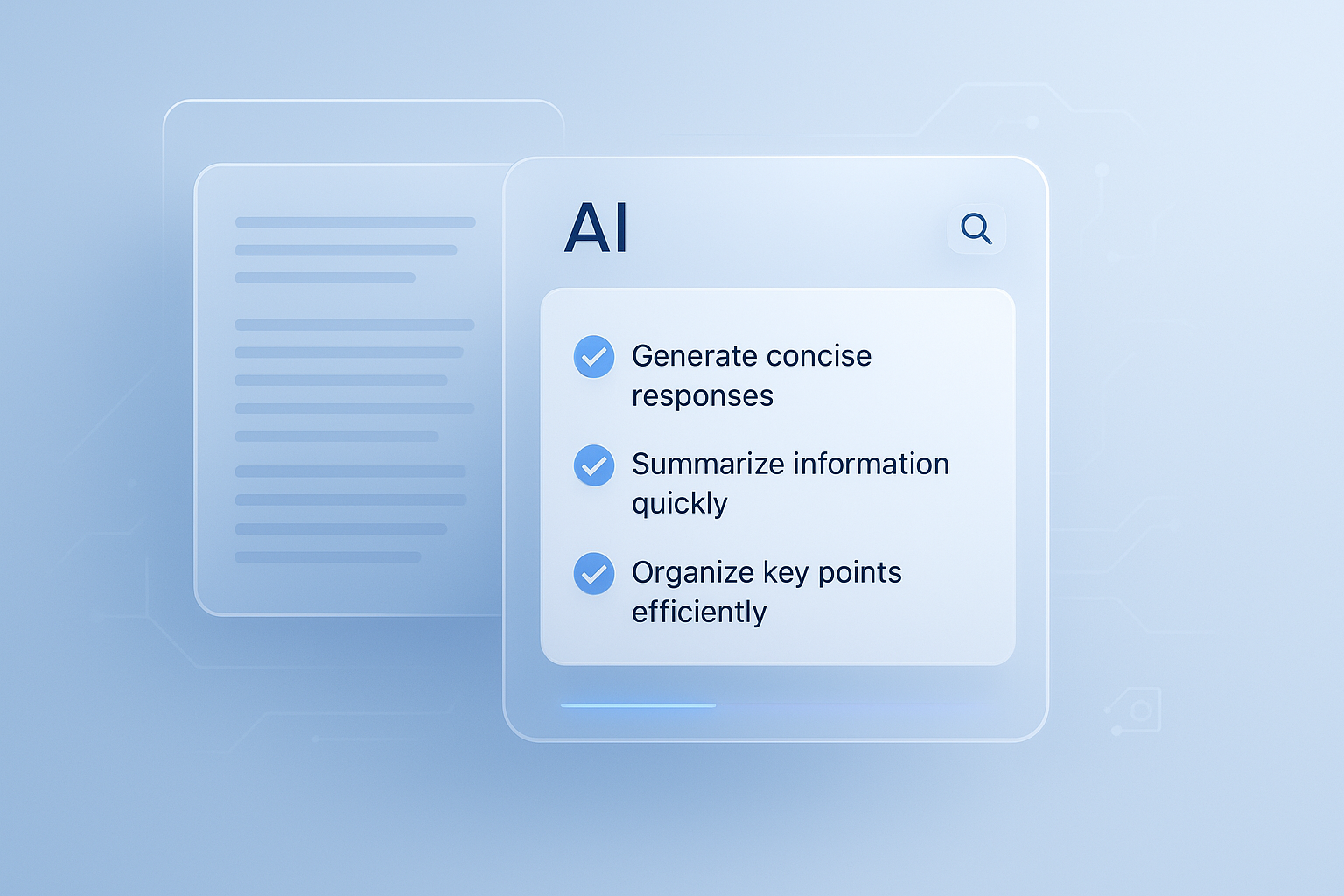

Staring at a blank page is exhausting. Whether you are writing a research paper, summarizing ten journal articles, or trying to understand a hard concept before class, the real time drain is rarely the task itself. It is figuring out where to start.
That is why the best AI prompts for students and researchers matter. A strong prompt can turn AI into a study partner, outline builder, citation helper, brainstorming assistant, and plain-language explainer. A weak prompt usually gives you vague and unhelpful answers.
This guide shows you how to write better prompts, when to use them, and which examples actually save time. You will also see practical prompt templates for studying, literature reviews, note-taking, writing, and data interpretation, plus the mistakes that cause poor results.
What are AI prompts, and why do they save students and researchers so much time?
AI prompts are the instructions you give an AI tool to get a useful response. For students and researchers, a good prompt reduces back-and-forth, improves accuracy, and helps the AI produce output in the exact format you need. That means less editing, less confusion, and faster progress.
Here is the simple rule: better input leads to better output. If you ask, “Explain photosynthesis,” you may get a generic answer. If you ask, “Explain photosynthesis for a first-year biology student in 5 bullet points with one real-world example,” the answer becomes far more useful.
- They save time on first drafts
- They clarify complex topics quickly
- They help organize research notes
- They improve brainstorming
- They reduce repetitive writing tasks
If you work with long PDFs and research handouts, you may also find it useful to keep file sizes manageable with an image compressor tool when preparing screenshots, figures, or visual notes for assignments.
Suggested Image: Student using AI to turn a rough question into a structured study prompt
How do you write a good AI prompt for academic work?
A good academic prompt is specific, contextual, and goal-focused. It tells the AI what you want, who the answer is for, what format to use, and any limits it should follow. This small detail changes everything because AI performs best when the task is clearly defined.
Use this simple formula:
- State the task
- Add context
- Define the audience or level
- Choose the format
- Set boundaries
The basic prompt formula
Use this template:
Act as a [role]. Help me [task]. The topic is [topic]. Write for [audience/level]. Use [format]. Include [requirements]. Avoid [what to avoid].
Example:
Act as an academic writing tutor. Help me create a clear outline for a 1,500-word essay on climate policy. Write for an undergraduate audience. Use section headings and bullet points. Include a thesis statement and 3 supporting arguments. Avoid jargon.
What makes a prompt weak?
- It is too broad
- It has no context
- It does not specify the output format
- It expects factual accuracy without verification
- It asks AI to do original research without sources
When handling data-heavy assignments, using clean numbers matters. If you need to convert values while reviewing research tables, a quick unit converter can help avoid simple mistakes.
| Weak Prompt | Better Prompt |
|---|---|
| Explain machine learning | Explain machine learning to a beginner psychology student in simple language using 3 examples and a short comparison with traditional statistics |
| Summarize this | Summarize this article in 7 bullet points, then list the main argument, method, and conclusion separately |
| Help with my paper | Help me improve the clarity of my introduction for a sociology research paper without changing the original meaning |
Best AI prompts for students who want to study faster
The best AI prompts for students are the ones that reduce mental load. They help you turn class material into flashcards, practice questions, summaries, and step-by-step explanations. Instead of asking AI to “teach everything,” ask it to support one learning task at a time.
1. Prompts for understanding difficult topics
- Explain this topic in simple English as if I am new to it: [topic]
- Teach me [topic] step by step, starting with the basics and ending with one advanced concept
- Give me a plain-language explanation of [topic], then a more academic explanation
- Use one analogy and one real-world example to explain [topic]
- What are the 5 most important things a student should understand about [topic] before an exam?
2. Prompts for turning notes into study material
- Turn these lecture notes into 15 flashcards with questions on one side and short answers on the other
- Convert these notes into a study guide with headings, key terms, and likely exam questions
- Create a one-page revision sheet from these notes using bullet points only
- Group these notes into themes and explain what matters most in each theme
If you need to clean up screenshots from slides or handwritten notes before storing them, an image resizer can make your study files easier to organize and share.
3. Prompts for test preparation
- Create 10 multiple-choice questions on [topic] with answers and explanations
- Quiz me on [topic] one question at a time and wait for my answer before continuing
- Generate 5 short-answer exam questions based on these notes and include a model answer for each
- Act as a tutor and help me identify weak areas based on these practice answers
Suggested Infographic: From class notes to flashcards, quiz questions, and summary sheets
Best AI prompts for researchers working with sources and literature reviews
Researchers often lose time in the early stages: identifying themes, comparing papers, and organizing findings. Good prompts help structure that work. They do not replace close reading, but they can speed up note extraction and pattern spotting.
4. Prompts for summarizing academic papers
- Summarize this paper in 150 words. Then list the research question, method, key findings, and limitations
- Extract the core argument from this article and explain it in plain language
- Summarize each section of this paper separately: introduction, methods, results, and discussion
- What should a graduate student remember after reading this paper?
5. Prompts for literature review support
- Compare these 5 abstracts and identify shared themes, disagreements, and research gaps
- Organize these paper summaries into a literature review structure with subheadings
- Based on these sources, what are the most common debates in [topic]?
- Help me group these studies by method, population, and findings
- Suggest a logical order for discussing these sources in a literature review
If you are collecting article metrics, percentages, or survey results, a percentage calculator can help you verify quick comparisons before adding them to your notes.
6. Prompts for identifying limitations and gaps
- Review this summary and identify possible limitations in the study design
- What research gaps appear across these studies?
- Which populations, variables, or methods seem underrepresented in this literature?
- Suggest 5 possible future research questions based on these findings
For research standards and source evaluation, the best practice is still to verify against primary guidance. The Google Search Central documentation is especially useful if your work involves search data, online publishing, or content credibility.
Best AI prompts for writing essays, papers, and thesis sections
AI can be helpful during writing, but only if you use it as support rather than a replacement. The strongest prompts focus on planning, clarity, rewriting, and structure. This is where many people struggle because they ask for a full paper instead of help with one writing problem.
7. Prompts for outlining
- Create a detailed outline for a paper on [topic] with an introduction, 3 main sections, counterargument, and conclusion
- Help me build a thesis statement and match each body paragraph to one supporting point
- Suggest 3 possible structures for an argumentative essay on [topic]
8. Prompts for improving clarity
- Rewrite this paragraph for clarity and flow without changing its meaning
- Make this writing more concise and academic, but keep it readable
- Identify unclear sentences in this draft and explain how to improve them
- Reduce repetition in this section and suggest stronger transitions
9. Prompts for introductions and conclusions
- Help me write an introduction that provides context, states the problem, and ends with a clear thesis
- Suggest 3 strong opening approaches for a paper on [topic]
- Write a conclusion that summarizes the argument and explains why it matters without repeating the introduction
When working with word counts, timing, or reading targets, simple helpers like a word counter tool can keep your draft within assignment requirements.
| Writing Task | Best Prompt Style |
|---|---|
| Essay outline | Ask for a structure with headings, argument flow, and evidence placement |
| Paragraph editing | Ask for clarity, concision, grammar, and preservation of original meaning |
| Thesis development | Ask for 3 thesis options at different levels of specificity |
| Conclusion writing | Ask for a concise summary plus broader significance |
Best AI prompts for data analysis, coding, and technical research support
Students in STEM, economics, social science, and computer science often use AI for technical help. The key is not to ask for blind answers. Ask for explanation, interpretation, debugging logic, and step-by-step reasoning you can verify yourself.
10. Prompts for statistics and data interpretation
- Explain what this statistical result means in simple terms: [paste result]
- Help me interpret this table and identify the main pattern without overstating the findings
- What is the difference between correlation and causation in this example?
- Explain when to use a t-test, ANOVA, or chi-square test in beginner-friendly language
11. Prompts for coding and debugging
- Explain what this code does line by line: [paste code]
- Find the likely error in this code and suggest a fix with explanation
- Rewrite this function to be simpler and easier for a beginner to understand
- Compare two approaches to solving this programming problem and explain the tradeoffs
If your technical notes include screenshots of code or charts, a quick JPG to PNG converter may improve clarity when adding them to documents or presentations.
For coding fundamentals and browser behavior, MDN Web Docs remains one of the most trusted references. If your research involves web standards, the W3C is also worth bookmarking.
Prompt templates that save the most time
If you want faster results, start with reusable prompt templates. They reduce writing time, improve consistency, and help you get better output across different tasks. Here’s the problem: many users reinvent prompts every time. A small template library solves that fast.
Template for summaries
Summarize the following text for a [student level] audience. Keep it under [word count]. Then list the main argument, evidence, and conclusion in separate bullet points.
Template for comparing sources
Compare these sources based on their research question, method, findings, strengths, and limitations. Present the answer in a table.
Template for learning a concept
Teach me [topic] as if I am a beginner. Start with a simple definition, then explain the core idea step by step, and end with a short quiz.
Template for rewriting
Improve the clarity and flow of this paragraph. Keep the original meaning, maintain an academic tone, and avoid unnecessary complexity.
Template for brainstorming research questions
Based on this topic and these source notes, suggest 10 focused research questions. Group them by feasibility, originality, and likely data needs.
Students who organize prompt libraries often keep them in simple documents, but screenshots and exported notes can get messy. Tools like a PDF to JPG converter can help when you need quick visual extracts from reading packets or annotated PDFs.
Common mistakes when using AI for school or research
The biggest mistake is treating AI like an authority instead of a helper. AI can speed up thinking, but it can also invent facts, misunderstand nuance, or present confident errors. The answer depends on one thing: whether you verify and guide the output.
- Using prompts that are too vague
- Trusting citations without checking them
- Asking AI to write the final submission from scratch
- Skipping fact-checking
- Ignoring academic integrity rules
- Failing to provide enough context
- Accepting generic answers that need major revision later
How to use AI responsibly
- Use AI for support tasks like outlining, summarizing, and clarifying
- Verify facts, quotes, and references manually
- Check your school’s policy on AI use
- Revise everything in your own voice
- Never submit unverified or fabricated citations
Many institutions now publish guidance on responsible AI use. For example, NIH resources and university integrity policies can help frame proper research practice in academic settings.
How to check whether an AI response is actually useful
A useful AI response is clear, accurate, relevant, and easy to apply. That may sound obvious, but this is exactly where poor prompting wastes time. Experienced users judge AI answers quickly and either refine the prompt or move on.
Use this 5-point check
- Is the answer factually plausible?
- Does it match the level you asked for?
- Is the format useful for your task?
- Does it avoid vague filler?
- Can you verify the important claims?
If the answer fails two or more of those checks, rewrite the prompt. Add more context. Ask for a table. Ask for bullet points. Narrow the scope. This is usually faster than editing a bad answer.
Suggested Screenshot: Example of a vague prompt versus a refined academic prompt with improved output
Can AI help with citations and references?
AI can help format, organize, and explain citation styles, but it should not be trusted to generate references without verification. Fabricated titles, wrong page numbers, and made-up journal details are common problems. Use AI to assist your workflow, not to replace source checking.
- Ask AI to explain APA, MLA, or Chicago rules
- Ask it to format a citation from details you already verified
- Ask it to check consistency across a reference list
- Do not trust invented sources
For style and source guidance, always confirm against official academic resources or your institution’s writing center. If your research workflow includes tables, numeric references, or adjusted percentages, having a grade calculator can also help when you are balancing assignment weighting and revision priorities across courses.
Frequently asked questions
What is the best AI prompt for students?
The best AI prompt for students is one that clearly defines the task, the topic, the audience level, and the output format. For example, asking AI to “turn these notes into a one-page study guide with key terms and 10 quiz questions” is much stronger than simply saying “help me study.” Specific prompts save time because they reduce vague answers and extra editing.
Can AI prompts help with research papers?
Yes, AI prompts can help with outlining, summarizing papers, comparing sources, clarifying complex methods, and improving writing clarity. They are especially useful in the planning and revision stages. However, researchers should still verify facts, read primary sources carefully, and avoid relying on AI for citations or final claims without checking them against the original material.
Are AI prompts safe to use for academic work?
They can be safe if used responsibly. Do not paste private data, unpublished sensitive research, or personal information into public AI tools. Also check your school’s academic integrity rules before using AI for coursework. Safe use means treating AI as a support tool for brainstorming, summarizing, and editing rather than as a substitute for original thinking and verified scholarship.
How specific should an AI prompt be?
More specific is usually better. A strong prompt includes the goal, the context, the audience level, and the format you want. If you need a summary, say how long it should be. If you need a study aid, ask for flashcards or quiz questions. Specific prompts reduce generic output and make the response easier to use right away.
Can AI generate good literature review prompts?
Yes, AI is helpful for literature review support when you ask it to compare themes, identify gaps, group studies by method, or propose a logical structure. It works best when you provide abstracts, summaries, or notes from real sources. It should support your analytical process, not replace close reading or critical judgment about what each source actually contributes.
Should students use AI to write full essays?
That is usually a poor idea, even when policies allow limited AI use. Full AI-written essays often sound generic, miss course-specific expectations, and require heavy revision. A better approach is to use AI for outlines, thesis options, paragraph clarity, and revision support. This saves time while keeping the work more accurate, personal, and aligned with your own understanding.
What are the biggest mistakes when writing AI prompts?
The most common mistakes are being too vague, not specifying the output format, trusting answers without fact-checking, and asking for too much in one prompt. Another common problem is forgetting to define the audience level. A prompt for a high school student should not sound like one for a doctoral seminar, and AI often needs that distinction spelled out.
Can AI help me study for exams?
Yes, AI can be very useful for exam prep. It can turn notes into flashcards, generate practice quizzes, explain concepts in simpler language, and simulate tutor-style questioning. The best results come from giving it your own material and asking for one focused output at a time, such as practice questions, summary sheets, or topic explanations with examples.
How do I know if an AI answer is wrong?
Watch for vague wording, invented statistics, suspicious citations, or explanations that sound confident but do not match your course material. Cross-check important facts with textbooks, lecture notes, and trusted sources. If an answer seems too polished yet oddly empty, that is often a sign it needs verification. Useful AI output should be specific, testable, and clearly relevant to your question.
Which tasks should researchers never fully outsource to AI?
Researchers should not fully outsource source verification, interpretation of nuanced findings, citation accuracy, ethical judgment, or final scholarly argumentation. AI can support these tasks, but responsibility stays with the researcher. This matters even more in formal work such as theses, manuscripts, and funded projects, where accuracy, transparency, and research integrity are non-negotiable.
Final thoughts
The best AI prompts for students and researchers to save time are not the fanciest ones. They are the clearest ones. Good prompts focus on one real task, give enough context, and ask for usable output. That could mean a summary, an outline, a quiz, a comparison table, or a simpler explanation of a hard concept.
Start small. Build a few prompt templates you can reuse. Verify anything factual. Revise the output in your own voice. And when your workflow includes files, notes, percentages, word counts, or study materials, use practical tools that reduce friction along the way, such as an online PDF merger for combining class materials and research handouts into one working file.
The real goal is not to let AI do your thinking. It is to remove busywork so you can spend more time on understanding, analysis, and better academic work.