
Have you ever rewritten a paragraph three times and still felt it sounded awkward? That’s exactly where an AI paragraph rephraser can help. It takes an idea you already wrote and reshapes it so the meaning stays the same, but the wording becomes clearer, smoother, or better suited to your audience.
For students, this is especially useful. Class notes can be messy. Essays can sound repetitive. Emails to professors can come off too casual. Rephrasing tools help fix those problems faster, but only if you know how to use them well.
In this guide, you’ll learn how an AI paragraph rephraser works, when it’s worth using, where it can go wrong, and how to get better results without losing your original message. If you want cleaner writing without sounding fake or over-edited, let’s break it down.
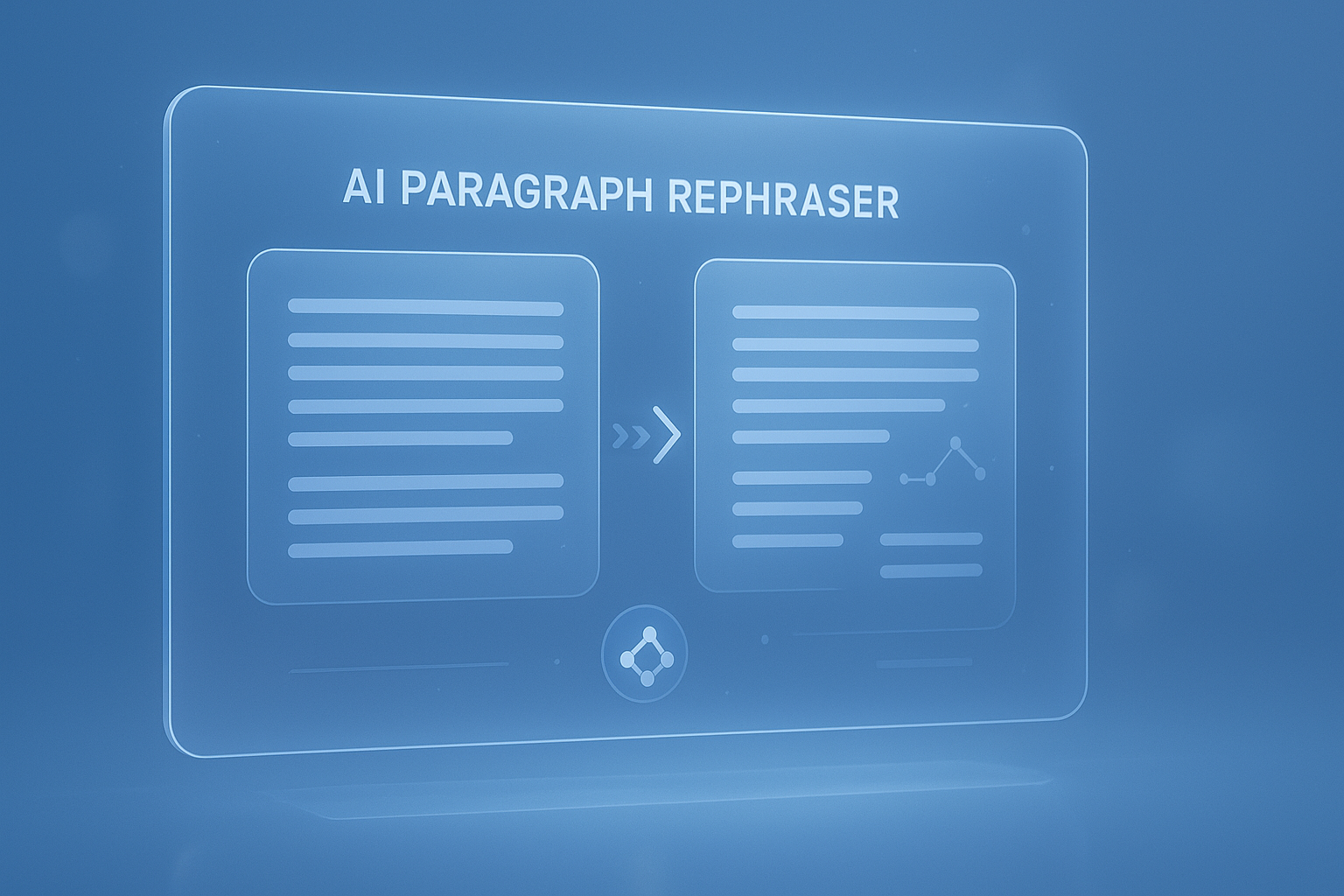
Suggested Image: Technology concept illustration showing AI rewriting text on a student laptop screen
What is an AI paragraph rephraser?
An AI paragraph rephraser is a writing tool that rewrites a block of text while trying to preserve its original meaning. Instead of correcting only spelling or grammar, it changes sentence structure, word choice, and tone to make the paragraph easier to read or better aligned with a specific purpose.
Think of it as a revision assistant, not a shortcut for original thinking. It can help turn stiff wording into natural language, simplify complex ideas, or make rough drafts sound more polished. Students often use it for essays, reports, scholarship statements, discussion posts, and presentations.
If you’re already using AI tools for schoolwork, you may also find it useful to compare rewriting tasks with other text workflows, such as an AI paragraph rephrase tool and related writing utilities.
What an AI rephraser usually changes
- Sentence order
- Word choice and synonyms
- Tone, such as formal or simple
- Clarity and readability
- Repetition and awkward phrasing
- Paragraph flow
What it should not change
- Your core meaning
- Factual accuracy
- Citations or quoted material
- Technical terms that must stay exact
- Your personal viewpoint, unless you ask for a different tone
How does an AI paragraph rephraser work?
An AI paragraph rephraser works by analyzing the words in your paragraph, identifying the meaning and sentence patterns, and then generating a new version that expresses the same idea differently. Modern tools rely on large language models trained on vast text datasets, which helps them predict natural-sounding alternatives.
Here’s the simple version: the tool reads your paragraph, figures out the likely intent, and reconstructs it using different language. This is why some outputs sound smooth and human, while others feel slightly off. The quality depends on the model, the prompt, and the clarity of the original text.
- Input analysis: The tool scans your paragraph for grammar, vocabulary, tone, and structure.
- Meaning detection: It estimates what the paragraph is trying to say.
- Alternative generation: It creates multiple wording options based on context.
- Language smoothing: It adjusts flow, readability, and sentence rhythm.
- Output delivery: It returns a rewritten paragraph for you to review and edit.
This process is related to how generative language systems work more broadly. If you want a technical foundation, OpenAI research and Google’s generative AI overview explain the larger ideas behind language models.
Why results can vary so much
This is where many people struggle. They assume the tool is either good or bad, but the result often depends on the input. A clear paragraph usually gets a strong rewrite. A vague or overloaded paragraph tends to produce weak output.
- Short, direct input often rephrases better
- Complex academic language may become oversimplified
- Ambiguous wording can lead to distorted meaning
- Long paragraphs may lose emphasis or structure
- Narrow subject matter may confuse general AI tools
If you’re working with rough or duplicated text before rewriting, tools like an online text case converter can help clean formatting first, which makes revision easier.
When should students use an AI paragraph rephraser?
An AI paragraph rephraser is most useful when your ideas are already there but the wording isn’t working. It helps with revision, not replacing the thinking process. If you use it to improve clarity and polish, it saves time. If you use it to avoid understanding the topic, it usually creates problems.
Let’s look at the situations where it genuinely helps.
Good use cases
- Making awkward writing clearer: Useful when you know what you mean but your paragraph sounds clumsy.
- Reducing repetition: Helpful if you keep using the same phrases in an essay.
- Adjusting tone: Good for changing casual language into a more academic style.
- Simplifying notes: Helps turn dense lecture notes into easier study material.
- Improving emails: Useful for writing respectful, clear messages to instructors.
- Checking readability: Helps make a paragraph easier for others to understand.
Real student examples
A first-year student writes a history paragraph with good facts but poor flow. The rephraser helps reorganize the sentences so the argument sounds more confident.
A science student drafts a lab reflection that feels too informal. The tool shifts the wording into a more academic tone without changing the observations.
A non-native English speaker has strong ideas but struggles with natural phrasing. Rephrasing gives them a smoother draft they can refine in their own voice.
For students working across multiple writing tasks, a broader collection of AI and ChatGPT tools can also help with brainstorming, summarizing, and editing.
When should you not use one?
You should avoid an AI paragraph rephraser when precision, originality, or academic integrity matters more than speed. Rephrasing tools can improve language, but they can also blur meaning, weaken evidence, or create text that no longer sounds like you.
Now comes the important part. Not every paragraph should be rewritten by AI.
- Don’t use it for direct quotations: Quoted material must stay exact and properly cited.
- Don’t use it to hide plagiarism: Rewording copied text is still academically risky.
- Don’t use it for technical definitions without checking: Small word changes can create errors.
- Don’t use it blindly on final drafts: Always review every sentence.
- Don’t rely on it if you don’t understand the content: If the concept is unclear to you, AI may make it sound polished but still wrong.
Academic honesty policies vary by school, and many institutions now have guidance on responsible AI use. For a broader policy context, UNESCO’s Recommendation on the Ethics of Artificial Intelligence is a useful starting point.
AI paragraph rephraser vs grammar checker vs paraphrasing tool
These tools overlap, but they’re not the same. A grammar checker fixes mistakes. A rephraser rewrites wording. A paraphrasing tool may do both, but often with broader intent such as shortening, simplifying, or changing style.
| Tool Type | Main Purpose | Best For | Main Risk |
|---|---|---|---|
| Grammar checker | Fixes spelling, punctuation, and grammar | Final proofreading | May miss style issues |
| AI paragraph rephraser | Rewrites sentences while keeping meaning | Clarity, tone, flow | Can shift meaning |
| Paraphrasing tool | Restates content in a new form | Summaries and redrafting | Can create vague wording |
If you need to prepare text for citations, assignments, or word limits, support tools like a word counter tool can help you measure the output before submission.
What makes a rephrased paragraph good?
A good rewrite keeps the original meaning, improves readability, and sounds natural for the reader. It should feel clearer than the first version, not just different. If the tool swaps easy words for complicated ones, the paragraph may be technically new but practically worse.
Checklist for a strong rewrite
- The meaning stayed the same
- The paragraph is easier to follow
- The tone matches the assignment
- The sentences don’t sound robotic
- Important terms were preserved
- No new factual errors were introduced
- The paragraph still sounds like something you would write
Here’s what experienced writers do differently: they judge the output by usefulness, not novelty. A clever rewrite is worthless if it makes the idea less accurate.
How to use an AI paragraph rephraser well
The best results come from treating the tool like an editor, not an author. Give it focused text, know what you want changed, and review every sentence afterward. Students who use it this way usually get faster, cleaner revisions without losing control of their work.
- Start with your own draft. Even a rough version is better than nothing.
- Rewrite one paragraph at a time. Shorter inputs are easier to control.
- Set a clear goal. Do you want simpler language, a more formal tone, or better flow?
- Compare line by line. Check what changed, not just how it sounds.
- Restore key details. Add back terms, names, and nuance if needed.
- Read it out loud. This quickly reveals awkward or unnatural phrasing.
- Make final edits yourself. Your judgment matters more than the tool’s version.
Suggested Screenshot: Before-and-after example of a student paragraph revised with an AI rephraser
If you’re cleaning writing taken from PDFs or handwritten notes, related utilities such as a PDF to Word converter can make the editing process much easier before you start rephrasing.
Common mistakes students make
Most problems with an AI paragraph rephraser come from overtrusting the output. The tool can make text look polished even when it subtly changes the point. That’s why strong students use AI to assist revision, not to replace close reading.
- Accepting the first version: Good writing still needs human review.
- Ignoring assignment tone: A casual rewrite may not fit academic work.
- Rephrasing citations incorrectly: Sources still need proper attribution. The APA Style website is helpful for citation guidance.
- Trying to sound too advanced: Overly formal wording can make a simple point harder to understand.
- Using rephrasing to mask copied text: This creates academic integrity risks. The Plagiarism.org educational resource explains why paraphrasing still requires original understanding and citation.
- Not checking subject-specific vocabulary: AI may replace a correct technical word with a weaker synonym.
How to protect originality and academic integrity
Using an AI paragraph rephraser responsibly means keeping ownership of your ideas. The safest rule is simple: write the core thought yourself, use AI only to improve expression, and always review the result carefully. Rephrasing is not a substitute for citing sources or understanding the material.
Many schools now expect students to disclose or limit AI use depending on the assignment. Before using any tool, check course rules, departmental guidance, and your instructor’s expectations. For search visibility and content quality in public writing, Google also emphasizes helpful, people-first content in its helpful content guidance.
Safe practices
- Use AI on your own draft first
- Keep a copy of the original paragraph
- Verify facts after rewriting
- Preserve quotations exactly
- Add citations manually where required
- Follow your school’s AI policy
If you need help cleaning copied notes or converting study material into better formats, practical text tools like a remove line breaks tool can save time before revision begins.
How to get better outputs from an AI paragraph rephraser
The answer depends on one thing: the prompt. Even a strong AI paragraph rephraser performs better when you tell it exactly what kind of rewrite you want. Vague requests produce generic results. Specific requests produce useful ones.
Better prompt examples
- Rewrite this paragraph in simpler English for a first-year college audience.
- Keep the academic tone, but reduce repetition and improve flow.
- Rephrase this paragraph without changing the meaning or technical terms.
- Make this sound more formal and concise for a research paper.
- Improve clarity and sentence rhythm, but keep my original argument.
Weak prompts to avoid
- Rewrite this
- Make it better
- Change words
- Humanize this
This small detail changes everything. The more precise your instruction, the more likely the output will match your actual goal.
Benefits and limitations at a glance
An AI paragraph rephraser can be an efficient study and writing aid, but it isn’t perfect. It helps most when you already have a draft and need to improve it. It helps least when the writing problem is really a thinking problem.
| Benefits | Limitations |
|---|---|
| Improves readability quickly | May change meaning subtly |
| Helps reduce repetition | Can produce generic wording |
| Useful for tone adjustment | May weaken technical accuracy |
| Supports non-native English writers | Still requires manual review |
| Saves editing time | May conflict with assignment rules if misused |
Frequently asked questions
Is an AI paragraph rephraser the same as paraphrasing?
Not exactly. Paraphrasing is a writing skill where you restate an idea in your own words while preserving the meaning and citing the source when needed. An AI paragraph rephraser is a tool that helps generate alternative wording automatically. It can support paraphrasing, but it does not replace understanding, judgment, or proper citation.
Can students use an AI paragraph rephraser for essays?
Yes, but only if the school or instructor allows it and you use it responsibly. It’s best for improving clarity, reducing repetition, or adjusting tone in a draft you wrote yourself. It should not be used to disguise copied material or replace actual learning. Always review the final wording and make sure it still reflects your argument.
Will AI rephrasing help avoid plagiarism?
No. Simply changing words does not automatically make writing original. If the ideas or structure come from another source, you may still need citation. Rephrasing tools can help you express your own ideas more clearly, but they are not a safe way to rewrite someone else’s work without attribution. Understanding the source and citing it properly is still essential.
Does an AI paragraph rephraser change the meaning of text?
It can. That is one of the biggest risks. Most tools try to preserve the original message, but they may simplify too much, alter emphasis, or swap in a word that is close but not correct. This happens more often with technical, academic, or nuanced writing. The safest approach is to compare the before and after versions sentence by sentence.
Are free AI paragraph rephrasers good enough for academic writing?
Sometimes, but quality varies. Free tools can be useful for quick editing, simple rewording, and improving readability. However, academic writing often needs precision, citation awareness, and strong tone control. That means free tools may be enough for first drafts or notes, but final submission still requires careful manual editing and fact-checking.
How can I make the output sound more human?
Start with your own draft and use the tool for light revision rather than full rewriting. Ask for specific changes like “make this clearer” or “reduce repetition” instead of a full transformation. Afterward, edit the result manually. Add your natural phrasing back in, shorten stiff sentences, and read it aloud. Human-sounding writing usually comes from final personal edits, not the first AI output.
Is it safe to paste assignments into an AI tool?
It depends on the platform’s privacy practices and your school’s rules. Before pasting sensitive work, review the tool’s data policy and avoid sharing personal, confidential, or unpublished research information. If the assignment includes private data, names, or institutional material, remove those details first. Responsible use means thinking about both academic policy and data privacy.
What should I do after using an AI paragraph rephraser?
Review the rewrite carefully, check facts, restore any missing nuance, and adjust the tone so it matches your assignment. Then proofread for citations, grammar, and word count. A helpful workflow is to rephrase, compare, refine, and read aloud once more before submission. The tool should make revision easier, but the final quality check should always be yours.
Final thoughts
An AI paragraph rephraser works best when you use it as a revision tool, not a replacement for writing. It can improve clarity, tone, and flow in minutes, which is why so many students find it helpful. But the real value comes from knowing when to trust it, when to question it, and when to rewrite the sentence yourself.
If you want better results, start with your own ideas, rephrase one paragraph at a time, and review every change closely. That simple habit will protect both your writing quality and your academic integrity in 2026 and beyond.
For your next step, you might also find these FreeToolr resources useful while editing assignments: the grammar checker, text summarizer, essay title generator, and plagiarism checker. Used together, they can make the whole drafting and revision process easier to manage.