Finding the right product name sounds simple until you’re staring at a blank page with 40 ideas that all feel weak. Some are too generic. Others are impossible to trademark, hard to pronounce, or forgettable five minutes later. That’s exactly why an AI product name generator has become such a useful tool for businesses.
An AI product name generator helps teams move from random brainstorming to structured idea generation. Instead of guessing, you can quickly produce name options based on your product category, target audience, tone, and brand direction. The result is faster ideation and often better naming.
This article explains how these tools work, when to use them, where they fall short, and how to turn raw AI ideas into strong, brandable names. If you’re naming a SaaS app, physical product, digital tool, or startup offer in 2026, this will help you do it with more confidence.
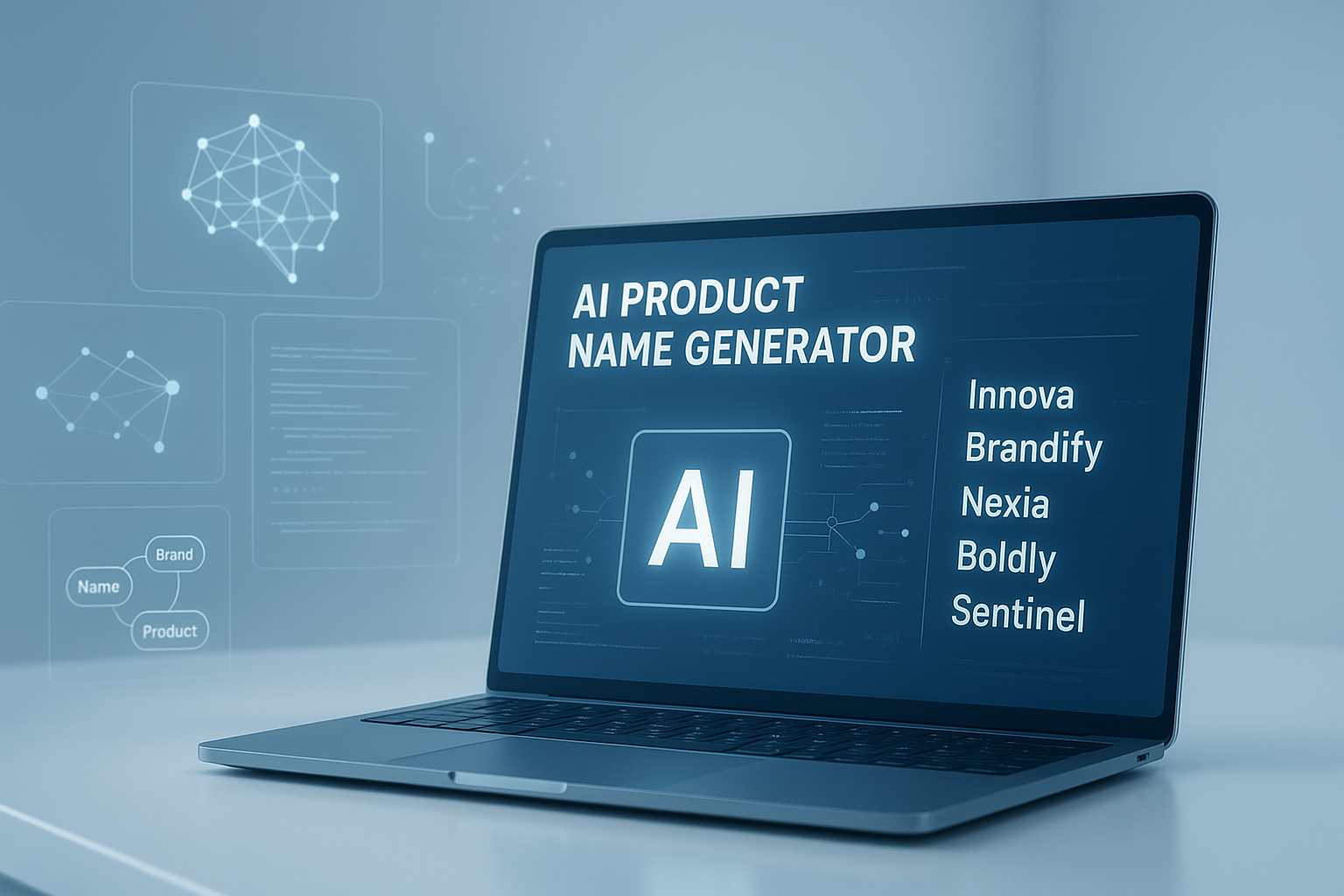
Suggested Image: Technology concept showing AI-driven brand naming workflow with keywords, audience, and product categories
What is an AI product name generator?
An AI product name generator is a tool that creates name ideas based on prompts such as product type, industry, brand style, target market, and desired tone. It uses language patterns to suggest names that sound more relevant and creative than simple word-splicing tools.
At a basic level, these tools save time. At a strategic level, they help teams explore naming directions they may not have considered. If you’re also shaping your wider messaging, tools like an AI slogan generator can help align your product name with your brand voice.
Most businesses use an AI product name generator for one or more of these goals:
- Brainstorming names quickly
- Exploring different brand tones
- Testing niche-specific wording
- Creating modern, short, memorable names
- Finding names for products, apps, tools, and companies
It’s important to be realistic, though. AI can generate options. It cannot guarantee legal availability, cultural fit, or market success. Those decisions still need human review.
Why businesses use AI for product naming
Businesses use AI naming tools because naming is slow, subjective, and expensive when done entirely by hand. AI shortens the first phase by producing many usable starting points in seconds.
Here’s the problem. Internal brainstorming often gets trapped in familiar language. Teams repeat obvious words, rely on industry clichés, or choose names that make sense internally but fail with customers. AI introduces range. It can surface combinations, styles, and angles that humans might overlook.
That matters for startups, ecommerce brands, software companies, agencies, and product teams launching multiple offers. If you’re creating landing pages for the final name later on, a clear structure matters too. An meta description generator can also help support search visibility once your product is live.
Key business benefits
- Speed: Generate dozens of ideas in minutes
- Variety: Explore formal, playful, premium, or technical naming styles
- Creative range: Break out of obvious internal vocabulary
- Lower cost: Reduce early-stage naming effort before agency or legal review
- Better collaboration: Give teams concrete options to discuss instead of abstract opinions
How an AI product name generator works
An AI product name generator works by interpreting your input and predicting plausible name combinations based on language patterns, branding conventions, and context. Better inputs usually produce better outputs.
Most tools process details like:
- Product category
- Target audience
- Core benefit
- Brand personality
- Preferred length
- Keywords to include or avoid
For example, a tool naming a project management app for small teams might generate names that sound efficient, collaborative, modern, and short. A tool naming a skincare product might emphasize softness, clarity, purity, or luxury.
Some businesses also use AI during adjacent content tasks. If you need to turn product concepts into customer-facing copy later, an AI paragraph generator can help draft descriptions around shortlisted names.
What affects the quality of the results?
This small detail changes everything: prompt quality. Generic prompts usually produce generic names. Specific prompts create stronger ideas.
Strong input often includes:
- What the product does
- Who it is for
- What makes it different
- The tone you want
- Any naming constraints
Example prompt:
Create 20 product names for a productivity app for remote design teams. The tone should feel modern, clean, smart, and collaborative. Avoid generic words like task, work, or team. Prefer short, brandable names with easy pronunciation.
What makes a product name brandable?
A brandable product name is memorable, easy to say, distinct from competitors, and flexible enough to grow with the business. It doesn’t need to describe everything. It needs to stick.
Many teams make the mistake of chasing perfect literal meaning. In practice, the strongest names often balance meaning and memorability. That’s why an AI product name generator works best when your goal is not just “descriptive,” but “recognizable and usable.”
| Naming Trait | Why It Matters |
|---|---|
| Short and clear | Easier to remember, type, and share |
| Easy to pronounce | Improves word-of-mouth and recall |
| Distinctive | Helps avoid blending into a crowded market |
| Relevant tone | Signals whether the product feels premium, fun, technical, or trustworthy |
| Flexible | Allows the product or company to expand later |
If you want to refine the wording behind your brand identity, a related AI brand name generator can be useful when product and company naming overlap.
Best prompts to use with an AI product name generator
The best prompts are specific, practical, and tied to business goals. If the input is vague, the output will usually sound generic or repetitive.
Here’s what experienced professionals do differently. They don’t ask for “good product names.” They define positioning first, then ask AI to generate ideas within that frame.
Prompt template you can reuse
Generate 25 product names for a [product type] designed for [target audience]. The product helps users [core benefit]. The brand tone should feel [3 to 5 adjectives]. Avoid words like [list]. Keep names under [number] syllables. Make them easy to pronounce and suitable for a modern business brand.
Prompt examples by business type
- SaaS: Generate names for an AI meeting notes tool for small law firms. Tone: precise, trustworthy, efficient.
- Ecommerce: Generate names for a reusable water bottle brand for active professionals. Tone: clean, premium, sustainable.
- B2B service: Generate names for a cybersecurity reporting dashboard for enterprise IT teams. Tone: secure, sharp, authoritative.
- Health product: Generate names for a sleep support app for busy parents. Tone: calm, helpful, modern.
If your process includes testing headlines and positioning around those names, an title generator can help you examine how each name performs in content and campaign concepts.
AI-generated names vs human brainstorming
AI-generated names are faster and broader. Human brainstorming is stronger at judgment, nuance, and market fit. The best results usually come from combining both.
Now comes the important part. This is not an either-or decision. AI is excellent at volume and variation. Humans are still better at reading emotional tone, spotting cultural issues, and knowing what will resonate with actual buyers.
| Approach | Best For | Limitations |
|---|---|---|
| AI product name generator | Fast ideation, exploring directions, breaking creative blocks | May generate generic, awkward, or already-used ideas |
| Human brainstorming | Strategic fit, emotional resonance, brand decision-making | Slower, subjective, often limited by internal bias |
| Hybrid process | Most business naming projects | Requires filtering and validation steps |
How to choose the best name from AI suggestions
The best way to choose a name is to shortlist options, score them against clear criteria, and test them in real business contexts. A name that looks clever in a list may fail on a website, sales call, or ad.
This is where many people struggle. They fall in love with novelty and forget usability. A strong name should work in speech, text, search, and branding.
A practical 7-step review process
- Remove weak options fast. Cut names that are hard to pronounce, too long, or too generic.
- Group by style. Separate descriptive, invented, premium, technical, and playful options.
- Check clarity. Ask whether the name feels aligned with the product and audience.
- Say each name out loud. Spoken awkwardness is often a deal-breaker.
- Search the web. Look for existing businesses, products, and strong overlaps.
- Check domain and social availability. This matters for launch practicality.
- Run a small audience test. Ask potential users what each name suggests.
If you’re creating supporting launch copy once a name is selected, an product description generator can help draft value-focused descriptions around the final choice.
Simple scorecard for decision-making
| Criteria | Questions to Ask |
|---|---|
| Memorability | Will people remember it after hearing it once? |
| Clarity | Does it feel relevant to the product category? |
| Brand fit | Does it match the tone you want customers to feel? |
| Availability | Is the name likely usable online and legally reviewable? |
| Scalability | Will it still make sense if the product expands? |
Common mistakes when using an AI product name generator
The biggest mistake is treating AI output as final instead of raw material. Good naming still requires judgment, filtering, and validation.
Let’s break this down. Businesses often move too quickly from generation to decision. That creates avoidable problems later in branding, SEO, customer understanding, and legal review.
- Using vague prompts: Broad requests create weak, repetitive outputs.
- Choosing names only because they sound trendy: Trendy names age fast.
- Ignoring pronunciation: If people can’t say it, they won’t share it.
- Skipping availability checks: Great ideas are useless if they can’t be used.
- Overvaluing uniqueness over clarity: A strange name is not automatically a strong brand name.
- Not comparing against competitors: Similar-sounding names weaken differentiation.
Google’s guidance on helpful content consistently emphasizes people-first quality over gimmicks. That principle applies to naming too. A customer-friendly name is often better than a clever internal favorite. See Google’s helpful content guidance for the broader principle.
How to validate a product name before launch
You should validate a product name across language, branding, search, and legal factors before using it publicly. AI can help generate ideas, but validation protects the business.
The answer depends on one thing: how serious the launch is. A test project may need a light review. A major product launch needs a formal process involving marketing, leadership, and legal teams.
Your validation checklist
- Search engine check: Look for existing products, apps, businesses, and confusing close matches.
- Trademark review: Search the relevant trademark database in your jurisdiction. In the US, start with the USPTO trademark search.
- Domain review: Check practical domain options, not just ideal ones.
- Social handle review: Consistent naming across channels is helpful.
- Audience test: Ask users what the name suggests before you explain it.
- Cross-language check: Especially important for international products.
- Accessibility and readability test: Make sure the name is easy to read and hear.
For digital products, reviewing accessibility language and usability is smart. The W3C Web Accessibility Initiative offers useful principles for user-friendly digital experiences, including readable language and clear communication.
Suggested Infographic: Product name validation flow from AI idea to legal and market approval
Will an AI product name generator help with SEO?
An AI product name generator can support SEO indirectly, but a product name alone does not guarantee rankings. Search visibility depends more on site quality, content, relevance, and technical setup than on the name itself.
That said, naming still affects discoverability. A name that is easy to spell, easy to remember, and distinct from existing products is easier to search for and easier to build authority around.
How naming influences SEO in practice
- Clear names are easier for users to recall and search later
- Distinct names reduce confusion with competitors
- Readable names perform better in search snippets and ads
- Brandable names support long-term branded search growth
For SEO best practices, rely on official recommendations rather than guesses. Useful resources include Google’s SEO Starter Guide and Bing Webmaster Guidelines.
If your next step is optimizing the page that introduces the product, an SEO title generator can help shape search-friendly titles around the selected name.
Real-world naming scenarios where AI is especially useful
An AI product name generator is most useful when you need fast ideation under constraints. It works well when there’s a clear audience, a defined product, and a need for multiple naming directions.
Here are a few strong use cases:
SaaS and software launches
Software teams often need short, modern names that feel credible and easy to remember. AI helps generate names across tones such as technical, premium, efficient, or innovative.
Ecommerce product lines
Retail brands launching collections, bundles, or private-label products can use AI to produce consistent naming patterns across categories.
Agencies naming client offers
Agencies often need quick first-round concepts. AI speeds up ideation, especially when clients want multiple styles before narrowing direction.
Internal tools and business products
Even internal tools need clear names. Better naming improves adoption, communication, and documentation. If those internal names later become customer-facing, a structured process avoids rework.
For planning written assets around product launches, many teams also use an blog post idea generator to build content around the new product after naming is complete.
Best practices for getting better AI-generated product names in 2026
In 2026, the businesses getting the best results from AI naming are the ones using it as part of a process, not as a shortcut to a final answer.
Here’s what works best now:
- Start with positioning first: Know your audience, promise, and tone before generating names.
- Request multiple naming styles: Ask for descriptive, invented, premium, minimalist, and category-breaking options.
- Limit weak vocabulary: Tell the tool what to avoid.
- Generate in rounds: Use one output to improve the next prompt.
- Combine AI with market review: Compare against real competitors and customer language.
- Test names in context: Put them on mock landing pages, app icons, packaging, and ad headlines.
Microsoft’s broader guidance on building high-quality AI-assisted workflows also reinforces the value of human oversight and review. See Microsoft Learn for current documentation across AI and digital production practices.
Frequently asked questions
1. Is an AI product name generator good for startups?
Yes, especially during early-stage brainstorming. Startups usually need speed, variety, and low-cost ideation, and AI helps with all three. It can surface naming directions quickly when founders are stuck or too close to the product. The important part is not choosing the first clever result. Shortlist names, test them with users, and check availability before committing.
2. Can AI generate names that are legally safe to use?
No tool can guarantee legal safety on its own. AI can suggest names, but it cannot confirm whether a name is trademark-safe in your market or category. You still need a proper trademark search and, for important launches, legal review. In the US, that process often starts with the USPTO database. Think of AI as an idea source, not a legal filter.
3. What should I include in my prompt for better name ideas?
Include the product type, target audience, main benefit, desired tone, naming style, length preferences, and words to avoid. The more specific the prompt, the better the results tend to be. Good prompts give AI boundaries. Without them, you often get generic suggestions that sound similar to dozens of existing products.
4. Should a product name include keywords for SEO?
Usually not as a primary goal. Some descriptive names can help users instantly understand the product, but forcing keywords often creates clunky, forgettable brands. A better approach is choosing a name that is memorable, distinct, and easy to search for. Then support SEO through strong page titles, product descriptions, content, and technical optimization.
5. Are invented names better than descriptive names?
Neither is always better. Invented names can be more distinctive and easier to trademark, but they may require more brand education. Descriptive names can communicate faster, but they’re often harder to differentiate. The right choice depends on your market, competition, budget, and long-term brand strategy. Many strong brands sit somewhere in the middle.
6. How many AI-generated names should I review before choosing one?
For most businesses, reviewing 30 to 100 options across a few naming styles is enough to identify strong patterns. You do not need to evaluate hundreds unless the naming project is large or heavily regulated. The goal is not endless choice. The goal is reaching a focused shortlist that can be tested and validated properly.
7. Can I use an AI product name generator for physical products and digital products?
Yes. These tools work for software, apps, subscription offers, private-label products, consumer goods, online services, and internal business tools. What changes is the prompt. A physical product may need emotional or sensory language, while a B2B software tool may need a clearer focus on trust, speed, and function.
8. What’s the best next step after generating product names with AI?
Create a shortlist and evaluate each option for memorability, relevance, pronunciation, brand fit, and availability. Then place the best names into real use cases such as homepage headlines, packaging mockups, ad copy, app listings, or sales scripts. This reveals weak names quickly. After that, move to domain, trademark, and audience validation.
Final thoughts
An AI product name generator is not a replacement for strategy, but it is an excellent tool for faster and better brainstorming. Used well, it helps businesses find naming directions faster, explore more creative territory, and make more informed branding decisions.
The smartest approach is simple: use AI to generate options, use humans to judge them, and validate everything before launch. That process gives you speed without sacrificing quality.
If you want to keep building around your new product name, useful next steps may include using an AI slogan generator, an product description generator, an SEO title generator, and a blog post idea generator. Each one supports the next stage after naming: messaging, search visibility, and content planning.