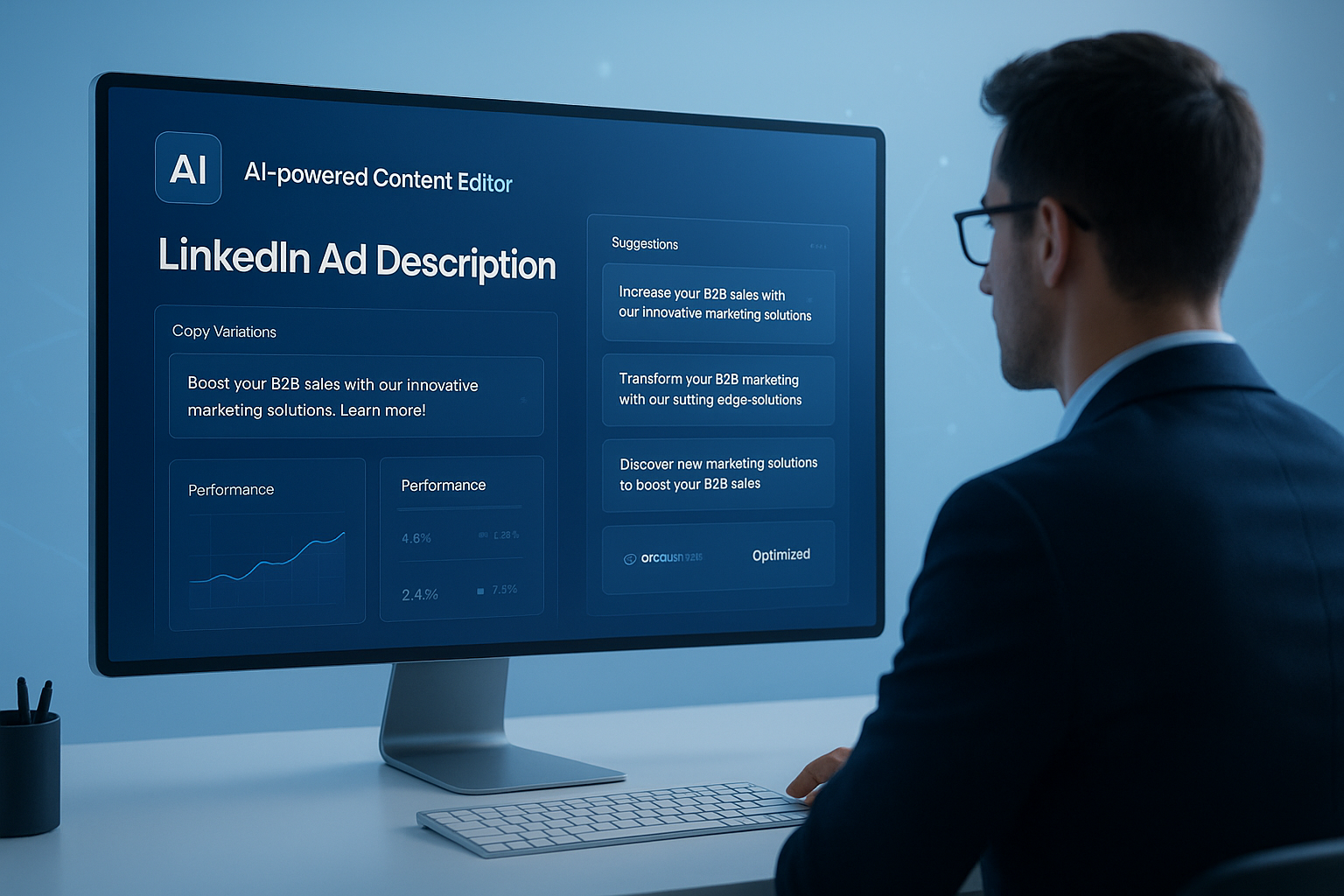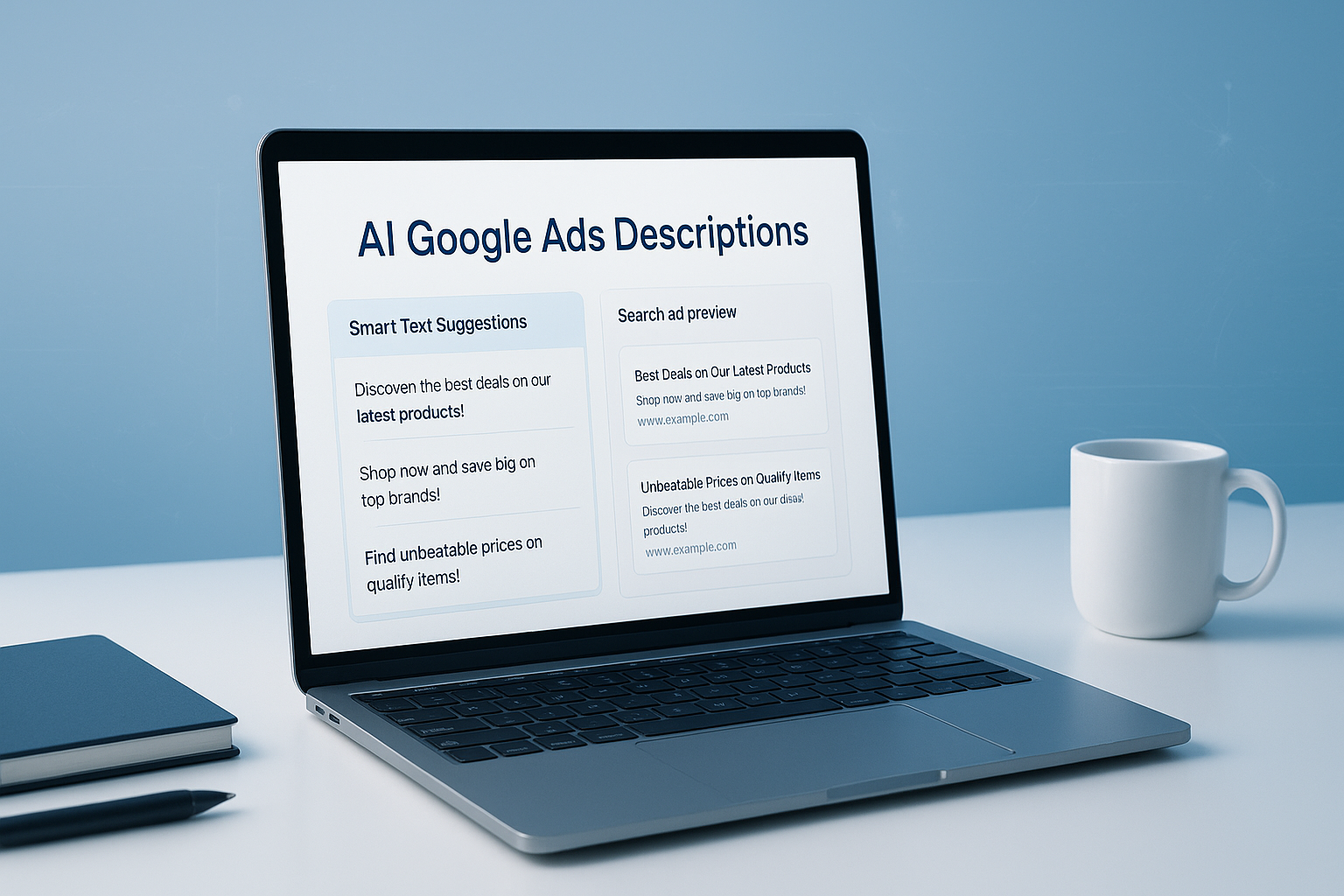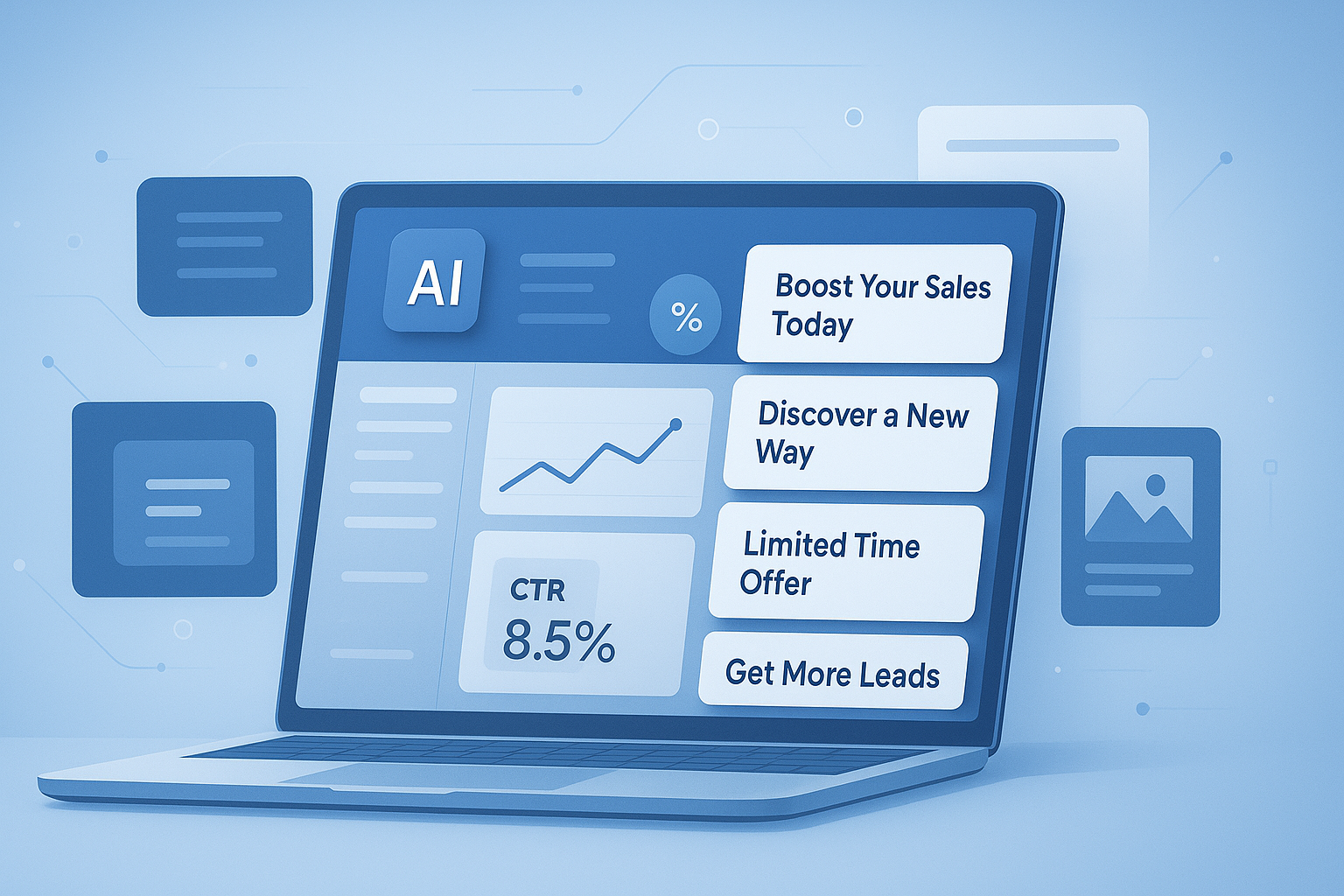
Coming up with a strong headline sounds simple until you have to do it at scale. You publish one post after another, and suddenly every idea starts sounding the same. That’s usually when marketers begin looking for an AI blog post title generator.
The tool can save time, but speed alone is not the goal. A title has to attract clicks, match search intent, and give both Google and AI-powered search engines a clear signal about what the page delivers. If it misses on any of those, even a well-written article can struggle.
This guide explains how to use an AI blog post title generator well, not blindly. You’ll learn what good titles have in common, how to prompt AI for better outputs, what mistakes to avoid, and how to turn generated ideas into headlines that perform in search in 2026 and beyond.
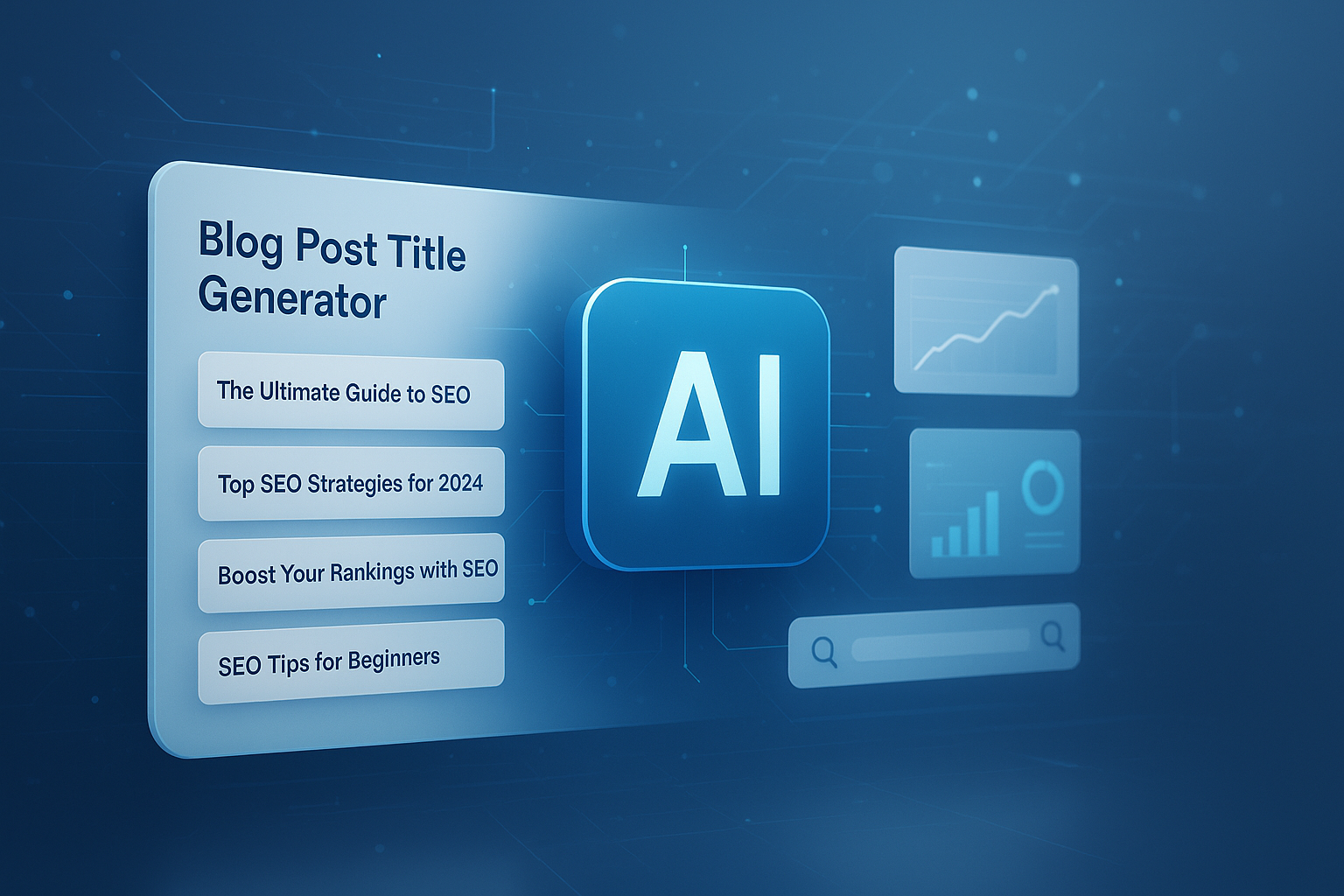
Suggested Image: Technology concept showing AI-generated title ideas on a content dashboard
What is an AI blog post title generator?
An AI blog post title generator is a tool that uses language models or rule-based prompts to suggest headline ideas based on a topic, keyword, audience, or goal. Its main value is not just generating more options. It helps marketers explore angles, search intent, and wording patterns faster.
Most tools produce title suggestions from a few inputs such as:
- Primary keyword
- Target audience
- Content format
- Search intent
- Tone of voice
- SEO objective
If you’re brainstorming titles and meta elements together, an AI blog post title generator is often most useful at the planning stage, before the draft is written. It can also help refresh underperforming content that ranks but does not earn enough clicks.
Why titles matter for SEO and AI search
A title influences rankings indirectly and clicks directly. It helps search engines interpret page focus, and it helps people decide whether your result is worth their attention. In AI search results, strong titles also improve summarization and citation relevance.
Here’s the problem. Many marketers treat titles like a finishing touch. In reality, the title shapes the whole content strategy. It affects:
- Keyword targeting
- Search intent alignment
- Click-through rate from search results
- Content angle and structure
- How AI tools summarize the page
- How the article is shared on social platforms
Google has repeatedly emphasized helpful, people-first content and clear page signals in its Google Search Central documentation. A vague or overhyped title creates friction immediately. A clear title makes the next step easy.
For marketers optimizing content workflows, checking title length and on-page layout together can help. If you are also preparing supporting visuals for the post, tools like an Image Compressor can help keep page performance strong, which supports user experience and SEO.
What makes a good AI-generated blog title?
A good AI-generated title is clear, specific, relevant to the keyword, and aligned with what the reader expects to learn. It doesn’t just sound clever. It promises the right value to the right audience.
The best titles usually include four elements:
- Topic clarity: The reader instantly knows what the article is about.
- Intent match: The wording fits informational, commercial, or navigational intent.
- Compelling angle: There is a reason to click now instead of later.
- Natural keyword use: The target phrase appears without sounding forced.
Quick checklist for evaluating title quality
- Does it reflect the main keyword naturally?
- Would a human understand the value in two seconds?
- Does it avoid clickbait?
- Is it better than the top search results?
- Does it fit the article’s actual content?
- Would an AI search engine accurately summarize the page from this title?
| Weak Title Trait | Stronger Alternative |
|---|---|
| Too broad | Targets a specific audience or problem |
| Keyword stuffing | Uses the keyword once in a readable way |
| Vague benefit | States a clear outcome or use case |
| Hype-driven wording | Specific and credible wording |
When testing headline formats, it also helps to estimate readability and snippet fit in advance. If your workflow includes content calculations or title experiments in bulk, a practical utility like the Percentage Calculator can help compare click-through changes across title variants after updates.
How to use an AI blog post title generator effectively
The best results come from better inputs. An AI blog post title generator can only work with the information you give it. If your prompt is weak, the output will usually be generic.
Here’s what experienced professionals do differently. They don’t ask for “10 blog titles about SEO.” They provide context that shapes useful suggestions.
Step 1: Start with one primary keyword
Pick a keyword with a clear topic and intent. In this case, the phrase is AI blog post title generator. Build around one main phrase first, then add related terms such as:
- SEO blog titles
- headline generator
- AI title ideas
- click-worthy blog titles
- search intent headlines
Step 2: Define the audience
Titles change depending on who the content is for. A marketer, SaaS founder, freelance writer, and ecommerce manager may all search the same topic for different reasons.
For audience-based planning, add details such as:
- B2B marketers
- Content teams
- Solo bloggers
- SEO specialists
- Agencies
Step 3: Specify the search intent
This small detail changes everything. Informational titles work differently from transactional ones. If the page is educational, ask the tool for wording that promises guidance, examples, or practical steps.
To map intent more clearly, Google’s guidance on creating helpful content in creating helpful, reliable, people-first content is worth reviewing.
Step 4: Request multiple title angles
One title pattern is never enough. Ask for several formats, such as:
- How-to titles
- Guide titles
- Question titles
- Comparison titles
- List titles
- Beginner-focused titles
Step 5: Edit manually
AI gives you raw material. You still need to improve clarity, remove repetition, and check whether the title fits the actual article. If the generated title overpromises, rewrite it before publishing.
If your process includes drafting descriptions, summaries, or supporting snippets, an AI Text Summarizer can help condense article themes before you turn them into headline ideas.
Prompt frameworks that produce better title ideas
The easiest way to improve title quality is to improve your prompt structure. Clear prompts create specific outputs, while vague prompts cause recycled, generic headlines.
Here are prompt formulas marketers can adapt.
Prompt formula for SEO title ideas
Create 15 SEO-friendly blog post titles for the keyword “AI blog post title generator.” The audience is marketers. Search intent is informational. Focus on clarity, clickability, and realistic search behavior. Avoid clickbait and keep titles under 65 characters where possible.
Prompt formula for angle variation
Generate headline ideas for a blog post about AI blog post title generators. Create 5 beginner titles, 5 advanced SEO titles, 5 titles focused on click-through rate, and 5 titles optimized for AI search visibility.
Prompt formula for rewriting existing titles
Improve these blog titles for SEO and user clarity. Keep the topic accurate, remove vague wording, and align each title with informational search intent.
If you’re collecting and refining title drafts from large content batches, a utility like Text Case Converter can be surprisingly useful for cleaning capitalization styles before editorial review.
Best title formats for marketers in 2026
Some title formats consistently work because they match how people search. The strongest format depends on intent, competition, and the type of article you are publishing.
Let’s break this down with examples.
1. How-to titles
Best for instructional content and beginner-friendly guides.
- How to Use an AI Blog Post Title Generator for Better SEO
- How Marketers Create Better Headlines With AI
2. Guide titles
Best for comprehensive educational content.
- AI Blog Post Title Generator Guide for Better SEO
- The Marketer’s Guide to AI-Powered Blog Titles
3. Question titles
Best for direct search behavior and FAQ-style pages.
- What Is an AI Blog Post Title Generator and How Does It Work?
- Can AI Help You Write Better SEO Titles?
4. Benefit-driven titles
Best when the value proposition is clear and specific.
- AI Blog Post Title Generator Tips to Improve Search Clicks
- Write Blog Titles Faster Without Hurting SEO
5. Comparison titles
Best for users evaluating methods or tools.
- AI Blog Post Title Generator vs Manual Headline Writing
- AI Headlines or Human Headlines: What Works Better for SEO?
| Title Format | Best Use Case | Main Advantage |
|---|---|---|
| How-to | Beginner tutorials | Clear intent match |
| Guide | Long-form educational content | Builds authority |
| Question | FAQ-focused searches | Natural SERP alignment |
| Benefit-driven | CTR improvement | Highlights outcome fast |
| Comparison | Evaluation-stage readers | Captures nuanced intent |
Suggested Infographic: Title format comparison for SEO, CTR, and AI search visibility
AI-generated titles vs human-edited titles
AI is excellent at speed and variation. Humans are better at judgment, nuance, and brand fit. The strongest titles usually come from a hybrid workflow where AI generates options and an editor makes the final call.
This is where many people struggle. They assume the first AI output is publish-ready. It usually isn’t.
| Approach | Advantages | Limitations |
|---|---|---|
| AI-only titles | Fast, scalable, useful for brainstorming | Often generic, repetitive, or slightly off-intent |
| Human-only titles | More strategic, brand-aware, nuanced | Slower and harder to scale |
| AI plus human editing | Best mix of speed, quality, and relevance | Requires review discipline |
For broader writing workflows, tools like an AI Paragraph Generator can support ideation, but title strategy should still be reviewed by someone who understands audience intent and SERP competition.
Common mistakes when using an AI blog post title generator
The biggest mistake is assuming more titles means better titles. Quantity helps brainstorming, but quality comes from filtering and editing. Smart marketers use AI to widen options, then narrow them carefully.
- Chasing cleverness over clarity: Fancy wording often lowers click confidence.
- Ignoring search intent: A title may sound good but fail to match what the searcher wants.
- Stuffing keywords: Repeating the keyword makes the title awkward and less trustworthy.
- Overpromising: If the article cannot fully deliver the promise, engagement drops.
- Using the same title pattern repeatedly: This can make a site feel templated and weak.
- Skipping SERP review: If you do not check the current search results, you may optimize for the wrong angle.
Google also provides guidance about title links in search results through its documentation on title links. While Google may rewrite titles in some cases, clear and descriptive page titles still matter.
How to optimize titles for Google AI Overviews and other AI search tools
AI search systems prefer content that is easy to interpret, clearly scoped, and directly useful. A title should tell both humans and machines what precise topic the page covers and why it matters.
Now comes the important part. AI search optimization is not about writing strange robot-friendly text. It is about reducing ambiguity.
Best practices for AI search visibility
- Use specific topic wording instead of broad, abstract phrasing
- Match the title closely to the article’s central question
- Include the audience or use case when helpful
- Avoid exaggerated claims like “ultimate” unless the content genuinely supports it
- Make headings and body content reinforce the title promise
- Use concise summaries early in the article
For technical quality signals, page experience still matters. Basic guidance from web.dev on Core Web Vitals can help ensure the page loads and behaves well once users click.
If you publish title experiments with supporting downloadable assets, a tool like PDF to Word can help repurpose outlines and editorial documents into editable content during production.
Real examples: weak titles and stronger rewrites
Seeing title revisions side by side makes the differences obvious. In most cases, the better title is not dramatically more creative. It is simply clearer, more useful, and better aligned with the searcher’s goal.
| Weak Title | Why It Falls Short | Stronger Rewrite |
|---|---|---|
| Best AI Titles Ever | Too vague and hype-driven | How to Create Better Blog Titles With AI |
| SEO Title Tool for Content | Unclear audience and outcome | AI Blog Post Title Generator Tips for Marketers |
| AI Blog Post Title Generator SEO Clicks Search | Keyword stuffing | AI Blog Post Title Generator for Better SEO Clicks |
| Write Great Headlines Fast | Missing keyword context | Use AI to Write SEO-Friendly Blog Headlines Faster |
A practical workflow marketers can use every time
A repeatable workflow removes guesswork. It also helps teams create stronger titles consistently across campaigns, blog categories, and content refresh projects.
- Choose one primary keyword and confirm intent in the search results.
- Write a short content goal in one sentence.
- Prompt the AI tool with keyword, audience, intent, and format.
- Generate 20 to 30 title options across several angles.
- Shortlist 3 to 5 titles based on clarity, relevance, and CTR potential.
- Compare those titles against current top-ranking pages.
- Edit the best option for precision and brand tone.
- Make sure the article intro and H2s reinforce the title promise.
If you manage content in batches, this workflow becomes easier when planning documents are standardized. For fast cleanup of exported research, copied briefs, or title lists, an Remove Duplicate Lines tool can save time during editorial prep.
How to measure whether your title is working
A title is only “good” if it performs in context. That means you need to measure results after publishing, not just rely on intuition before launch.
Useful metrics include:
- Organic click-through rate
- Impressions in search results
- Average position
- Bounce or engagement signals
- Time on page
- Assisted conversions where relevant
Use Google Search Console to monitor impressions and clicks, especially after title updates. If impressions stay stable but clicks rise, the title improvement likely helped. If rankings drop after a rewrite, your new title may have weakened relevance.
For campaign reporting, marketers often miss the relationship between title edits and downstream results. Even simple calculations can clarify whether a CTR improvement materially affected leads or signups.
Frequently asked questions
Is an AI blog post title generator good for SEO?
Yes, it can be useful for SEO when used as a brainstorming tool rather than a final answer machine. It helps generate title options quickly, uncover related keyword angles, and test different search-intent approaches. The key is human review. You still need to check keyword fit, clarity, SERP competition, and whether the title accurately reflects the article.
Can AI-generated blog titles improve click-through rate?
They can, especially if your current titles are vague or inconsistent. AI can produce more variations than most teams would create manually, which makes testing easier. Still, better CTR usually comes from editing the generated titles for specificity, stronger benefit language, and closer search-intent alignment. AI creates options. Smart optimization creates results.
Should the exact keyword always appear in the title?
Not always, but in many SEO blog posts it helps when the primary keyword appears naturally in the title. Exact-match phrasing can improve clarity and relevance, especially for informational searches. That said, readability matters more than rigid repetition. If the exact phrase makes the title awkward, a close variation is often better.
How many title options should I generate before choosing one?
A good working range is 15 to 30 options. Fewer can limit creativity, while too many can waste time and create decision fatigue. The goal is to generate enough variety to compare different angles, such as how-to, guide, beginner, and comparison formats. After that, narrow your shortlist based on intent, clarity, and competitiveness.
Are AI blog post title generators safe to use for client work?
Yes, generally, as long as you review outputs carefully and avoid sharing sensitive information in prompts. Titles themselves are low risk, but your workflow should still follow client confidentiality standards. Also check that generated suggestions are original enough and do not mirror well-known competitor headlines too closely. Human oversight remains essential.
What is better: AI-generated titles or manually written titles?
Neither is always better on its own. AI-generated titles are faster and useful for ideation. Manually written titles tend to be better at nuance, brand tone, and strategic positioning. In practice, the best results usually come from combining both. Use AI for speed and variation, then apply editorial judgment to pick and refine the strongest option.